





Everything You Need to Plan for the Advanced Clean Fleets Regulation
Zonar Receives First CARB Certification for Emissions Telematics
Zonar has been awarded a California Air Resource Board executive order for Clean Truck Check on-board emissions diagnostic testing.
July 11, 2024

Zonar's V4 telematics control unit automatically performs emisisons scans and sends the data over-the-air directly to CARB.
Graphic: Zonar
2 min to read
Zonar announced it is the first telematics provider to receive formal certification from California Air Resources Board’s (CARB) Clean Truck Check (CTC) program. The certification approves Zonar as a provider of continuously connected remote on-board diagnostic (CC-ROBD) testing devices for exhaust emissions.
Over-the-Air Emissions Monitoring
Zonar’s V4 telematics control unit (TCU) has undergone rigorous assessment and approval processes to achieve certification as an OBD device in accordance with CARB’s CTC requirements.
After providing the requisite emissions data and supporting information, Zonar has officially been granted an executive order to provide its OBD device and over-the-air emissions monitoring service to customers.
“As the first certified telematics provider of OBD testing devices, Zonar is proud to provide a solution that will automatically perform emission checks while fleet vehicles are on route ensuring compliance, eliminating downtime and reducing costly logistical nightmares due to rerouting vehicles to testing centers for a required scan,” said Greg Colvin, senior director of solutions engineering at Zonar. “Our end-to-end solution will help drivers seamlessly adapt to the new mandate, save significant time and money, and ultimately make meaningful progress toward reduced carbon emissions. This is a major achievement as we enter the final stage of work for our in-market solution to be released prior to the regulatory deadline.”
Multiple Tests Per Year
Heavy-duty truck emissions of nitrogen oxide and particulate matter have been reduced by 99% over the last two decades, significantly improving air quality and public health.
To maintain this progress and further combat climate change, CARB’s CTC program aims to reduce smog-forming and carcinogenic air pollutants produced by all commercial vehicles that travel through California. This accounts for a significant portion of the industry as CARB estimates over 1.8 million medium- and heavy-duty vehicles operate daily in California.
Beginning January 1, 2025, any commercial vehicle traveling to or through California will be required to undergo testing twice per year. In 2027, vehicles will be required to test four times per year.
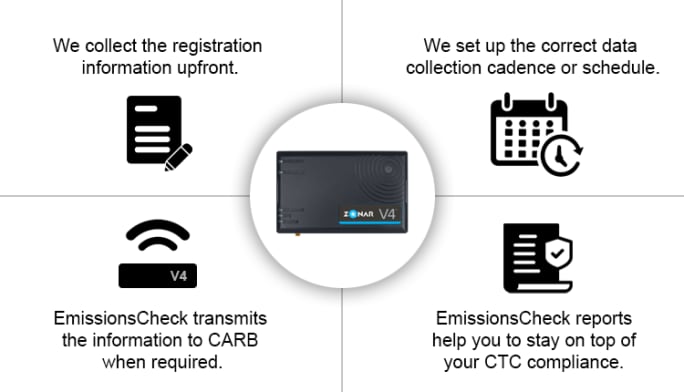
Zonar's onboard V4 diagnostics system makes emission compliance easier for fleets traveling to or in California.
Graphic: Zonar
By combining regular vehicle testing with advanced emissions monitoring, OBD testing devices must scan every CTC regulatory-required vehicle in a fleet at the beginning of its 90-day compliance intervals (based on vehicles’ VIN or date of registration) to give fleets adequate time to identify and schedule emissions-related repairs as needed to pass.
Fleets will have two emissions scanning options: a handheld shop tool plugged into the OBD port operated by a certified technician; or an OBD device installed into the vehicle which automatically performs scans and sends the data over-the-air directly to CARB.
If a CTC-regulatory required vehicle is unable to pass an emissions test, consequences may include fines, citations, and/or vehicle registration holds.
More Safety & Compliance

FMCSA Pauses Biennial-Update Enforcement Amid Motus Transition
Carriers whose updates were due on or after June 1 have more time, while FMCSA works to stabilize its new registration system and warns of phishing sites impersonating its new carrier registration system, Motus.
Read More →
ZF Expands Commercial Vehicle Push in North America
ZF is expanding its North American commercial-vehicle presence with new transmission applications, electrification, trailer technology and autonomous-driving systems.
Read More →
Truck Drivers Need More Than Another Alert
Fleets have more visibility into truck health, safety events, and driver activity than ever. The next challenge is turning all that information into useful guidance for the person who has to decide what to do next.
Read More →
Tesla Wants a Self-Driving Semi. Are Cameras Enough?
Could Tesla’s camera-only autonomous driving technology work on an 80,000-pound Semi? In this commentary, HDT's Deborah Lockridge takes a look at Tesla, Cybercab, and how autonomous trucks see the road.
Read More →
What DOT’s Automated Vehicle Strategy Means for Trucking
The U.S. Department of Transportation issued a new automated-vehicle strategy that outlines plans for driverless-truck regulations, cross-state freight corridors, and federal safety standards.
Read More →
NYC Expands Speed, Pedestrian Safety Tech Across Fleet
New York City is expanding intelligent speed assistance and pedestrian-alert systems across its municipal fleet, moving the technologies from pilot programs into vehicle procurement and retrofit requirements.
Read More →
FMCSA Removes 110 Truck Driver Training Schools from Certified ELDT List
Federal regulators also are targeting more than 160 additional training providers and launching a nationwide audit of third-party CDL skills testers as part of a broader crackdown on trucking fraud.
Read More →
Beyond DOT Compliance: What Makes a Trucking Fleet Truly Safe?
A trucking fleet can follow every rule and still make unsafe decisions. The real test comes when safety conflicts with freight, productivity, or cost.
Read More →
Hours of Service Pilot Programs: FMCSA Readies for 2027 Rollout
Two pilot programs could eventually reshape hours-of-service rules, giving truck drivers options to pause their 14-hour clock or use longer split sleeper rest periods.
Read More →
New Guide Offers Pet Safety Tips for Truck Drivers
Hundreds of thousands of pets travel in truck cabs. A new safety guide from Volvo Trucks and the Center for Pet Safety offers practical advice for truck drivers who bring dogs and cats along for the ride.
Read More →