




When Labor Rules and Trucker Hours of Service Collide
Drivers could be entitled to earn minimum wage for all hours worked – even during waiting periods officially entered as "off duty" or “sleeper berth” in log books – depending on the outcome of a case that could eventually have national implications.


Are truck drivers still "on duty" under federal labor regulations even when they're "off duty" under DOT hours of service regulations? That's the question in the courts.
Photo by Jim Park
Drivers could be entitled to earn minimum wage for all hours worked – even during waiting periods officially entered as "off duty" or “sleeper berth” in log books – depending on the outcome of a case that could eventually have national implications.
A federal court in Arkansas recently affirmed a decision from last fall allowing a class action suit to move forward against Tontitown, Arkansas-based Pam Transport for alleged violations of the Fair Labor Standards Act.
Last October, the U.S. District Court for the Western District of Arkansas, Fayetteville division, denied Pam’s motions to dismiss the lawsuit, filed in 2016 by three truck drivers. Another 3,000 drivers joined the suit in a class action.
On Jan. 25, U.S. District Judge Timothy Brooks reaffirmed that decision, certifying the matter as a class action under state law and determining that the case should continue as a collective action under federal law, according to Swartz Swidler LLC, the attorneys representing the drivers.
Attorneys for the drivers explained that the case is about paying drivers the minimum hourly wage under the Fair Labor Standards Act. The suit says hat Pam “failed to compensate its drivers at least the federal minimum wage for all compensable time worked, during the initial orientation period, and while driving over-the-road solo or as team drivers,” as well as for “travel time that occurred during normal business hours.”
The judge wrote that the dispute “involves a somewhat tangled web of statutes, agency regulations, and agency interpretations of statutes and regulations.”
Among other things, the suit cites a Department of Labor rule that it says caps the amount of time an employer may dock an employee who is on duty for more than 24 hours at 8 hours.
The rule in question is part of the Fair Labor Standards Act regarding how much unpaid time is allowed if a worker is “on duty” and waiting. That rule says if an employee is required to report at a place of work at a specific time, time spent waiting to begin is compensable. “Under certain conditions, an employee is considered to be working even though some of his time is spent in sleeping….Where an employee is on duty for 24 hours or more, the most that can be ascribed to eating and sleeping (non-compensated time) is 8 hours.”
Pam disagreed and contended that it is legally permissible to exclude from compensation all time that a driver spends in a truck’s sleeper berth.
The suit also cited a regulation requiring that “work performed while traveling” must be paid. Judge Brooks wrote in his Oct. 19 memorandum:
There is no ambiguity … as to whether an employer must count as hours worked the time that an employee spends riding in a commercial truck while neither sleeping nor eating: time thus spent "is working" and "any work" performed "while traveling must... be counted as hours worked.
What’s in a name
Much of this debate comes down to definitions. The Fair Labor Standards act doesn’t define the terms “on duty” or “hours worked.” Pam points to DOT hours of service regulations for the definition of “on duty.” HOS rules define “on-duty time” as “all time from the time a driver begins to work or is required to be in readiness to work until the time the driver is relieved from work and all responsibility for performing work.” The HOS rules explicitly exclude “time spent resting in a sleeper berth” from on-duty time.
Brooks dismissed Pam’s defense on this: “This court believes those DOT regulations have little, if any, bearing on the matter at hand. They are a different set of regulations from the DOL regulations under discussion… concerned with different policy aims.…
“If the DOT prohibits commercial truck drivers from driving for more than 14 hours in a 24-hour period, while the DOL requires their employers nevertheless to pay them for at least 16 hours in that same period, then this court sees nothing inconsistent or inharmonious about that state of affairs,” the judge wrote. “It would simply be a cost of business that the federal government has seen fit to impose on employers of commercial truck drivers in order to ensure an adequate level of road safety and driver compensation.”
Attorney Jim Hanson, partner of transportation law firm Scopelitis, Garvin, Light, Hanson & Feary, told HDT that he believes the court’s decision is “based on a faulty premise.”
“The premise is a truck driver is on duty 24 hours a day when he’s on the road, and I think that’s a faulty premise. Under the DOT regulations, a driver cannot be on duty 24 hours a day. They have to take at least a 10-hour break to be relieved of all duty and responsibility for the equipment and the load.”
He pointed out that the case is still far from over, and there is another case working its way through the courts that may set a precedent that will be considered in the Pam case.
Beyond Tontitown
The Pam case isn’t the only recent litigation that deals with hourly wage laws and how they intersect with hours of service rules.
Hanson cited Petrone v. Werner Enterprises, where drivers in the company’s student driver program sued alleging they didn’t earn the minimum wage. In this program, students hit the road with experienced driver trainers and help with driving, fueling, maintenance, etc. They’re paid a flat weekly rate, but Werner said it reviews the total number of on-duty hours logged and if necessary supplements the students’ pay to ensure they’re getting paid minimum wage for on-duty time.
Again, we get into the definition of “on duty." Werner argued that while the driver was in the sleeper, he was not on “active duty.” The court noted that’s not the same as “on duty.”
Petrone testified: “I wasn’t completely relieved of responsibility from my employer. I was pretty much on assignment for 24 hours. I was responsible for the cargo on the truck. I wasn’t free to go where I – I didn’t have free roam to do what I had to do. I was limited being by the truck. . . I was always at hand as needed for my responsibilities. As long as I was with that truck, that truck was my responsibility . . . So I don’t believe I was ever completely relieved of my responsibilities of the truck even though I was ‘off duty.’”
The plaintiff’s motion for sleeper berth compensation was denied in 2015, by Judge Lyle Strom, U.S. District Court, but the case is still working its way through the court system.
Hanson also pointed to a case that was thrown out by a judge in Oregon in 2014, Nance v. May Trucking Co. In that case, Idaho carrier May Trucking successfully defended itself against similar minimum-wage claims.
The suit had alleged that the $50 per day drivers were paid during May’s entry-level driver training program did not amount to minimum wage, because May Trucking did not pay trainees for time spent in the sleeper berth of a moving truck.
In this case, however, the judge ruled that the plaintiffs’ examples of “on duty,” such as on-call firemen, didn’t apply. And he said that that the DOL law requiring an employee who drives a truck be compensated for “work performed while traveling” has an exception for “when [driver] is permitted to sleep in adequate facilities furnished by the employer,” and that DOL’s field operations handbook says sleeper berths “are regarded as adequate sleeping facilities.”
“This case is not over; this is only [a ruling] on a motion,” Hanson said. “Pam Transport will have a chance to go back to the court and provide additional argument. And the Werner case is currently on appeal to the 8th Circuit.”
More Drivers
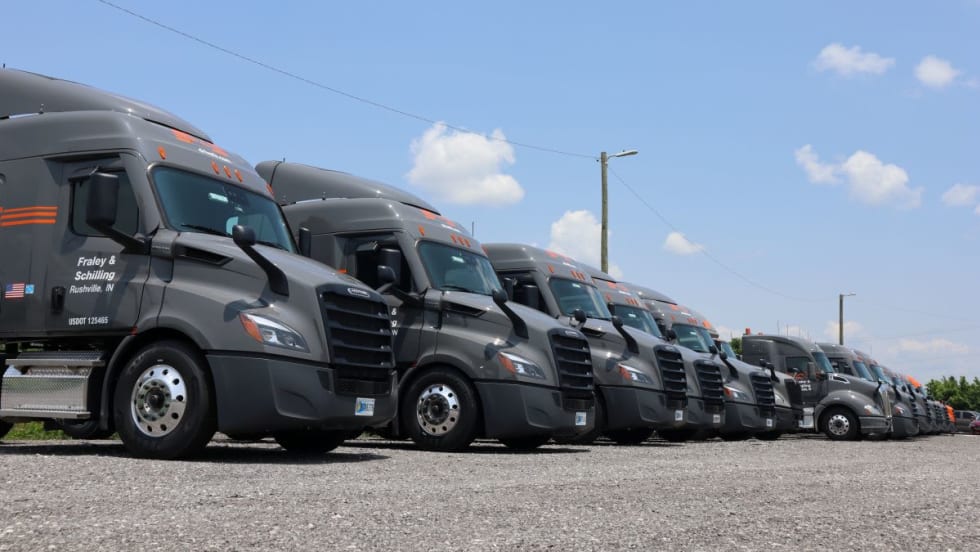
How Fraley & Schilling Improved Logbook Compliance by Over 50%
Fraley & Schilling needed a way to close a compliance workflow gap in its ELD system without adding more work from driver training, reminders, and back-office follow-ups. It found the answer in a custom driver app.
Read More →
Volvo Goes Gaming
Volvo has roared into American Truck Simulator with two new flagship trucks.
Read More →
What the Best Fleets to Drive For Teach About Driver Retention
Survey fatigue, AI-powered routing, owner-operator expectations, and the decline of social media all emerged as themes from this year's Best Fleets to Drive For program.
Read More →
Driver Retention Lessons From the Best Fleets to Drive For
What separates trucking's best workplaces from the rest? Jane Jazrawy shares the biggest lessons from this year's Best Fleets to Drive For program on driver retention, communication, AI, and workforce trends on the HDT Talks Trucking podcast.
Read More →
Farewell, CDL: Why I'm Giving Up My Commercial Driver's License
After more than 20 years as a CDL holder, HDT Executive Editor Jack Roberts is letting his commercial license expire. Not because he wants to — but because trucking's nuclear verdict crisis has made the risks of public-road test drives too great for editors, manufacturers, and everyone involved.
Read More →
How Top Trucking Fleets Improve Driver Retention [Video]
What do healthy snacks, optimized routing, and just picking up the phone have in common? They're all strategies the Best Fleets to Drive For are using to retain truck drivers.
Read More →
Trucker Path Adds Verisk CargoNet Theft Data to Navigation Platform
Trucker Path’s new cargo theft risk overlays give drivers and fleets visibility into high-risk areas, stolen commodity trends, and theft hotspots.
Read More →
Netradyne Intelligence Uses New AI Agents to Automate Response to In-Cab Camera Data
The company called the next-generation in-cab camera safety platform "a fundamental shift from systems that report on what happened to systems that actively drive what should happen next."
Read More →
Why Truck Detention Keeps Costing Fleets Time and Money
A 2024 ATRI study found detention affects nearly 40% of truckload stops and costs the industry more than $15 billion annually. Despite the toll on drivers, fleets, and supply chains, the problem remains stubbornly persistent.
Read More →
Prime Inc. to Open $7.9M Flagship Used-Truck Dealership
A new driver-focused facility to sell Prime Inc's used trucks and trailers will be the first purpose-built location in the company's history.
Read More →