




Wabash Underride Verdict Raises Questions About Regulations
Can manufacturers be held liable in a crash even though the equipment involved met federal safety standards at the time it was made? A $462 million verdict against Wabash National raises questions about rear underride guard standards.

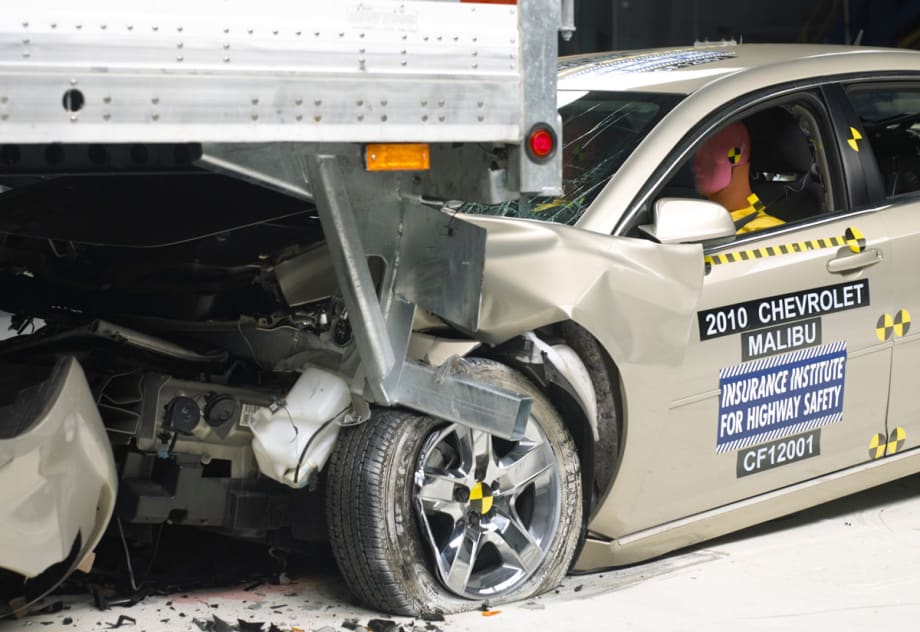
The Insurance Institute for Highway Safety tested underride guards in 2012.
Photo: IIHS
A $462 million verdict against Wabash National raises questions not only about rear underride guards, but also about the role of federal safety regulations in the era of nuclear verdicts.
Two men were killed on May 19, 2019, when their car went underneath the rear of a trailer along Interstate 44 and 55 in St. Louis.
When the car hit the back of the trailer somewhere between about 45 and 55 mph, the trailer’s rear underride guard failed, allowing the vehicle to go underneath the trailer.
The underride guard on the trailer, sold in 2004, was designed to the federal minimum 30-mph standard in place at the time, but the plaintiff’s attorneys claimed that Wabash ignored decades of research and warnings about underride failures.
The plaintiffs’ attorneys argued that had the trailer had a newer design rear impact guard with four protective posts instead of the older design using two posts, Taron Tailor and Nicholas Perkins would not have died in the crash.
However, Wabash attorneys contend that even the latest underride guard technology would not have prevented the fatalities.
Jury Awards $450 Million in Punitive Damages in Truck Underride Crash
Simon Law attorneys John Simon and Johnny Simon tried the case with co-counsel Brian Winebright of Cantor Injury Law and Lisa Tsacoumangos of Brown & Crouppen. The trial lasted two weeks and the jury deliberated for about three hours before finding in favor of the plaintiffs.
The jury awarded punitive damages at $450 million — an amount Simon estimated Wabash saved by failing to install the safer rear underride guards for three decades. Compensatory damages included $6 million to the family of each of the men who died.
The Simons also argued that trucking industry leaders have been at the forefront of lobbying efforts to prevent federal regulations from requiring rear underride guards be made to prevent underride at survivable speeds.
The plaintiff’s attorneys accused Wabash of never performing effective crash testing on the two-post guard, and that the company chose not to spend the money to upgrade despite evidence from other similar accidents that they posed a serious safety risk.
Wabash Likely to Appeal Underride Verdict
Wabash general counsel Kristin Glazner issued a statement after the verdict saying the company is evaluating “all available legal options.”
The statement pointed out that the accident occurred nearly two decades after the trailer was manufactured by Wabash, and it was in compliance with all existing regulatory standards at the time.
“No rear impact guard or trailer safety technology has ever existed that would have made a difference here,” Glazner said.
Wabash attorneys at trial argued that the crash would have resulted in fatalities even if the trailer had the most modern four-post rear impact guards.
The defense team blamed the driver, who they said “drove into the back of a trailer in broad daylight” on a clear sunny day. Wabash presented testimony estimating the speed of the crash at 55 mph, 10 mph higher than the estimate presented by the plaintiffs’ attorneys.
Wabash also said the jury was prevented from hearing critical evidence in the case, including that the driver’s blood alcohol level was over the legal limit at the time of the accident. The fact that neither the driver nor his passenger was wearing a seatbelt was also kept from the jury.
Federal Safety Regulations on Underride Guard Standards
Wabash told jurors that an adverse verdict would effectively make the federal safety standards irrelevant.
The plaintiff’s attorneys argued that a 1998 federal safety standard for rear impact guards, which featured heavily in Wabash’s defense, did not go far enough. They contended that the standard’s limitations were known to manufacturers throughout the trucking industry, some of which had upgraded to more modern four-post designs.
New underride guard standards were made final by the National Highway Traffic Safety Administration in 2022. The underride rule had been in the works since 2015.
Those rules now require rear impact guards to be able to protect occupants of compact and subcompact passenger cars impacting the rear of trailers at 35 mph, compared to the 30 mph of the previous rules.
Canada already had a higher 35-mph standard, and many U.S. underride guards were made to that Canadian standard for cross-border carriers.
You might think 5 mph is not much of a difference, but the static-test forces involved in that 5-mph increment are almost double — a little over 78,000 pounds for the Canadian bumper vs. 44,000 pounds for the American spec, according to a 2016 TMC session.
The 2022 regulation also improved protection in crashes where there is a partial underride, with 50% of the width of the passenger motor vehicle overlapping the rear of the trailer or semitrailer.
Safety groups, however, criticized the new rule and petitioned NHTSA to overturn it.
The Insurance Institute for Highway Safety, which had petitioned the federal government in 2011 to improve underride protection, said the rule didn’t go far enough.
“While the new standard is an improvement over the old one, nearly all newly manufactured guards on trailers already meet this new standard, which is similar to a longstanding Canadian requirement,” IIHS said in a statement. It called for NHTSA to require crash test guards when mounted on trailers, allow fewer exemptions for other kinds of trucks, and improve protection in offset crashes.
“Meanwhile, IIHS crash testing and the Toughguard award we inaugurated in 2017 have pushed the largest trailer manufacturers to strengthen their underride guards well beyond this level, demonstrating that further improvements are feasible.
Improved Underride Guards Appeared Before 2022 Underride Regulation
In fact, in 2016, Wabash unveiled a new underride guard option. The Rig-16 rear impact guard design option for its 53-foot dry van trailers was designed to prevent underride in multiple offset, or overlap, impact scenarios.
The Rig-16 Underride Guard System, made of high-strength steel, featured two additional vertical posts and a longer, reinforced bumper tube. These features were engineered to work together to absorb energy better and deflect rear impact at any point along the bumper.
In 2018, the Insurance Institute for Highway Safety awarded its top underride guard rating to eight major trailer manufacturers — including Wabash — representing 80% of trailers on the road.
To qualify for the IIHS ToughGuard award, trailers must have rear guards that prevent underride of a midsize car in three test modes: full-width, 50% overlap, and 30% overlap. In each test, a midsize car travels at 35 mph toward the back of a parked semitrailer.
This followed underride testing testing done by IIHS in 2013 on underride guards that found in crashes involving only a small portion of the truck's rear, most trailers failed to prevent potentially deadly underride.
More Equipment

How Volvo Updated Its D13 for EPA 2027 [Watch]
Volvo’s updated D13 promises lower emissions without sacrificing performance or fuel economy. Take a closer look at what changed inside the engine in this HDT Spotlight video.
Read More →
Michelin Tire Improves Efficiency and Durability for Regional Fleets
The Michelin X Multi Energy D2 is a regional haul drive tire engineered to help fleets improve fuel efficiency, durability and traction in demanding stop-and-go operations.
Read More →
ZF Expands Commercial Vehicle Push in North America
ZF is expanding its North American commercial-vehicle presence with new transmission applications, electrification, trailer technology and autonomous-driving systems.
Read More →
Tesla Wants a Self-Driving Semi. Are Cameras Enough?
Could Tesla’s camera-only autonomous driving technology work on an 80,000-pound Semi? In this commentary, HDT's Deborah Lockridge takes a look at Tesla, Cybercab, and how autonomous trucks see the road.
Read More →
Kodiak: Driverless Long-Haul Truck Launch on Track for 2026
Kodiak AI says its driverless long-haul safety case is 93% complete and it remains on track to begin commercial operations by year-end 2026.
Read More →
What DOT’s Automated Vehicle Strategy Means for Trucking
The U.S. Department of Transportation issued a new automated-vehicle strategy that outlines plans for driverless-truck regulations, cross-state freight corridors, and federal safety standards.
Read More →
East Coast Port Launches $45M Electric Truck Push
The Port Authority of New York and New Jersey announced millions in incentives for zero-emission drayage trucks, yard tractors, and new charging hubs near the port.
Read More →
PlusAI Going Public to Fund Autonomous Truck Launch
A SPAC deal could provide PlusAI with up to $300 million as it works toward a 2027 commercial launch of factory-built autonomous trucks.
Read More →
NHTSA Moves to Rewrite Truck Fuel-Economy Rules
The National Highway Traffic Safety Administration says it lacks authority to regulate medium- and heavy-duty truck engines separately from complete vehicles, but the existing standards have not yet been eliminated.
Read More →
Detroit Opens Orders for EPA 2027 Engines
Detroit isn’t starting from scratch to meet EPA 2027 diesel emissions standards. Its Gen 6 DD13 and DD15 engines keep much of today’s platform while updating the fuel and aftertreatment systems.
Read More →