




Volvo LIGHTS Ends – A New Era Dawns
The ambitious Volvo LIGHTS collaborative BEV project has ended with lessons learned and new goals set for electric truck operation on the West Coast.

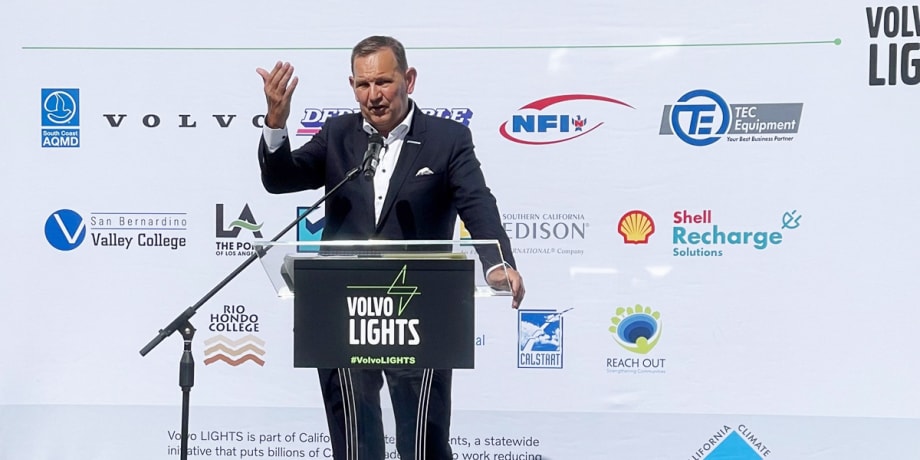
VTNA President Peter Voorhoeve hails the success of the Volvo LIGHTS BEV partnership during a ceremony in Ontario, California on Aug. 23.
Photo: Jack Roberts
During a ceremony at the Ontario Convention Center in California, Volvo Trucks North America formally declared the end of its innovative Volvo LIGHTS collaborative battery-electric truck partnership after a successful three-year run.
Established in 2019, Volvo LIGHTS was a first in the trucking industry. It was an effort headed by the truck OEM that brought together 14 public and private partners to design and implement a blueprint for the robust support ecosystem necessary to deploy battery-electric trucks and equipment at scale.
VTNA President Peter Voorhoeve spoke to representatives from all the Volvo LIGHTS partners during his opening remarks at a day-long event detailing the project’s successes, which included visits to TEC Equipment, Volvo Trucks' largest West Coast dealership, and NFI’s Cinco distribution center. NFI is currently running electric trucks in drayage operations out of the Port of Long Beach. Other events included round-table discussions with Volvo LIGHTS partners and a one-on-one interview between Voorhoeve and industry journalists attending the event.
During the project, which ran from 2019 to 2022 in California's South Coast Air Basin, Voorhoeve noted that Volvo deployed its first Class 8 pilot Volvo VNR Electric trucks to fleet operators in order to collect real-world operating data and customer feedback ahead of announcing its commercial model in December 2020. The project was driven by the need for real-world information on the use of battery-electric trucks as they neared scale production and deployment in fleet operations.
"By working closely with an extraordinary group of public and private partners through the Volvo LIGHTS project, we were able to validate key processes around Class 8 battery-electric truck adoption for commercial transport segments and identify challenges that needed to be addressed for widespread market introduction," Voorhoeve said during his remarks. "The most valuable takeaway for our team was really experiencing the value of close cross-functional and cross-organizational collaboration as we continue to drive innovation and develop new solutions for sustainable transport."
The Volvo LIGHTS project was led by VTNA and California's South Coast Air Quality Management District, and included NFI, Dependable Highway Express, TEC Equipment, Shell Recharge Solutions (formerly Greenlots), the Port of Long Beach, the Port of Los Angeles, Southern California Edison, Calstart, the University of California, Riverside CE-CERT, Reach Out, Rio Hondo College, and San Bernardino Valley College.
During the multi-year project, Volvo Group North America collaborated with each organization to develop programs and best practices that would help lay the foundation for the successful commercialization of battery-electric freight trucks, including:
Identifying ideal routes for electrification. Volvo Trucks deployed 30 Volvo VNR Electric trucks to 11 fleets to operate in their daily Southern California fleet routes to assess many factors that may impact vehicle range, including topography, ambient temperature, traffic patterns, and driving styles. The insights gained were informative as Volvo Trucks introduced the Electric Performance Generator, its route planning tool which enables fleet managers to simulate real-world routes for their VNR Electric trucks.
Comprehensive dealer support. TEC Equipment, Volvo Trucks' largest West Coast dealership, provided uptime support to the fleet customers that leased VNR Electrics through the Volvo LIGHTS project. The hands-on experience gained during the project led to TEC Equipment Fontana becoming the nation's first Volvo Trucks Certified Electric Vehicle Dealer and spurring the rollout of certified dealerships across North America.
Reliable and cost-effective charging infrastructure. Multiple project partners collaborated with Shell Recharge Solutions and SCE on the installation and energization of 58 networked public and private electric vehicle charging stations, identifying opportunities to streamline processes, shorten installation timelines, and refine existing laws related to allowing entities other than utilities to re-sell electricity for EV charging. SCE also conducted a site grid system impact study to help plans for supporting a future of fully electrified goods movement.
Technician training programs. Rio Hondo College and San Bernardino Valley College both collaborated with Volvo Trucks to launch heavy-duty electric truck technician training programs, with a combined total of more than 45 graduates throughout the project.
First responder training programs. Throughout the project, Reach Out, a local outreach organization worked with Volvo Trucks to keep community stakeholders informed about the project. This partnership helped facilitate the development of training materials for first responders to raise awareness about the high-voltage components on the Volvo VNR Electric and develop the first responder safety document that is now publicly available from the National Fire Protection Agency.
"This project shows how important it is for public and private entities to work together to bring zero-emission technologies and infrastructure to the nation," said Ben J. Benoit, chair of South Coast AQMD's governing board. "Now that the project is coming to an end, we look forward to seeing these cleaner trucks on the road, and the impact they will have on air quality.
A New Grid Already Growing
During a panel discussion later in the day — moderated by Keith Brandis, VTNA’s vice president of system solutions and partnerships — Volvo LIGHTS partners shared what they learned during the three-year project about the use of electric trucks in Southern California.
Larkin Williams, general manager of Quality Custom Distribution’s Los Angeles facility, noted that his company’s main customer – Starbucks – was keenly interested in sustainable transportation solutions, which made the decision to become a Volvo LIGHTS partner an easy one to make.
“When the opportunity arose to use government funding to get into electric trucks, this was really the perfect layout for us,” Williams said. “The grants allowing infrastructure installation just made sense for us. And the carbon credits we’re already getting for putting that infrastructure in place will basically save us hundreds of thousands of dollars over the coming decades. And the companies that are not already embarking on the transition to electric trucks will pay that money out for us.”
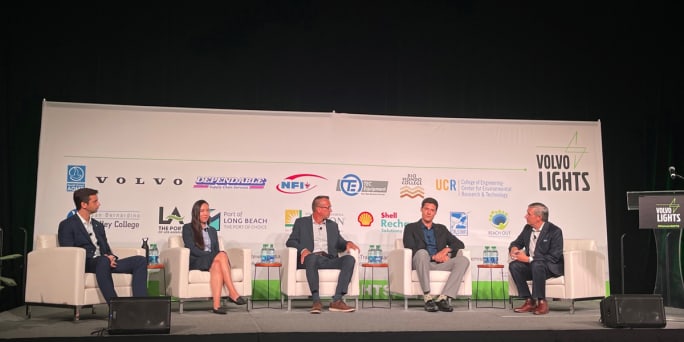
(Left to right) Tom Ashely, VP of policy and market development for Shell Recharge Solutions; Justine Chao, senior project manager of charge ready transport for Southern California Edison; Jeff Pals, EVP of fleet maintenance for 10 Roads Express; Larkin Williams, general manager of Quality Custom Distribution’s Los Angeles facility; and Keith Brandis, VP of system solutions and partnerships for VTNA take part in a roundtable discussion on lessons learned from the Volvo LIGHTS project.
Photo: Jack Roberts
Jeff Pals, executive VP of fleet maintenance for 10 Roads Express said: “We all have a responsibility to reduce carbon emissions. We really wanted to demonstrate to our customers that we’re working toward that goal. Another big factor for us in going electric was the driver shortage. Like everyone else, we’re affected by it. And we wanted to show both our current drivers, and potential new drives, that we are investing in cutting-edge technologies that will make their jobs more interesting and easier to do.”
Infrastructure remains a big question mark as BEV sales rise. Justine Chao, senior project manager for charge ready transport at SCE told attendees that the utility is committed to fast-tracking a new power grid that can handle the expected influx of BEVs.
“SCE is already hard at work planning a new grid for large-scale electrification,” she said. “But recently, we proposed and got approval to use a much more aggressive forecast that considers more wide-spread clean fleets than we initially considered. We are hard at work now identifying when and where we will need increased electrical loads for BEV charging. This data is important for planning this new electric grid. We need to understand where power will be needed, and what times of day it will be needed. And there’s really no substitute for hearing from fleets on this. So, we encourage all of our fleet customers interested in acquiring and operating EVs to engage with us early and give us an idea of what your plans are for the next two-, five- and 10-years so that we can better plan to meet those needs as they arise.”
Volvo has published a Volvo LIGHTS guidebook to share key insights from the project to help fleets nationwide interested in electric truck technology. The 22-page guidebook, Bringing Battery-Electric Freight Trucks to Market: From Demonstration to Commercialization, is available for download.
More Fuel Smarts

How Volvo Updated Its D13 for EPA 2027 [Watch]
Volvo’s updated D13 promises lower emissions without sacrificing performance or fuel economy. Take a closer look at what changed inside the engine in this HDT Spotlight video.
Read More →
Diesel Price Spike Shortens Payback for Natural Gas Trucks, Report Says
Energy Vision estimates fleets could recover the higher purchase price of an RNG-fueled Class 8 tractor in 1.3 to 2.8 years under current fuel-price scenarios.
Read More →
Calstart Becomes Catalyst Mobility, Reflecting Broader Focus
Calstart is now Catalyst Mobility, reflecting the nonprofit’s growing national role in clean transportation, including zero-emission trucks, infrastructure and incentive programs.
Read More →

Record Diesel Prices Squeeze Trucking Fleets
Average U.S. diesel prices have climbed to nearly $6 a gallon, surpassing the 2022 record as tight refinery capacity and Middle East disruptions keep fuel costs elevated.
Read More →
How Fuel Delivery Shapes Engine Performance
Fuel delivery depends on more than what happens at the injector. For fleet, maintenance and technical professionals, looking at the full path from pump to injector can provide useful context for understanding engine performance.
Read More →
East Coast Port Launches $45M Electric Truck Push
The Port Authority of New York and New Jersey announced millions in incentives for zero-emission drayage trucks, yard tractors, and new charging hubs near the port.
Read More →
California Bill Could Shed Light on Electric Truck Prices
Why do battery-electric Class 8 trucks remain so expensive? A California bill headed to Gov. Gavin Newsom would give fleets and state agencies more visibility into what manufacturers charge.
Read More →
Detroit Opens Orders for EPA 2027 Engines
Detroit isn’t starting from scratch to meet EPA 2027 diesel emissions standards. Its Gen 6 DD13 and DD15 engines keep much of today’s platform while updating the fuel and aftertreatment systems.
Read More →
Zero-Emission Truck Corridor Planned for West Coast
California, Oregon, Washington, British Columbia and Baja California are coordinating plans for truck charging and hydrogen fueling from Canada to Mexico.
Read More →
A Closer Look at Kenworth’s Electric T880E Vocational Truck [Video]
Learn more about Kenworth's T880E battery-electric vocational truck at the Paccar Technical Center, including its range, applications, upfitting considerations, and PTO options, in this HDT Spotlight video.
Read More →