





Tech Update: Low-Tech Trucks in a High-Tech World
U.S. Xpress Steps Back From High-Tech Variant Fleet to Focus on ‘Blocking and Tackling’
Variant, U.S. Xpress' digital fleet, was supposed to be the future, using telematics data and complex algorithms to manage the fleet. At first, it was a success. But last year things started going downhill.
September 12, 2022
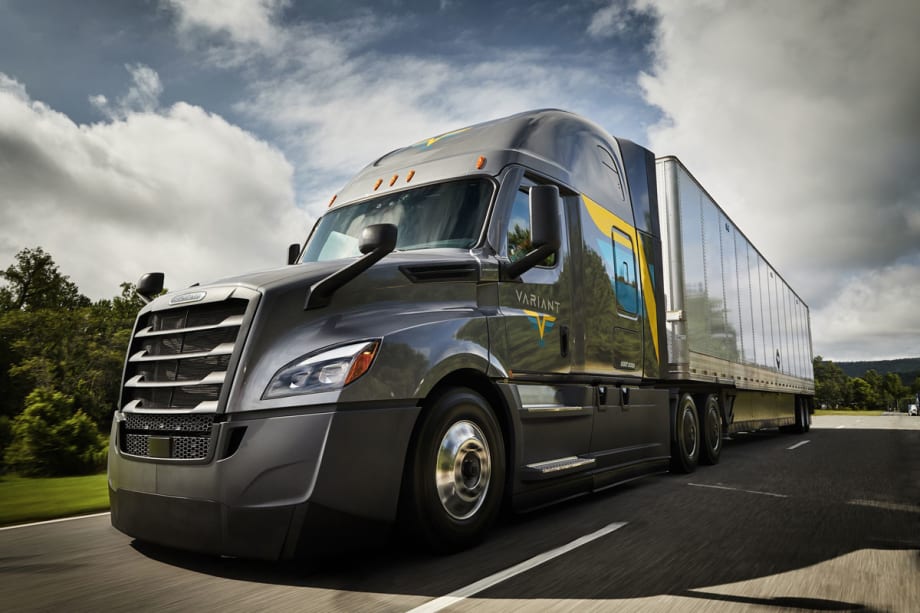
Variant’s fleet orchestration platform, Vector, used interconnected algorithms and services to automatically reorchestrate the Variant fleet and adapt dynamically to ever-changing events on the road.
Photo: U.S. Xpress
8 min to read
As U.S. Xpress saw a net loss of $9.5 million in the first six months of 2022, President and CEO Eric Fuller says two things became apparent to him.
“The first was, we built some really advanced technology to deploy across the company,” he explained in an investor conference call announcing a “realignment” of the company. “The second was, the technology can’t replace all the knowledge and experience of our people. They need to work together.”
The Chattanooga, Tennessee-based truckload carrier has long been known for its innovation, and its Variant fleet — a digitally dispatched/managed, driver-focused fleet — at one point was touted as a big success, with driver turnover a fraction of traditional truckload models.
However, U.S. Xpress announced on Sept. 7 that it is rolling the Variant fleet into its legacy over-the-road operations as part of a realignment and cost-cutting designed to bring it back to profitability.
“Our vision to build a digitally enabled OTR fleet was ambitious and achieved certain successes, but with the freight market softening, it is important that we right-size our cost structure for the current environment to protect our corporate health, our commitments to our customers, and our stockholders’ investment,” said Fuller in a news release. “The investments we made in our digital enablement initiatives over the last few years will be incorporated into our newly realigned divisions."
U.S. Xpress’ Truckload operating ratio for the first six months of 2022 was 99.9%, compared to 97.9% the first six months of 2021. The brokerage business did a little better, but the overall operating ratio was still 99.4% for the first six months.
Revenue per tractor per week declined sequentially in the second quarter to $3,863 due to a combination of lower utilization within the fleet and a lower rate per mile as a large decline in the spot market portion of its business more than offset a meaningful increase in contracted rates in the quarter.
Cutting $25 Million
The new streamlined business will be made up of two divisions: Dedicated and Highway Services. Dedicated will continue to operate as it does currently. Highway Services will encompass its legacy OTR, Variant, and Brokerage operations.
CFO Eric Peterson explained on the conference call that the change means a workforce reduction, “primarily removing duplicative costs as we consolidated corporate IT functions with our tech teams at both Variant and Express Technologies” (its brokerage operations). Those IT teams also have stopped work on projects without near term payback, he said. “We will have a leaner tech team focused on high-priority projects.”
The realignment plan is focused on improving the company's over-the-road operations, with limited impact to its Dedicated and Brokerage businesses. With the personnel reduction, divestitures of non-core real estate holdings and other cuts, U.S. Xpress expects to save approximately $25 million on an annualized basis beginning in the fourth quarter of 2022.
Among those other cost savings is extending its trade cycle. The company doesn’t plan to cut its tractor count, but it is going to freeze the fleet size where it is for now.
“We will run our tractors about 100,000 more miles beginning in 2023,” Fuller explained, “taking advantage of our maintenance program. The average age of the fleet will go from 22 months to 27 months by the end of 2023, he said, “with minimal impact to maintenance costs on a per-mile basis.”
In the conference call, Fuller answered a question about the change in strategy by saying, “Some of the things we did didn’t work.” Others worked, but not well enough from a results standpoint. And the market is deteriorating.
“We think focusing on back to the basics, the blocking and the tackling, and driving near-term results, is the right answer. We think we can get to profitability through these moves and position ourselves for the next upcycle market.
“The first half of the year has been extremely difficult,” Fuller said, “but we believe this realignment plan will position the company for better times ahead.”
The Gamble on Variant
Variant, a “digitally orchestrated fleet,” was launched with five trucks in June 2019. Two years later it had surpassed 1,200 seated tractors. Using complex, scalable algorithms and telematics data to position trucks in real time, it was supposed to get professional truck drivers more miles and more reliable home time.
Variant’s fleet orchestration platform, Vector, used interconnected algorithms to analyze current and forecasted truck position, telematics data, current and forecasted Hours of Service, shippers’ orders, operational characteristics, and live freight markets to automatically reorchestrate the Variant fleet and adapt dynamically to ever-changing events on the road.
“Variant is also reengineering driver support and communication by substituting traditional fleet managers with a driver success service center,” a U.S. Xpress spokesperson said at the time. “This, combined with better route scheduling through the Optimizer, leads to increased driver satisfaction and lower turnover rates than the industry average.”
“Variant’s goal is to increase driver satisfaction through an automated approach,” explained 2021 HDT Truck Fleet Innovator Shaun Sadler in early 2021, along with more premium equipment. The technology was designed to be more responsive to driver needs, with better and quicker load assignments, using algorithms to assign trailers so drivers weren’t deadheading. Where most traditional truckload drivers get 2,000 or less miles per week, the Variant drivers were seeing 2,500, he said, with a fifth of the typical truckload turnover.
However, as the heady post-pandemic market started to soften, the model appeared to falter. Its turnover slid throughout last year, from 58% in the first quarter to 95% by the fourth quarter.
Last December, the company fired Variant President Cameron Ramsdell, who joined U.S. Xpress in the spring of 2019 after working more than a decade at UPS-owned Coyote Logistics. In a filing with the Securities and Exchange Commission, Fuller said the business could now be better integrated with the rest of U.S. Xpress’ operations.
Since late last year, U.S. Xpress has been working to try to turn Variant around. In its second quarter earnings report, it revealed turnover at the Variant fleet, which by this point had grown to nearly 1,900 trucks, was 150%.
“I wouldn’t say Variant is dead,” Fuller said in response to a question on the conference call. “We still think a lot of the technology we developed has a lot of value. But with that said, we are kind of skinnying down the strategy. Previous management was very focused on a true startup strategy, where there was a lot being thrown against the wall. We have to get more narrow in our focus. We have to be very targeted in what we’re working on. Operationally right now internally we’re really focused on the basics, the blocking and the tackling. If I was going to be hypercritical of the last year, year and a half, I would say we’ve lost a lot of the blocking and tackling and the basics in our industry. We have to get back to that.”
U.S. Xpress is still pursuing other technology initiatives. A company spokesperson, responding to an email from HDT, noted, "Right now, we’re squarely focused on the fundamentals of the business, but longer-term relationships and investments with AV developers are still moving forward. We still believe autonomous and fuel cell is part of the future of trucking and it’s necessary to remain committed to these partnerships."
Organizational Realignment
In an investors conference call announcing the realignment, Fuller said, “If you look at Q4, there was enough freight in the market, but our operations group was not managing our trucks and drivers whatsoever.” Drivers were taking extended time off and not available to haul freight, he said. “Since we made the management change in December, we’re focusing on what are we going to do to get our availability turned around, and we improved that by almost 1,000 basis points. The problem is we’re in a weaker market, so there’s less available freight…. We have to scrap for every load.”
Another big challenge U.S. Xpress is facing is an increase in insurance and claims expense as claim settlements have accelerated and courts work to clear the backlog of cases which were delayed during the pandemic. Company officials expect about $15 million more in insurance and claims expense in its third quarter financial results than the second quarter, primarily driven by one large claim.
Justin Harness, who led the turnaround of the U.S. Xpress Dedicated division over the last year and a half, will lead both the operational and commercial functions of the OTR and Brokerage businesses, serving as president of Highway Services. Brandon Danneffel, senior VP of Brokerage, will replace Harness as the president of Dedicated.
Fuller said a big focus going forward is utilization. “I think the big thing is utility,” he said. “We saw a big drop, which meant drivers were making less money. So we’re back to focusing on utility.”
Asked about the state of the market overall, Fuller answered, “I think we’re at the bottom. The big question is, how long does this last. At least in the spot market if you look at historical vs contract we’re kind of bouncing along the bottom. We still haven’t seen a big impact to contract I think partially because of where we are in the cycle and seasonally — most of the bid season is over. But I think we are seeing capacity coming out of the market, we’re seeing that with some of our brokerage carriers. The market is starting to correct itself. We probably hit the bottom about a month ago. We may see a little life in Q4, but we have at least a few months if not more before it starts to turn and firm up a little more.”
More Fleet Management

Why Private Fleets Are Taking More Freight
Private fleets are putting their own trucks on demanding customers and high-cost lanes as companies seek greater control over service, costs, and capacity.
Read More →
Sponsored•September 16, 2026
Color Match Smarter: Tools That Restore & Perform
For fleet managers and collision repair professionals keeping heavy-duty trucks on the road, getting the color right the first time isn't just about appearance — it's about efficiency, turnaround time, and bottom-line results. Discover how today's digital color tools are transforming the repair process from guesswork to precision.
Read More →
FMCSA Pauses Biennial-Update Enforcement Amid Motus Transition
Carriers whose updates were due on or after June 1 have more time, while FMCSA works to stabilize its new registration system and warns of phishing sites impersonating its new carrier registration system, Motus.
Read More →


Sponsored•September 14, 2026
2026 Blueprint for Countering Smarter Supply Chain Theft
Cargo theft is no longer just the cost of doing business. It's a multi-billion-dollar criminal enterprise exploiting vulnerabilities across your fleet, drivers, and supply chain.
Read More →
Sponsored•September 1, 2026
How Telematics Improves Visibility, Control, and Performance in Refrigerated Fleets
Explore how telematics help refrigerated fleets improve visibility, uptime, efficiency, compliance, and cargo protection across connected cold chain operations.
Read More →
What the U.S.-Canada Trade War Means for Trucking
Escalating U.S.-Canada tariffs could disrupt cross-border freight, reduce truck volumes, raise costs, and create new uncertainty for carriers on both sides of the border.
Read More →
What Are Trucking’s Top Concerns for 2026?
The American Transportation Research Institute wants to know what's worrying trucking fleet managers, drivers, and other stakeholders in its annual Industry Issues survey.
Read More →
American Trucking Associations Looks for a New Leader
ATA President and CEO Chris Spear abruptly left his job at the association on August 21, at a pivotal time for the trucking industry.
Read More →
Public Wi-Fi Cybersecurity Risks: How Truck Drivers and Fleets Can Protect Their Data
Public Wi-Fi can expose truck drivers and fleets to credential theft, malware, and other cyber threats. Here’s how to reduce the risk on the road.
Read More →
For Nicky Cupp, Fleet Innovation Starts With Frustration
HDT Truck Fleet Innovator Nicky Cupp turns everyday pain points at Fraley & Schilling into opportunities for better technology and smarter processes.
Read More →