





Related: Volvo Expands XE Powertrain Lineup
Technology's Promise Paying Off, Says Volvo Group CEO
In his keynote address at the annual HDMA Briefing Breakfast at the Mid-America Trucking Show Friday morning, Persson sketched out the top trends in transportation regarding highway safety, environmental sustainability, and technology.
March 27, 2015

Volvo CEO Olof Persson keynoting HDMA Briefing at MATS. Photo by Paul Hartley courtesy HDMA
5 min to read
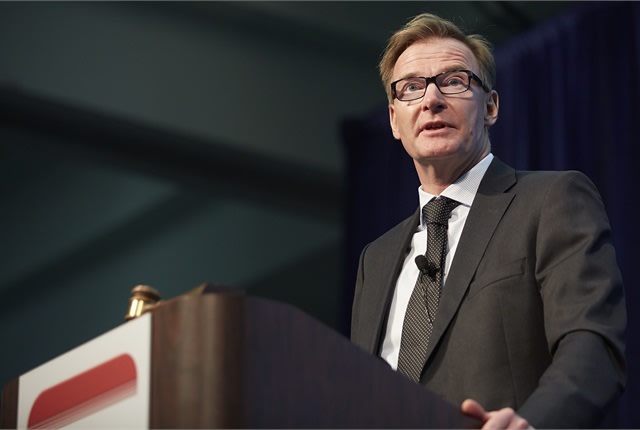
Volvo CEO Olof Persson keynoting HDMA Briefing at MATS. Photo by Paul Hartley courtesy HDMA
LOUISVILLE, Ky. — In his keynote address Friday at the annual HDMA Briefing Breakfast at the Mid-America Trucking Show, Volvo Group CEO Olaf Persson sketched out the top trends in transportation including highway safety, improved environmental sustainability, greater integration of truck systems and advancing “connected truck” platforms to “deliver uptime breakthroughs” to truck operations.
Furthering the range of technology-driven solutions already in play is the key to ensuring fleets will weather important trends now buffeting the trucking industry globally, according to Persson.
Safety Impact
Persson remarked that “the increasing societal demand for safety is certainly in evidence here in the U.S., in the wake of several terrible, well-publicized accidents last year involving trucks... “Safety has been a Volvo core value since our founding, and we are continuing to work on a variety of active safety technologies.”
As an example, he pointed to an advanced active system Volvo is developing to monitor “all of the truck’s surroundings for the driver, and suggest actions to avoid accidents, whether they involve pedestrians, cyclists, or other vehicles.” This “360-degree awareness can even predict what the moving entities it’s scanning might do next. If the driver does not respond to suggested actions, the steering or braking system can be activated autonomously.”
Noting that while Volvo still has several technical challenges to overcome, Persson said “we think it’s possible this technology could be become a reality in five to 10 years from now.”
He added that Volvo’s safety vision is “a bold one—to have no accidents involving Volvo trucks. This technology has the potential to take us another step toward that vision, and it represents the kind of advancement that society will increasingly expect from our industry.”
Green for Good
Persson said environmental sustainability will remain front and center as it is “what society demands from all of us, here and around the world.”
While conceding that low oil prices in the U.S. has of late toned down “the buzz around alternative fuels” here, he declared those days are numbered. “Forty-five dollars a barrel won’t last forever, and governments here and around the world will continue to have emissions in general – and greenhouse gas [GHG] in particular – in focus.”
He gave natural gas its due, remarking that Volvo sees the fuel as “continuing to play a role in some segments of this market – particularly in certain vocational applications and shorter, regional haul. But when it comes to other segments, particularly longer hauls, we continue to believe DME [Dimethyl Ether] shows tremendous promise.” That’s because the conversion of natural gas into DME can “address many of the distribution, storage, and fueling challenges otherwise presented by natural gas – particularly liquefied natural gas – as a heavy truck fuel. If the industry were able to get the critical mass of production volume we need, DME could really be a game-changer.”
Turning to the developing Phase GHG/MPG rule, Persson endorsed having it based solely on a complete vehicle standard. “First of all, it seems to us a separate engine standard would be redundant, since the engine would be accounted for in the complete vehicle assessment. And the last time I looked, there were no loose engines pulling freight down American highways.
“But more important than redundancy,” he continued, “an engine standard– particularly if it’s stringent – could force the use of technologies that could bring seriously negative consequences for our customers, in terms of cost, weight, space, cooling, and so on.”
Indeed, Perrson cautioned that “If reason does not prevail, the industry could be faced with a mandate for increased engine efficiency that actually reduces total vehicle efficiency in real-world conditions. That would obviously be a loss not just for truck customers, but for society and the environment.”
Integration vs. Displacement
As for the positive impact of further integrating vehicle systems, Persson called powertrain integration “the most effective and efficient way to manage the kind of complexity I’ve just talked about – whether it’s driven by environmental regulations or by customer demands for increased fuel economy and performance. Having components that were specifically designed for each other, and act seamlessly together, allows us to create more and more intelligent, higher-performing vehicles.”
He contended that “the technological march toward getting more power from smaller packages – in everything from computers, to batteries, to passenger car engines – won’t just skip over the heavy vehicle industry.
“I understand there is a saying in the U.S. that ‘There’s no replacement for displacement,’” he added. “But there is a replacement for displacement– it’s innovation. And integration is helping us drive innovation.”
Wireless Workshops
Lastly, Persson touched on what he termed the “very exciting area of ‘connected trucks,’” noting that we are rapidly approaching the point at which no trucks will ever really be ‘offline.’”
Making his case, he remarked that he “wondered how much of even, say, a year’s worth of savings from a three percent fuel economy improvement would be undercut by just one day of unplanned downtime – especially after you factor in the consequences for the trucking company’s reputation and for customer relationships.
“So ‘uptime’ is a very strong focus area for both of our truck brands in North America, and one in which we think connectivity is key.”
Noting that already more than 80,000 Volvo and Mack vehicles on North American roads are equipped with remote diagnostics systems, Persson stated that “these systems will ultimately allow us to become increasingly proactive in making changes to the vehicle wirelessly-- on-the-fly– either to correct problems or to optimize for things like terrain, temperature, or other operating conditions.
“In short, we’re working toward a ‘wireless workshop,’ where trucks are in some cases evaluating themselves, while in operation, and being repaired remotely,” he said.
“But while we’re very excited about the technology," Persson added, "it’s also clear to us that the real gains can’t be made with technology alone. People – skilled, knowledgeable personnel – are essential components.”
More Fleet Management

Sponsored•September 16, 2026
Color Match Smarter: Tools That Restore & Perform
For fleet managers and collision repair professionals keeping heavy-duty trucks on the road, getting the color right the first time isn't just about appearance — it's about efficiency, turnaround time, and bottom-line results. Discover how today's digital color tools are transforming the repair process from guesswork to precision.
Read More →
FMCSA Pauses Biennial-Update Enforcement Amid Motus Transition
Carriers whose updates were due on or after June 1 have more time, while FMCSA works to stabilize its new registration system and warns of phishing sites impersonating its new carrier registration system, Motus.
Read More →
Sponsored•September 14, 2026
2026 Blueprint for Countering Smarter Supply Chain Theft
Cargo theft is no longer just the cost of doing business. It's a multi-billion-dollar criminal enterprise exploiting vulnerabilities across your fleet, drivers, and supply chain.
Read More →


Sponsored•September 1, 2026
How Telematics Improves Visibility, Control, and Performance in Refrigerated Fleets
Explore how telematics help refrigerated fleets improve visibility, uptime, efficiency, compliance, and cargo protection across connected cold chain operations.
Read More →
What the U.S.-Canada Trade War Means for Trucking
Escalating U.S.-Canada tariffs could disrupt cross-border freight, reduce truck volumes, raise costs, and create new uncertainty for carriers on both sides of the border.
Read More →
What Are Trucking’s Top Concerns for 2026?
The American Transportation Research Institute wants to know what's worrying trucking fleet managers, drivers, and other stakeholders in its annual Industry Issues survey.
Read More →
American Trucking Associations Looks for a New Leader
ATA President and CEO Chris Spear abruptly left his job at the association on August 21, at a pivotal time for the trucking industry.
Read More →
Public Wi-Fi Cybersecurity Risks: How Truck Drivers and Fleets Can Protect Their Data
Public Wi-Fi can expose truck drivers and fleets to credential theft, malware, and other cyber threats. Here’s how to reduce the risk on the road.
Read More →
For Nicky Cupp, Fleet Innovation Starts With Frustration
HDT Truck Fleet Innovator Nicky Cupp turns everyday pain points at Fraley & Schilling into opportunities for better technology and smarter processes.
Read More →
Adam Buttgenbach’s Approach to Electric Trucks: Start With Where They Fit
HDT Truck Fleet Innovator Adam Buttgenbach helped PepsiCo build one of North America’s largest EV fleets by focusing on where electric trucks make operational sense.
Read More →