




Switching to Rail Freight May Not Be the Greenest Option
The answer to achieving reductions in greenhouse gas emissions may not necessarily be the greater use of freight rail, but we should consider improved access to intermodal terminals, equalization of rail and truck standards for production of potent NOx exhaus
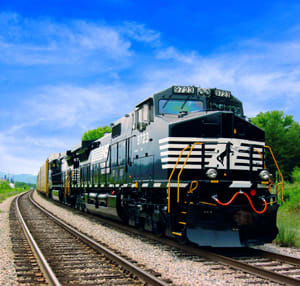
One option for a greener transport system would be a transloading model, where truck is used for local transport and rail for the intercity movement. Photo courtesy of Norfolk Southern
The answer to achieving reductions in greenhouse gas emissions may not necessarily be the greater use of freight rail, but we should consider improved access to intermodal terminals, equalization of rail and truck standards for production of potent NOx exhaust
and modifying existing truck size and weight regulations, according to Noel Perry, author of Transportation Fundamentals. In his analysis, Perry questions government efforts to encourage greater use of freight rail to produce a greener transportation system.
"Existing market forces have already done an excellent job of maximizing fuel efficiency by allowing rail and truck to do what they do best," Perry said.
While Perry agrees that rail is far more fuel efficient than truck, he says that this is just part of the energy equation. In examining fuel efficiency, he says you need to look at the complete supply chain from start to finish, including the local pick-up and delivery function for which trucks are far more efficient than rail. When taking all of this into account, most freight currently moving by truck would consume more energy if coverted to a 100 percent rail move, he says.
Perry suggests a transloading model, where truck is used for local transport and rail for the intercity movement. Government efforts should be directed at creation of more such truck/rail interchange terminals to make this option more accessible.
Perry also recommends modifying existing truck size and weight standards, which have not changed in over 20 years. Both energy efficiency and safety would be improved by the operation of larger, but fewer trucks, he believes.
Another way to reduce greenhouse gas emissions would be to apply current truck standards for the emission of NOx greenhouse gases to the railroads. One unit of NOx produces 310 times the global warming effect of one unit of CO2, the gas normally tracked in carbon comparisons. Perry says that as a result of the differences in regulation between truck and rail engines, rail locomotives currently emit an average of 4.5 times more NOx per horsepower-hour than truck. Even after both truck and rail NOx emission regulations are tightened, new locomotives will still emit 6.5 times more NOx per horsepower-hour than new trucks.
Transport Fundamental Newsletter is a monthly commentary on transport economics and its impact on the North American heavy freight market published by Transport Fundamentals, Inc. and distributed by FTR Associates.
For more information, visit www.ftrassociates.com.
More Fleet Management

Why Private Fleets Are Taking More Freight
Private fleets are putting their own trucks on demanding customers and high-cost lanes as companies seek greater control over service, costs, and capacity.
Read More →
Color Match Smarter: Tools That Restore & Perform
For fleet managers and collision repair professionals keeping heavy-duty trucks on the road, getting the color right the first time isn't just about appearance — it's about efficiency, turnaround time, and bottom-line results. Discover how today's digital color tools are transforming the repair process from guesswork to precision.
Read More →
FMCSA Pauses Biennial-Update Enforcement Amid Motus Transition
Carriers whose updates were due on or after June 1 have more time, while FMCSA works to stabilize its new registration system and warns of phishing sites impersonating its new carrier registration system, Motus.
Read More →


2026 Blueprint for Countering Smarter Supply Chain Theft
Cargo theft is no longer just the cost of doing business. It's a multi-billion-dollar criminal enterprise exploiting vulnerabilities across your fleet, drivers, and supply chain.
Read More →
How Telematics Improves Visibility, Control, and Performance in Refrigerated Fleets
Explore how telematics help refrigerated fleets improve visibility, uptime, efficiency, compliance, and cargo protection across connected cold chain operations.
Read More →
What the U.S.-Canada Trade War Means for Trucking
Escalating U.S.-Canada tariffs could disrupt cross-border freight, reduce truck volumes, raise costs, and create new uncertainty for carriers on both sides of the border.
Read More →
What Are Trucking’s Top Concerns for 2026?
The American Transportation Research Institute wants to know what's worrying trucking fleet managers, drivers, and other stakeholders in its annual Industry Issues survey.
Read More →
American Trucking Associations Looks for a New Leader
ATA President and CEO Chris Spear abruptly left his job at the association on August 21, at a pivotal time for the trucking industry.
Read More →
Public Wi-Fi Cybersecurity Risks: How Truck Drivers and Fleets Can Protect Their Data
Public Wi-Fi can expose truck drivers and fleets to credential theft, malware, and other cyber threats. Here’s how to reduce the risk on the road.
Read More →
For Nicky Cupp, Fleet Innovation Starts With Frustration
HDT Truck Fleet Innovator Nicky Cupp turns everyday pain points at Fraley & Schilling into opportunities for better technology and smarter processes.
Read More →