





Related: Why Electric Trucks? Why Now?
Smart Hybrid Trucks to Silently Deliver to McDonald’s Locations in Stockholm
The city of Stockholm, Sweden, banned trucks from making deliveries at night to reduce noise levels. But a new pilot program will test quieter hybrid trucks for overnight deliveries to McDonald's restaurants in the area.
February 15, 2019
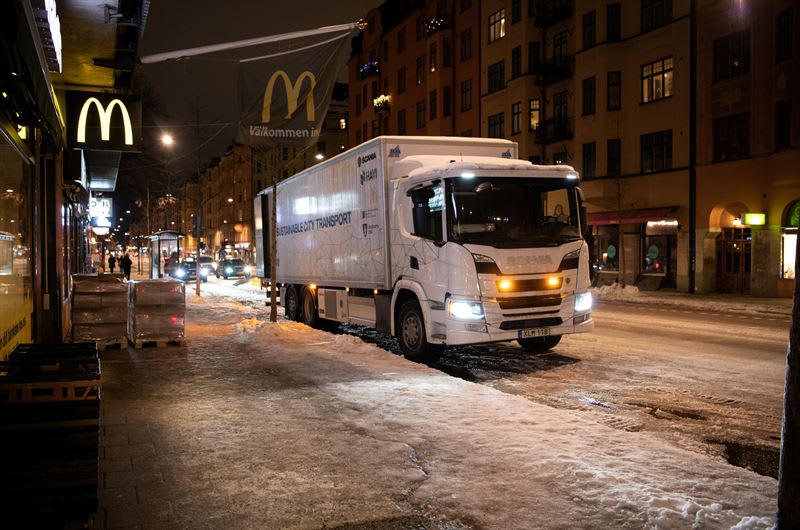
A new pilot program in Stockholm, Sweden will test quiet hybrid trucks making overnight deliveries to McDonald's restaurants in the city center, to see if the vehicles can avoid traffic and run silent.
Photo courtesy Scania
2 min to read
In the city center of Stockholm, Sweden, trucks are restricted from overnight deliveries because of their noise levels, which means that deliveries for shops and restaurants tend to occur during the morning rush hour.
However, a recently expanded pilot program is trying to maintain low-noise levels and reduce traffic and emissions by deploying hybrid Scania trucks to make deliveries to McDonald’s restaurants there overnight.
The project is under way thanks to the collaboration of the City of Stockholm, logistics provider Havi, the KTH Royal Institute of Technology, the European Union, McDonalds, and Scania. The trial will deploy Scania chargeable hybrid trucks that use a combination of electrical power and a type of biodiesel fuel called HVO, which is said to produce reduced emissions of particles and carbon dioxide.
The trucks have a limited capability to travel completely on electric power, with a range of about 10 kilometers or about 6.2 miles. The trucks will also be connected and fitted with geofencing technology that will allow them to adapt to the driving conditions in predetermined areas.
This will allow the trucks to deploy the limited electric range where it is most needed and still have access to better range and power once outside city limits. The geofence will determine which power mode and speeds the trucks can travel in as they approach the city center, potentially providing the desired noise and emissions reduction.
"These trucks drive quietly and are emission-free in these sensitive urban areas,” said Camilla Eklöf, quality, safety & environmental manager, Havi. “At the same time, however, they are still capable of driving longer distances. Our global partnership with Scania and McDonald's is really making a difference to the environment as we work together to minimize emissions."
The pilot program will study how much of an environmental benefit is gained by not having trucks stuck in traffic and by always having good accessibility.
The hybrid truck’s battery can be charged externally and by power generated by the truck’s brakes. Charging stations will be placed near one of the McDonald’s restaurants to charge the battery while loading, unloading, and during driver breaks to ensure that the vehicles can continue operating solely on electric power while in the city center.
“This project is an excellent opportunity to demonstrate and evaluate the possibilities that a connected hybrid truck can offer, with the technology available to us here and now, to enable us to reduce our dependency on fossil fuels,” said Jesper Brauer, product manager for urban trucks, Scania.
More Fuel Smarts

How Volvo Updated Its D13 for EPA 2027 [Watch]
Volvo’s updated D13 promises lower emissions without sacrificing performance or fuel economy. Take a closer look at what changed inside the engine in this HDT Spotlight video.
Read More →
Diesel Price Spike Shortens Payback for Natural Gas Trucks, Report Says
Energy Vision estimates fleets could recover the higher purchase price of an RNG-fueled Class 8 tractor in 1.3 to 2.8 years under current fuel-price scenarios.
Read More →
Calstart Becomes Catalyst Mobility, Reflecting Broader Focus
Calstart is now Catalyst Mobility, reflecting the nonprofit’s growing national role in clean transportation, including zero-emission trucks, infrastructure and incentive programs.
Read More →

Record Diesel Prices Squeeze Trucking Fleets
Average U.S. diesel prices have climbed to nearly $6 a gallon, surpassing the 2022 record as tight refinery capacity and Middle East disruptions keep fuel costs elevated.
Read More →
Sponsored•September 9, 2026
How Fuel Delivery Shapes Engine Performance
Fuel delivery depends on more than what happens at the injector. For fleet, maintenance and technical professionals, looking at the full path from pump to injector can provide useful context for understanding engine performance.
Read More →
East Coast Port Launches $45M Electric Truck Push
The Port Authority of New York and New Jersey announced millions in incentives for zero-emission drayage trucks, yard tractors, and new charging hubs near the port.
Read More →
California Bill Could Shed Light on Electric Truck Prices
Why do battery-electric Class 8 trucks remain so expensive? A California bill headed to Gov. Gavin Newsom would give fleets and state agencies more visibility into what manufacturers charge.
Read More →
Detroit Opens Orders for EPA 2027 Engines
Detroit isn’t starting from scratch to meet EPA 2027 diesel emissions standards. Its Gen 6 DD13 and DD15 engines keep much of today’s platform while updating the fuel and aftertreatment systems.
Read More →
Zero-Emission Truck Corridor Planned for West Coast
California, Oregon, Washington, British Columbia and Baja California are coordinating plans for truck charging and hydrogen fueling from Canada to Mexico.
Read More →
A Closer Look at Kenworth’s Electric T880E Vocational Truck [Video]
Learn more about Kenworth's T880E battery-electric vocational truck at the Paccar Technical Center, including its range, applications, upfitting considerations, and PTO options, in this HDT Spotlight video.
Read More →