




Retail Container Volumes to See Uptick in 2010
Retail container ports are on track to experience the first year-over-year increase in import cargo volume in more than two years in early 201
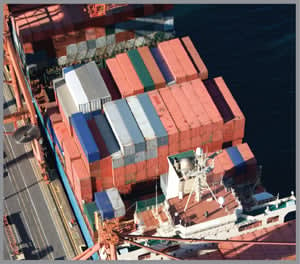
Retail container cargo is expected to total 973,872 TEU in February, a 16 percent rise over February 2009.
Retail container ports are on track to experience the first year-over-year increase in import cargo volume in more than two years in early 2010
, according to the monthly Port Tracker report released by the National Retail Federation and IHS Global Insight.
"This could be the turnaround we've been waiting to see for a long time," said Jonathan Gold, NRF vice president for supply chain and customs policy. "There's not enough data yet to establish a clear trend, but we're hopeful that this is a sign of recovery."
In September, the U.S. ports handled 1.14 million Twenty-foot Equivalent Units, down 3 percent from August and 16 percent below the year-ago month. October volume was at 1.17 million TEU, down 15 percent from last year, while November is on track for 1.09 million TEU, an 11 percent drop from last year. December should land at 1.06 million TEU, a stable number compared with last year, while January 2010 is expected to reach 1.03 million TEU, down 3 percent.
The report predicts the trend to be broken in February, when cargo is expected to total 973,872 TEU, a 16 percent rise from February 2009. March 2010 is forecast at 1.02 million, a 5 percent increase over March 2009.
For 2009, total volume is expected to reach 12.7 million TEU, 16.8 percent lower than last year and the lowest since 2003.
"The second half of 2009 has continued to see declines from 2008's levels, but not as large as we saw during the first half of this year," said Paul Bingham, IHS Global Insight economist. "These 'less bad' numbers are evidence that the industry is seeing early signs of recovery."
The Port Tracker covers Los Angeles/Long Beach, Oakland, Seattle and Tacoma on the West Coast; New York/New Jersey, Hampton Roads, Charleston and Savannah on the East Coast, and Houston on the Gulf Coast.
For more information, visit www.nrf.com/PortTracker.
More Fleet Management

Why Private Fleets Are Taking More Freight
Private fleets are putting their own trucks on demanding customers and high-cost lanes as companies seek greater control over service, costs, and capacity.
Read More →
Color Match Smarter: Tools That Restore & Perform
For fleet managers and collision repair professionals keeping heavy-duty trucks on the road, getting the color right the first time isn't just about appearance — it's about efficiency, turnaround time, and bottom-line results. Discover how today's digital color tools are transforming the repair process from guesswork to precision.
Read More →
FMCSA Pauses Biennial-Update Enforcement Amid Motus Transition
Carriers whose updates were due on or after June 1 have more time, while FMCSA works to stabilize its new registration system and warns of phishing sites impersonating its new carrier registration system, Motus.
Read More →


2026 Blueprint for Countering Smarter Supply Chain Theft
Cargo theft is no longer just the cost of doing business. It's a multi-billion-dollar criminal enterprise exploiting vulnerabilities across your fleet, drivers, and supply chain.
Read More →
How Telematics Improves Visibility, Control, and Performance in Refrigerated Fleets
Explore how telematics help refrigerated fleets improve visibility, uptime, efficiency, compliance, and cargo protection across connected cold chain operations.
Read More →
What the U.S.-Canada Trade War Means for Trucking
Escalating U.S.-Canada tariffs could disrupt cross-border freight, reduce truck volumes, raise costs, and create new uncertainty for carriers on both sides of the border.
Read More →
What Are Trucking’s Top Concerns for 2026?
The American Transportation Research Institute wants to know what's worrying trucking fleet managers, drivers, and other stakeholders in its annual Industry Issues survey.
Read More →
American Trucking Associations Looks for a New Leader
ATA President and CEO Chris Spear abruptly left his job at the association on August 21, at a pivotal time for the trucking industry.
Read More →
Public Wi-Fi Cybersecurity Risks: How Truck Drivers and Fleets Can Protect Their Data
Public Wi-Fi can expose truck drivers and fleets to credential theft, malware, and other cyber threats. Here’s how to reduce the risk on the road.
Read More →
For Nicky Cupp, Fleet Innovation Starts With Frustration
HDT Truck Fleet Innovator Nicky Cupp turns everyday pain points at Fraley & Schilling into opportunities for better technology and smarter processes.
Read More →