





Update: The Federal Register notice was published on July 6, with a comment period of 61 days, meaning comments must be received by September 6.
Proposed Rule Would Require Automatic Emergency Braking, Stability Control
DOT said its proposed rule on automatic emergency braking and stability control could prevent more than 19,000 crashes and save 155 lives every year.
June 27, 2023
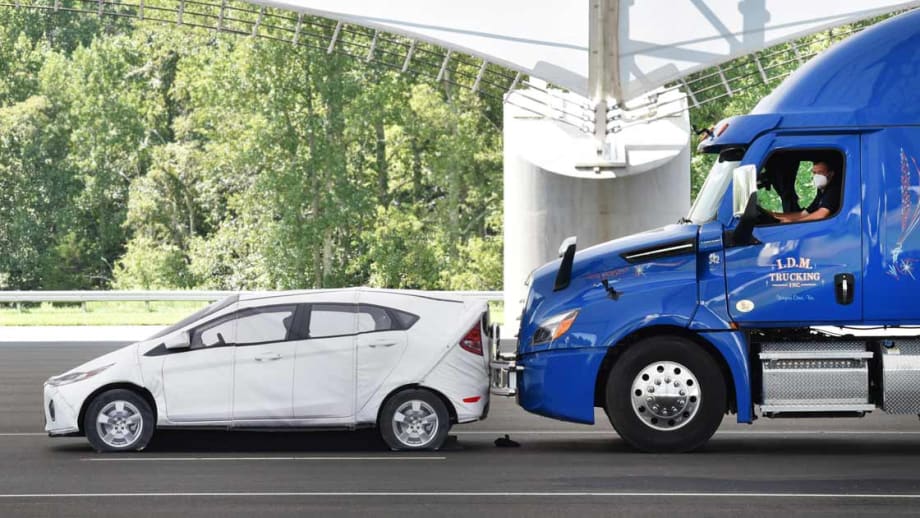
A 2020 study from the Insurance Institute for Highway Safety found that trucks equipped with forward collision warning had 22% fewer crashes and trucks with AEB had 12% fewer crashes than those without either technology.
Photo: Insurance Institute for Highway Safety
6 min to read
New commercial vehicles over 10,000 pounds would be required to have automatic emergency braking systems — as well as stability control systems — under a new proposed rule from two Department of Transportation agencies.
The National Highway Traffic Safety Administration and the Federal Motor Carrier Safety Administration on June 22 announced a Notice of Proposed Rulemaking (NPRM) that would require heavy vehicles to have automatic emergency braking (AEB) systems to mitigate the frequency and severity of rear-end crashes.
An AEB system uses multiple sensor technologies that work together to detect a vehicle in a crash-imminent situation. The system automatically applies the brakes if the driver has not done so, or, if needed, applies more braking force to supplement the driver’s braking.
The proposed rule, which fulfills a mandate under the Bipartisan Infrastructure Law, defines “heavy vehicles” as those having a gross vehicle weight greater than 10,000 pounds.
According to NHTSA statistics, there are approximately 60,000 rear-end crashes a year in which the heavy vehicle is the striking vehicle. Once implemented, NHTSA estimates the proposed rule will prevent 19,118 crashes, save 155 lives, and prevent 8,814 injuries annually.
NHTSA earlier proposed a similar rule that would require AEB systems in passenger vehicles and light trucks.
The 254-page proposal also would amend FMVSS No. 136, “Electronic stability control systems for heavy vehicles,” to require nearly all heavy vehicles to have an electronic stability control system that meets the requirements of FMVSS No. 136.
The proposal would apply only to newly manufactured vehicles. It would not require a retrofit of existing vehicles.
What the AEB Proposal Would Require
The proposal would create a new Federal Motor Vehicle Safety Standard.
It would require the technology to work at speeds ranging between 6-mph and roughly 50-mph situations.
The proposed rule would have a two-tiered phase-in schedule:
Vehicles currently subject to FMVSS No. 136, “Electronic stability control systems for heavy vehicles,” which affects vehicles with a gross vehicle weight rating over 26,000 pounds, would have to be manufactured with AEB beginning the first September three years after the final rule is published.
Vehicles not subject to ESC rules (10,001-26,000 pounds) would have an additional year.
The rule also would change Federal Motor Carrier Safety Regulations to require the electronic stability control and AEB systems to be on during vehicle operation. And it would require the ESC and AEB systems to be inspected and maintained in accordance with federal safety regulations part 396.3.
The DOT said this is a key component of the department's National Roadway Safety Strategy (NRSS), a roadmap released in January 2022 to address the national crisis in motor vehicle fatalities and serious injuries.
Public comments on the proposed rule will be accepted for 60 days.
Reactions to the AEB Proposal
The American Trucking Associations welcomed the announcement.
“ATA has long supported the use of AEB on all new vehicles,” said ATA Vice President of Safety Policy Dan Horvath in a statement. “With NHTSA’s recent regulation requiring AEB on all new passenger vehicles, this proposal for heavy-duty trucks is timely and appropriate.
“The trucking industry supports the use of proven safety technology like automatic emergency braking,” Horvath said. “We look forward to reviewing this proposal from NHTSA and FMCSA and working with them as it is implemented.”
In 2015, ATA urged car and truck manufacturers to make AEB standard equipment on new vehicles, and in 2021, the association supported legislation that would have mandated AEB technology on new Class 7 and 8 trucks.
However, the Owner-Operator Independent Drivers Association doesn't agree that this is "proven technology" and has long contended that the technology be perfected before any sort of mandate is issued.
“As we review the proposal, NHTSA and FMCSA must resolve any performance issues before any mandate is implemented,” said Jay Grimes, OOIDA’s director of federal affairs, according to OOIDA's Land Line.
“For example, NHTSA is currently investigating 250,000 heavy-duty trucks equipped with AEB that may inaccurately identify objects and cause unexpected stops. Drivers will also need more assurances that AEB technology will work in all types of road and weather conditions. We do agree with the agencies’ assessment that retrofitting current vehicles should not be included as part of the proposal.”
The Truck Safety Coalition praised the proposal in a news release.
“Automatic braking rules for cars and trucks are the most important safety improvements that could be issued,” said Joan Claybrook, board president of CRASH (Citizens for Reliable and Safe Highways). “Like airbags in the 1990s, this rule will save thousands of lives and reduce or eliminate millions of horrible injuries on the highway.”
“Humans are fallible. Sometimes truck drivers are distracted or fatigued. AEB is effective even when humans make mistakes. This is a slam dunk for roadway safety," said Truck Safety Coalition Executive Director Zach Cahalan.
The National Transportation Safety Board has been calling for mandatory AEB on all vehicles for some time, putting it on its 2021-23 Most Wanted List.
Is AEB Ready?
NHTSA said it is researching drivers’ experiences with AEB and other collision mitigation technologies. In fact, much of the 254-page proposal is dedicated to the research regarding the effectiveness of these systems.
Though the presence of AEB in heavy vehicles has increased over the years, many new heavy vehicles sold in the U.S. are not equipped with AEB, according to the proposal.
Market data obtained by NHTSA indicates that although AEB is likely equipped on the majority of Class 8 vehicles and is available on nearly all Class 3 and Class 4 vehicles, few Class 5 and 6 vehicles come equipped with any type of AEB system.
In addition, though the capabilities of these AEB systems have also improved over time, there has been no set of standardized performance metrics in the U.S. that manufacturers could use as a benchmark to meet. This NPRM proposes standard performance metrics to address that.
Class 7 and 8 truck tractors have been the earliest to voluntarily adopt AEB systems. These vehicles are (with some exceptions) already subject to the electronic stability control requirement in FMVSS No. 136 and contain fewer variations in vehicle type, configuration, and operational pattern.
It was estimated that in 2013 only 8% to 10% of Class 8 trucks in the U.S. were equipped with this technology. In 2017 a FMCSA report extrapolated available information to estimate that nearly 13% of the entire on-road fleet of Class 8 trucks in the United States were equipped with an AEB system, while the industry estimated that up to 15% of Class 8 trucks were equipped with AEB.
Data from a recent study indicates that the large majority of Class 8 vehicles sold from 2018 until mid-2022 had AEB as a standard feature, and that the top 10 selling Class 8 vehicles all include standard AEB, according to the proposed rule.
More Safety & Compliance

FMCSA Pauses Biennial-Update Enforcement Amid Motus Transition
Carriers whose updates were due on or after June 1 have more time, while FMCSA works to stabilize its new registration system and warns of phishing sites impersonating its new carrier registration system, Motus.
Read More →
ZF Expands Commercial Vehicle Push in North America
ZF is expanding its North American commercial-vehicle presence with new transmission applications, electrification, trailer technology and autonomous-driving systems.
Read More →
Truck Drivers Need More Than Another Alert
Fleets have more visibility into truck health, safety events, and driver activity than ever. The next challenge is turning all that information into useful guidance for the person who has to decide what to do next.
Read More →
Tesla Wants a Self-Driving Semi. Are Cameras Enough?
Could Tesla’s camera-only autonomous driving technology work on an 80,000-pound Semi? In this commentary, HDT's Deborah Lockridge takes a look at Tesla, Cybercab, and how autonomous trucks see the road.
Read More →
What DOT’s Automated Vehicle Strategy Means for Trucking
The U.S. Department of Transportation issued a new automated-vehicle strategy that outlines plans for driverless-truck regulations, cross-state freight corridors, and federal safety standards.
Read More →
NYC Expands Speed, Pedestrian Safety Tech Across Fleet
New York City is expanding intelligent speed assistance and pedestrian-alert systems across its municipal fleet, moving the technologies from pilot programs into vehicle procurement and retrofit requirements.
Read More →
FMCSA Removes 110 Truck Driver Training Schools from Certified ELDT List
Federal regulators also are targeting more than 160 additional training providers and launching a nationwide audit of third-party CDL skills testers as part of a broader crackdown on trucking fraud.
Read More →
Beyond DOT Compliance: What Makes a Trucking Fleet Truly Safe?
A trucking fleet can follow every rule and still make unsafe decisions. The real test comes when safety conflicts with freight, productivity, or cost.
Read More →
Hours of Service Pilot Programs: FMCSA Readies for 2027 Rollout
Two pilot programs could eventually reshape hours-of-service rules, giving truck drivers options to pause their 14-hour clock or use longer split sleeper rest periods.
Read More →
New Guide Offers Pet Safety Tips for Truck Drivers
Hundreds of thousands of pets travel in truck cabs. A new safety guide from Volvo Trucks and the Center for Pet Safety offers practical advice for truck drivers who bring dogs and cats along for the ride.
Read More →