




Plus, Traton Launch Level 4 Autonomous Truck Software
Plus and the Traton Group have announced the launch of Level 4 autonomous trucking software in Europe and the U.S.

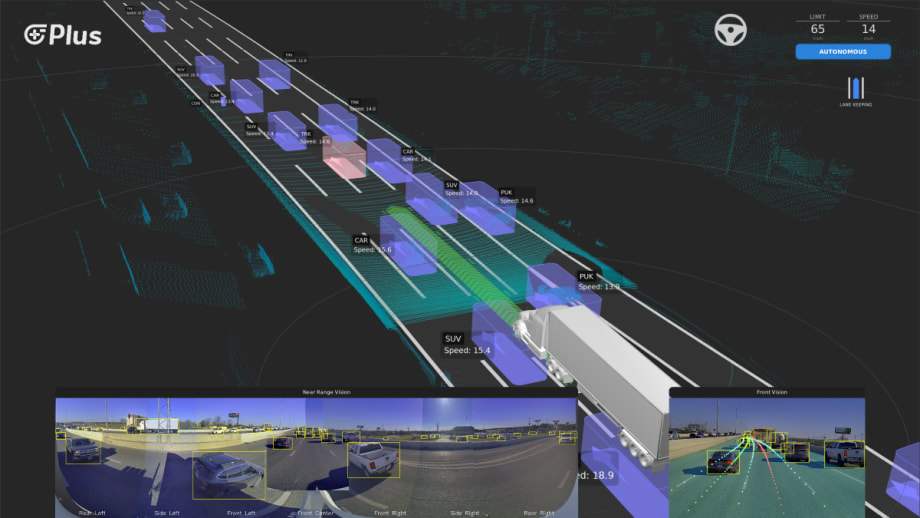
SuperDrive is now operational in Traton autonomous trucks in Europe and the U.S. after months of testing on public roads.
Photo: Plus
Plus and Traton Group have announced the release of Level 4, AI-based, autonomous driving software. Dubbed SuperDrive, the Beta 5.0 version of the system is now operational in Traton autonomous trucks in both Europe and the U.S. The companies have also mapped hub-to-hub routes for phased commercial deployment in Texas.
SuperDrive has been tested for months on public roads on both continents. Test trucks have included Traton brands Scania, Man and International.
Scania-Led Development
Plus and Traton said in a press release that the software launch marks the successful completion of their initial phase of collaboration to bring driverless trucks to the world.
“Deploying a global product requires seamless integration across people and technology,” said Peter Hafmar, vice president and head of autonomous solutions at Scania. “We’re proud of the progress we’ve made in our Level 4 autonomous trucking program with Plus, and excited to move to the next phase of our collaboration, which will include continued technology development in addition to fleet trials in Texas in the coming months.”
Scania is leading the coordination of Autonomous Solutions for the Traton Group.
According to Hafmar, the achievement highlights the commitment to excellence from the Traton Group brands and Plus, as well as the power of international collaboration.
Teams in Sweden, Germany, and the U.S. worked in close partnership to ensure seamless deployment of the autonomous driving software. This included establishing a well-defined process for software release and testing, which now features a structured cadence: offline testing, closed-course evaluations, and extensive public road testing in both Europe and the U.S.
With Texas being a strategic transportation hub in the U.S. and home to a number of major trucking routes, International and Plus plan to use it as the start of their autonomous hub-to-hub transport operations in the U.S. and expand the route to other states and eventually cover the U.S.
Safe and Scalable Autonomous Solutions
The software was meticulously developed with global deployment in mind, necessitating a high level of coordination between the European and American teams across multiple brands and locations. The approach included:
A Defined Testing Process: Implementing a regular and thorough testing regimen to ensure reliability and performance.
Feature Metrics and Autonomy Readiness: Developing a robust system to track key feature metrics and assess overall system readiness for autonomous operations.
Global Product Alignment: Aligning on a global product roadmap while architecting software that accommodates differences in sensor placement and low-level actuation for different vehicle designs.
Feature Consistency Across Platforms: Ensuring that all features perform effectively on both EU and U.S. platform variants, including compatibility across localization, perception, planning, and control layers.
“Today’s milestone exemplifies Plus’s ability to quickly deliver a safe and scalable AI-centric autonomous driving system that can already operate on two continents for the Traton Group,” said Shawn Kerrigan, COO and co-founder at Plus. “The next phase of fleet pilots will help fleets gain a practical understanding of how to integrate our autonomous trucks into their operations, and the safety and efficiency benefits these trucks bring.”
Deployment of the common autonomous driving software is made possible by Plus’s generative AI technology and months of public road testing and validation, according to the companies.
More Fleet Management

Color Match Smarter: Tools That Restore & Perform
For fleet managers and collision repair professionals keeping heavy-duty trucks on the road, getting the color right the first time isn't just about appearance — it's about efficiency, turnaround time, and bottom-line results. Discover how today's digital color tools are transforming the repair process from guesswork to precision.
Read More →
FMCSA Pauses Biennial-Update Enforcement Amid Motus Transition
Carriers whose updates were due on or after June 1 have more time, while FMCSA works to stabilize its new registration system and warns of phishing sites impersonating its new carrier registration system, Motus.
Read More →
2026 Blueprint for Countering Smarter Supply Chain Theft
Cargo theft is no longer just the cost of doing business. It's a multi-billion-dollar criminal enterprise exploiting vulnerabilities across your fleet, drivers, and supply chain.
Read More →


How Telematics Improves Visibility, Control, and Performance in Refrigerated Fleets
Explore how telematics help refrigerated fleets improve visibility, uptime, efficiency, compliance, and cargo protection across connected cold chain operations.
Read More →
What the U.S.-Canada Trade War Means for Trucking
Escalating U.S.-Canada tariffs could disrupt cross-border freight, reduce truck volumes, raise costs, and create new uncertainty for carriers on both sides of the border.
Read More →
What Are Trucking’s Top Concerns for 2026?
The American Transportation Research Institute wants to know what's worrying trucking fleet managers, drivers, and other stakeholders in its annual Industry Issues survey.
Read More →
American Trucking Associations Looks for a New Leader
ATA President and CEO Chris Spear abruptly left his job at the association on August 21, at a pivotal time for the trucking industry.
Read More →
Public Wi-Fi Cybersecurity Risks: How Truck Drivers and Fleets Can Protect Their Data
Public Wi-Fi can expose truck drivers and fleets to credential theft, malware, and other cyber threats. Here’s how to reduce the risk on the road.
Read More →
For Nicky Cupp, Fleet Innovation Starts With Frustration
HDT Truck Fleet Innovator Nicky Cupp turns everyday pain points at Fraley & Schilling into opportunities for better technology and smarter processes.
Read More →
Adam Buttgenbach’s Approach to Electric Trucks: Start With Where They Fit
HDT Truck Fleet Innovator Adam Buttgenbach helped PepsiCo build one of North America’s largest EV fleets by focusing on where electric trucks make operational sense.
Read More →