




Phillips Connect: Autonomous Trucks Need Smart Trailers
How will an autonomous truck know what's happening in the trailer behind it? “Autonomous trucks don’t work without a smart trailer," says Phillips Connect Technologies.

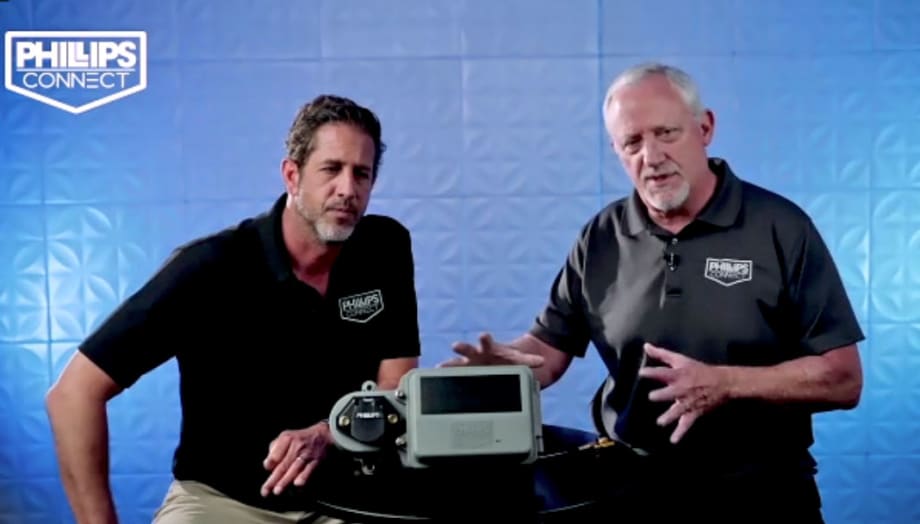
Rob Phillips, left, and Jim Epler, of Phillips Connect, discuss the future of smart trailers.
Photo: Screen shot of Media Day presentation
“Autonomous trucks don’t work without a smart trailer. If you’ve got an autonomous truck going down the highway with a fireball behind it, a load of paper towels and diapers on fire behind the tractor and there’s no driver, that’s a problem.”
That’s Rob Phillips, CEO of Phillips Connect, which is laying the groundwork now to make those smart trailers possible – and provide additional benefits for trucks with drivers.
He made the comment in a virtual media update May 18. In that session, company officials offered trucking reporters an update, covering their current product offering as well as what they’re working on for both near and far future trucks.
“One of our goals is to help the industry achieve autonomous transportation,” said Jessica Smith, vice president of customer and data insights, noting that the company has a number of sensors in research and development.
When it can, she explained, the company tries to combine sensors. For instance, later this year the company plans to launch a door sensor that locks and unlocks trailer doors – but this sensor also will handle the door closed-or-open data currently handled by a separate sensor.
One of the issues faced by both future autonomous trucks and current tractor-trailers is the issue of latency, explained Rob Phillips – how long it can take for data to make its way from the rear of the trailer into the cab. “Latency has been a challenge,” he said. “We’re working on developing special harnessing that allows you to almost eliminate that.”
In the nearer term, Phillips is working on the latency issue in conjunction with a new backup camera it’s developing – something “the industry has needed for a long time,” said Rob Phillips.
The company also is working on developing a cargo camera. Although there are cameras available, after testing many of them, the company decided it needed something that would work better with its integrated systems.
Company officials explained that the new camera will use a twisted pair that’s woven into the main trailer harness.
“It makes it easy to get alerts through the trailer gateway to the in-cab monitor so the driver’s going to get a very quick alert, bypassing cloud and cellular,” said Rob Phillips.
“In autonomous trucks, all the health data needs to be transmitted through the trailer and harnessing right into that tractor, so it knows what’s going on with the trailer,” said Jim Epler, PCT executive vice president.
Phillips Connect officials also emphasized the integration of sensors and telematics into a single telematics hub makes it easy for fleets to stay on top of their trailers now and will help the move toward smarter trailers in the future.
Earlier this year, it announced its Connect Smart7 integrated telematics hub, which manages all trailer health sensors using one device and one platform. It offers a real-time comprehensive view of the status of a trailer, such as loaded/unloaded status, tire pressure, door open/closed, wheel hub temperatures, ABS faults, lights out, and so forth, with all of the data available on a consolidated web or mobile device user interface via PCT's Connect1 platform.
During the May 18 media update, officials noted that they’re working on a version of the Smart7 that incorporates it swivel nose box, which swivels side to side to follow the tractor and features automatic disconnect feature to protect components.
More Equipment

How Volvo Updated Its D13 for EPA 2027 [Watch]
Volvo’s updated D13 promises lower emissions without sacrificing performance or fuel economy. Take a closer look at what changed inside the engine in this HDT Spotlight video.
Read More →
Michelin Tire Improves Efficiency and Durability for Regional Fleets
The Michelin X Multi Energy D2 is a regional haul drive tire engineered to help fleets improve fuel efficiency, durability and traction in demanding stop-and-go operations.
Read More →
ZF Expands Commercial Vehicle Push in North America
ZF is expanding its North American commercial-vehicle presence with new transmission applications, electrification, trailer technology and autonomous-driving systems.
Read More →
Tesla Wants a Self-Driving Semi. Are Cameras Enough?
Could Tesla’s camera-only autonomous driving technology work on an 80,000-pound Semi? In this commentary, HDT's Deborah Lockridge takes a look at Tesla, Cybercab, and how autonomous trucks see the road.
Read More →
Kodiak: Driverless Long-Haul Truck Launch on Track for 2026
Kodiak AI says its driverless long-haul safety case is 93% complete and it remains on track to begin commercial operations by year-end 2026.
Read More →
What DOT’s Automated Vehicle Strategy Means for Trucking
The U.S. Department of Transportation issued a new automated-vehicle strategy that outlines plans for driverless-truck regulations, cross-state freight corridors, and federal safety standards.
Read More →
East Coast Port Launches $45M Electric Truck Push
The Port Authority of New York and New Jersey announced millions in incentives for zero-emission drayage trucks, yard tractors, and new charging hubs near the port.
Read More →
PlusAI Going Public to Fund Autonomous Truck Launch
A SPAC deal could provide PlusAI with up to $300 million as it works toward a 2027 commercial launch of factory-built autonomous trucks.
Read More →
NHTSA Moves to Rewrite Truck Fuel-Economy Rules
The National Highway Traffic Safety Administration says it lacks authority to regulate medium- and heavy-duty truck engines separately from complete vehicles, but the existing standards have not yet been eliminated.
Read More →
Detroit Opens Orders for EPA 2027 Engines
Detroit isn’t starting from scratch to meet EPA 2027 diesel emissions standards. Its Gen 6 DD13 and DD15 engines keep much of today’s platform while updating the fuel and aftertreatment systems.
Read More →