




Penske, Daimler Truck North America and Carrier Transicold Unveil Electric Refrigerated Truck
Penske Truck Leasing, Daimler Truck North America (DTNA) and Carrier Transicold have collaborated on an all-electric refrigerated medium-duty truck.

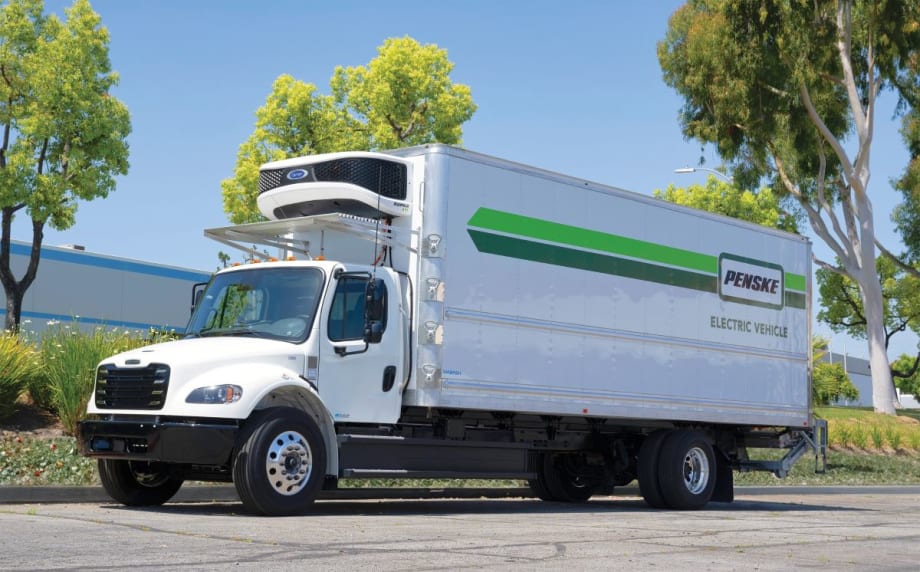
The new Class-7 Freightliner eM2 battery-electric truck with Carrier Transicold’s Supra e11 eCool electric refrigeration unit was designed for Penske Leasing fleet customers.
Photo: Carrier Transicold
At the Advanced Clean Transportation Expo (ACT Expo) in Las Vegas on May 20, Penske Truck Leasing, Daimler Truck North America (DTNA) and Carrier Transicold introduced a new, all-electric refrigerated medium-duty truck.
The companies said the new, Class 7 Freightliner eM2 was designed to help leasing customers with temperature-controlled freight realize the financial and environmental benefits that zero-emissions equipment can provide.
250-Mile Range
The vehicle, displayed by Penske at ACT Expo, combines a Class-7 Freightliner eM2 battery-electric box truck with Carrier Transicold’s Supra e11 eCool electric refrigeration unit on a 26-foot refrigerated body.
It is an ideal specification for regional and local fleets seeking regulatory compliance or cleaner, more sustainable options for distributing food and other perishable goods, according to Carrier Transicold.
“The Freightliner eM2 and Carrier Supra e11 are ideally matched to deliver the performance and efficiency our customers expect from a refrigerated vocational truck, with the advantages and peace of mind that come with full-service leasing,” said Paul Rosa, senior vice president, Procurement and Fleet Planning, Penske Truck Leasing.
Built on Freightliner’s M2 106 Plus platform, the Class-7 Freightliner eM2 features a battery-electric Detroit ePowertrain with a typical range of 250 miles on one charge.
An electric power takeoff (ePTO) allows the Supra e11 unit to use energy directly from the truck’s high-voltage battery, eliminating fuel consumption, emissions and noise associated with engine-driven systems while providing comparable refrigeration performance.
The Supra e11 includes all-electric, variable-speed components that help extend the vehicle's operating range by more precisely and efficiently matching the power draw required from the battery to the cooling required for the refrigerated cargo.
The electric fans and hermetically sealed compressor work quietly while significantly reducing maintenance needs and increasing uptime compared to diesel-driven units, according to Carrier Transicold.
“Following the successful expansion of our electric product portfolio with the Freightliner eM2 last year, it is critical to maintain this momentum and see the eM2 vehicles now begin to be operated in customer applications,” said David Carson, senior vice president, sales and mMarketing, Daimler Truck North America.
Designed for Local and Regional Fleets
Carrier Transicold introduced the Supra e11 refrigeration unit in 2023 to help fleets meet California Air Resources Board (CARB) standards for deploying trucks with zero-emission refrigeration technologies. The engineless Supra e11 unit provides comparable refrigeration performance to Carrier Transicold’s diesel-powered Supra S10 unit without the associated emissions or noise, the company said.
“This collaboration is part of our commitment to bring Carrier’s Supra eCool family of electric refrigeration units to the industry’s most popular medium-duty truck platforms,” said Alice DeBiasio, vice president and general manager, truck trailer Americas and digital solutions, Carrier. “This is an ideal vehicle for local and regional fleets that want to transition to a zero-emission medium-duty refrigerated truck, backed by the expertise and support of three industry leaders.”
More Fuel Smarts

How Volvo Updated Its D13 for EPA 2027 [Watch]
Volvo’s updated D13 promises lower emissions without sacrificing performance or fuel economy. Take a closer look at what changed inside the engine in this HDT Spotlight video.
Read More →
Diesel Price Spike Shortens Payback for Natural Gas Trucks, Report Says
Energy Vision estimates fleets could recover the higher purchase price of an RNG-fueled Class 8 tractor in 1.3 to 2.8 years under current fuel-price scenarios.
Read More →
Calstart Becomes Catalyst Mobility, Reflecting Broader Focus
Calstart is now Catalyst Mobility, reflecting the nonprofit’s growing national role in clean transportation, including zero-emission trucks, infrastructure and incentive programs.
Read More →

Record Diesel Prices Squeeze Trucking Fleets
Average U.S. diesel prices have climbed to nearly $6 a gallon, surpassing the 2022 record as tight refinery capacity and Middle East disruptions keep fuel costs elevated.
Read More →
How Fuel Delivery Shapes Engine Performance
Fuel delivery depends on more than what happens at the injector. For fleet, maintenance and technical professionals, looking at the full path from pump to injector can provide useful context for understanding engine performance.
Read More →
East Coast Port Launches $45M Electric Truck Push
The Port Authority of New York and New Jersey announced millions in incentives for zero-emission drayage trucks, yard tractors, and new charging hubs near the port.
Read More →
California Bill Could Shed Light on Electric Truck Prices
Why do battery-electric Class 8 trucks remain so expensive? A California bill headed to Gov. Gavin Newsom would give fleets and state agencies more visibility into what manufacturers charge.
Read More →
Detroit Opens Orders for EPA 2027 Engines
Detroit isn’t starting from scratch to meet EPA 2027 diesel emissions standards. Its Gen 6 DD13 and DD15 engines keep much of today’s platform while updating the fuel and aftertreatment systems.
Read More →
Zero-Emission Truck Corridor Planned for West Coast
California, Oregon, Washington, British Columbia and Baja California are coordinating plans for truck charging and hydrogen fueling from Canada to Mexico.
Read More →
A Closer Look at Kenworth’s Electric T880E Vocational Truck [Video]
Learn more about Kenworth's T880E battery-electric vocational truck at the Paccar Technical Center, including its range, applications, upfitting considerations, and PTO options, in this HDT Spotlight video.
Read More →