




Pennsylvania, California Tighten COVID-19 Restrictions
Pennsylvania and California issued stricter orders to residents and businesses to try to contain the spread of the COVID-19 coronavirus. What does that mean for trucking and other commercial transportation?

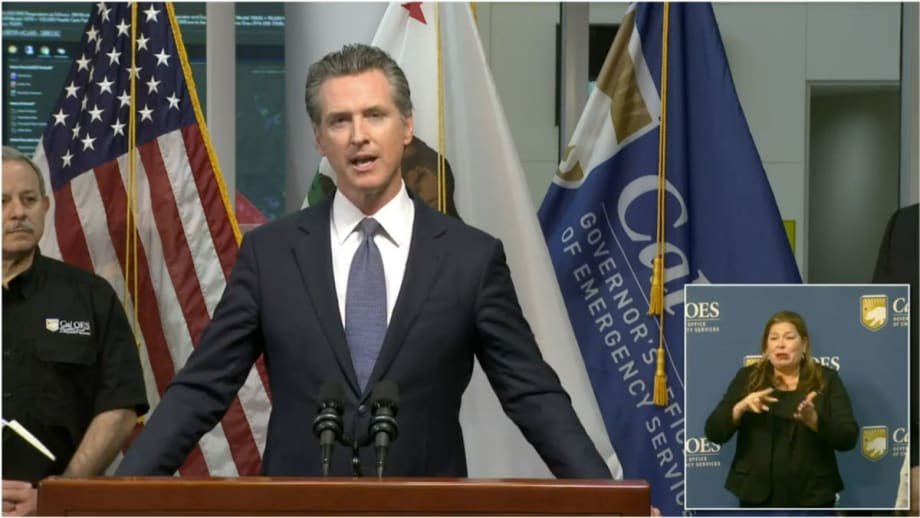
California Gov. Gavin Newsom issues a stay-at-home order March 19.
Screen shot from Facebook Live press conference
Late on March 19, Pennsylvania and California issued stricter orders to residents and businesses to try to contain the spread of the COVID-19 coronavirus.
Pennsylvania’s governor issued an order effectively requiring all non-life sustaining businesses to close their physical locations and move to a virtual/telework business model to attempt to stem the spread of the COVID-19 virus.
California’s governor issued an order to California residents to “stay at home” except as needed to maintain continuity of operations of critical businesses. In his order, Gov. Newsom specifically recognized that “the supply chain must continue.”
The transportation attorneys at Scopelitis, Garvin, Light, Hanson & Feary point out that these orders apply regardless of whether businesses are open to the public, and therefore have a substantially farther reach than currently existing state and local restrictions on restaurants, bars, and other businesses at which people typically gather.
Both states continue to permit the operation of “essential” businesses. The federal government has identified transportation and logistics services as part of the essential critical infrastructure, and no state-level order has yet sought to curtail these essential operations.
An alert from Scopelitis explains that beyond transportation of cargo, this includes employees supporting or enabling transportation functions, firms that enable transportation logistics, automotive repair and maintenance facilities, manufacturers and distributors of packaging and distribution and staging materials, and employees who repair and maintain vehicles.
The California Trucking Association issued an alert to members noting that in the governor's press conference, he indicated he is largely expecting voluntary compliance, but that enforcement actions could be taken in the future if necessary.
“CTA staff is already working to seek further guidance and clarification from the federal and state governments. In the meanwhile, please heed this section of from the Department of Homeland Security guidance: ‘Critical infrastructure industry partners will use their own judgment, informed by this list, to ensure continued operations of critical infrastructure services and functions. All decisions should appropriately balance public safety while ensuring the continued delivery of critical infrastructure services and functions.’
“It goes without saying that we are in uncharted territory. We urge our members to exercise your best judgment during these times and institute best practices to ensure our essential workforce remains healthy and that we can continue to keep the nation's supply chain moving.”
More Safety & Compliance

ZF Expands Commercial Vehicle Push in North America
ZF is expanding its North American commercial-vehicle presence with new transmission applications, electrification, trailer technology and autonomous-driving systems.
Read More →
Truck Drivers Need More Than Another Alert
Fleets have more visibility into truck health, safety events, and driver activity than ever. The next challenge is turning all that information into useful guidance for the person who has to decide what to do next.
Read More →
Tesla Wants a Self-Driving Semi. Are Cameras Enough?
Could Tesla’s camera-only autonomous driving technology work on an 80,000-pound Semi? In this commentary, HDT's Deborah Lockridge takes a look at Tesla, Cybercab, and how autonomous trucks see the road.
Read More →
What DOT’s Automated Vehicle Strategy Means for Trucking
The U.S. Department of Transportation issued a new automated-vehicle strategy that outlines plans for driverless-truck regulations, cross-state freight corridors, and federal safety standards.
Read More →
NYC Expands Speed, Pedestrian Safety Tech Across Fleet
New York City is expanding intelligent speed assistance and pedestrian-alert systems across its municipal fleet, moving the technologies from pilot programs into vehicle procurement and retrofit requirements.
Read More →
FMCSA Removes 110 Truck Driver Training Schools from Certified ELDT List
Federal regulators also are targeting more than 160 additional training providers and launching a nationwide audit of third-party CDL skills testers as part of a broader crackdown on trucking fraud.
Read More →
Beyond DOT Compliance: What Makes a Trucking Fleet Truly Safe?
A trucking fleet can follow every rule and still make unsafe decisions. The real test comes when safety conflicts with freight, productivity, or cost.
Read More →
Hours of Service Pilot Programs: FMCSA Readies for 2027 Rollout
Two pilot programs could eventually reshape hours-of-service rules, giving truck drivers options to pause their 14-hour clock or use longer split sleeper rest periods.
Read More →
New Guide Offers Pet Safety Tips for Truck Drivers
Hundreds of thousands of pets travel in truck cabs. A new safety guide from Volvo Trucks and the Center for Pet Safety offers practical advice for truck drivers who bring dogs and cats along for the ride.
Read More →
Medical Cards, English Proficiency Reshape Roadcheck Violations
Medical-card violations jumped to the top of the driver out-of-service list during CVSA’s 2026 International Roadcheck, while English-language proficiency violations appeared among the leading violations for the first time.
Read More →