




NTSB to FMCSA: Ban Hands-Free Phone Use
Truck drivers should not use hands-free phones while driving, says the National Transportation Safety Board. The Board’s recommendation was one of several changes it wants the Federal Motor Carrier Safety Administration to make in the wake of a 2013 truck-train crash that caused a derailment, hazmat fire and explosion.

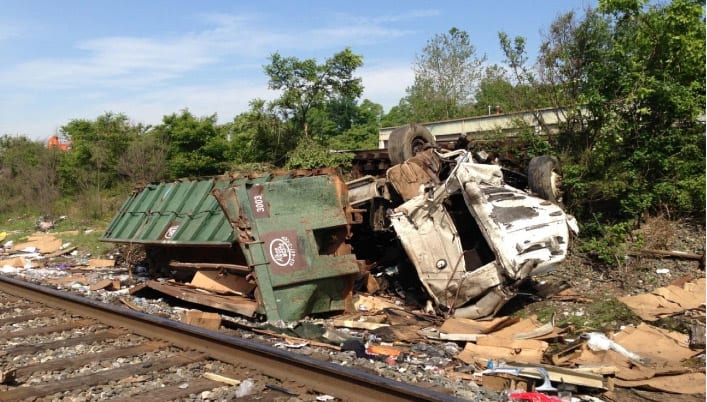
Driver of this trash truck said he didn’t hear the train’s horn, but investigators said he had just gotten a phone call and failed to stop, look and listen. Photo from the NTSB report.
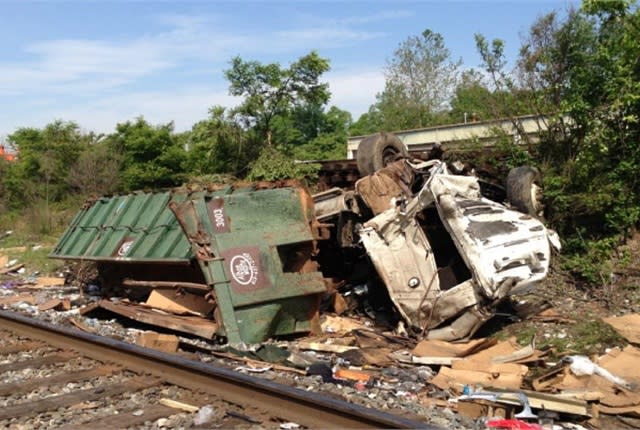
Driver of this trash truck said he didn’t hear the train’s horn, but investigators said he had just gotten a phone call and failed to stop, look and listen.Photo from the NTSB report.
Truck drivers should not use hands-free phones while driving, says the National Transportation Safety Board.
The board’s recommendation was one of several changes it wants the Federal Motor Carrier Safety Administration to make in the wake of a 2013 truck-train crash that caused a derailment, hazmat fire and explosion.
The crash occurred May 28, 2013, in Rosedale, Maryland, when a truck driver failed to make sure there was no train on the tracks he was crossing.
The driver was severely injured and several of the 15 cars that were knocked off the tracks contained hazardous material that burst into flames and exploded, damaging property as far as a half-mile away.
The Board found in its investigation that the driver, who made that crossing regularly, was in the habit of relying on the sound of a train’s horn to determine if it was coming.
The train engineer blew his horn three times as he approached the crossing but the driver said he did not hear it. Vegetation and the curve of the road made it hard for the driver to see if a train was approaching, but the board found that if he had stopped at the tracks he could have seen it coming.
One key contributing factor was that the driver was distracted by a call that came in on his hands-free phone just as he was approaching the tracks, the board said.
NTSB said the current FMCSA ban on drivers using hand-held phones does not go far enough.
“Current laws may mislead people to believe that hands-free is as safe as not using a phone at all,” said Acting Board Chairman Christopher Hart. “Our investigations have found over and over that distraction in any form can be dangerous behind the wheel.”
Several other factors contributed to the crash, the board said.
The trucking company, a new entrant called Alban Waste, had a long record of noncompliance with safety regulations – a record that should have triggered agency action.
Among other shortcomings, Alban did not maintain driver qualification files, did not have a complete drug and alcohol testing program and did not keep thorough track of driver hours.
The company and the agency went through several cycles of enforcement and corrective action, but the board found that the agency did not do enough.
“We continue to be concerned with FMCSA’s new-entrant program,” said Hart. “Problem operators keep falling through the cracks.”
The board recommended that the agency conduct a full compliance review on new entrants that fail a safety audit or a corrective action plan, or are issued an expedited action letter.
Another problem was that the driver had severe, untreated sleep apnea that likely affected his alertness, the board said. The driver did not disclose this on his medical exam forms, and his physician reportedly certified him to drive even though he knew about the sleep disorder.
The board recommended that the agency develop a way to tell medical examiners about violations FMCSA investigators have found that could result in medical disqualification.
The board also said that private rail crossings need more oversight.
“Efforts to improve safety at private grade crossings have been inadequate,” Hart said. “We need states, railroads, and land-owners to address problems before serious collisions occur.”
The full report is available here.
More Drivers

From One Generation to the Next: How Mentorship Builds Safer Truck Drivers
After three decades in trucking, Harold Perry shares what he's learned about driver safety, mentorship, and helping the next generation build confidence behind the wheel.
Read More →
Truck Drivers Need More Than Another Alert
Fleets have more visibility into truck health, safety events, and driver activity than ever. The next challenge is turning all that information into useful guidance for the person who has to decide what to do next.
Read More →
FMCSA Removes 110 Truck Driver Training Schools from Certified ELDT List
Federal regulators also are targeting more than 160 additional training providers and launching a nationwide audit of third-party CDL skills testers as part of a broader crackdown on trucking fraud.
Read More →
Hours of Service Pilot Programs: FMCSA Readies for 2027 Rollout
Two pilot programs could eventually reshape hours-of-service rules, giving truck drivers options to pause their 14-hour clock or use longer split sleeper rest periods.
Read More →
Medical Cards, English Proficiency Reshape Roadcheck Violations
Medical-card violations jumped to the top of the driver out-of-service list during CVSA’s 2026 International Roadcheck, while English-language proficiency violations appeared among the leading violations for the first time.
Read More →
Driver Trust Can Make or Break the Success of Fleet Safety Technology
New Teletrac Navman research suggests that onboarding, transparency about driver data, and positive feedback can play a significant role in how commercial drivers respond to safety and coaching technology.
Read More →
EEOC Sues KLLM Over Alleged Sex Discrimination in Driver Training
KLLM is facing a federal sex-discrimination lawsuit over policies the EEOC alleges put female truck driver trainees at a disadvantage.
Read More →
FMCSA Moves to Codify English Language Requirements for Commercial Drivers
By changing regulations on English-language proficiency requirements for commercial drivers, rather than relying on a guidance memo, the FMCSA said future administrations won't be able to walk back the Trump administration's stricter enforcement with just a memo.
Read More →
Drivers Put Western Star Trucks to the Test at Star Nation Experience
Watch to get an inside look at the Western Star trucks, technology, and community behind the Star Nation Experience 2026!
Read More →
Trump Administration Looks to Put More Veterans Behind the Wheel
The Freedom Haulers program pulls together existing and expanded programs at several federal agencies to recruit veterans to drive commercial heavy-duty trucks and cut the red tape for them to get a CDL, training, and employment.
Read More →