





You also might like: Allison Brings Real-World Testing into the Lab
New Transmission Fluid Spec for Allison Improves Performance, Protection
Allison Transmission has a new lubricant spec for its automatic transmissions, and Petro-Canada Lubricants is the first oil company to meet it. The new DuraDrive HD Synthetic 668 will be the factory fill in Allison automatic transmissions starting Jan. 1, 2021.
September 29, 2020
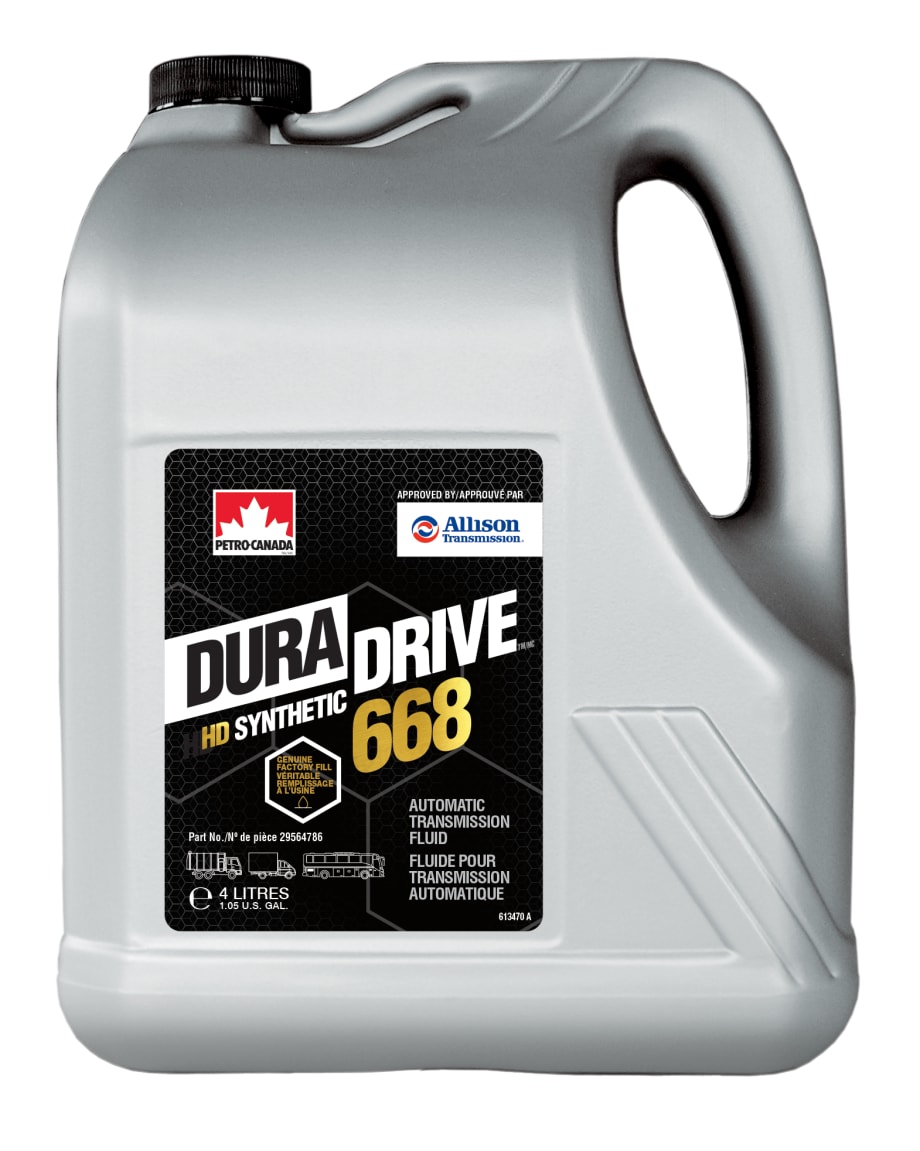
Petro-Canada officials said the DuraDrive HD Synthetic 668 for Allison transmissions helps customers maximize uptime and improve performance.
Photo: Petro-Canada
3 min to read
Allison Transmission has a new lubricant spec for its automatic transmissions, and Petro-Canada Lubricants is the first oil company to meet it. The new DuraDrive HD Synthetic 668 will be the factory fill in Allison automatic transmissions starting Jan. 1, 2021.
Allison’s new TES 668 is a modern formulation with many advantages compared to mineral-based, non-synthetic fluids, according to the transmission maker. This next generation transmission fluid is specified for all Allison 1000 Series, 2000 Series, 3000 Series, and 4000 Series automatic transmissions.
TES 668 builds on the previous TES 295 transmission fluid spec in a number of key areas, such as oxidative stability, anti-wear performance and friction modifier durability, according to Allison. These factors improve the quality of the shifts and reduce the noise, vibration and harshness experienced as the fluid ages. Better friction performance provides more consistent clutch application—even across temperature variations and load sizes.
The new spec allows Allison to back long drain intervals, even when operating under heavy loads. For Allison there are two drain intervals – a standard drain interval linked to Allison-approved TES 389 fluids, and extended drain interval linked to Allison-approved TES 295 fluids. DuraDrive HD Synthetic 668 will have the same extended drain recommendation as TES 295 fluids.
The new oil is specified for on-highway vehicles, including vocational applications, and is fully backwards compatible for every Allison transmission that requires an Allison-approved TES 295 fluid.
Benefits include:
Smoother performance: Anti-shudder and torque control mean it’s easier to drive, with smoother acceleration and faster point-to-point acceleration, even under demanding conditions.
Maximum durability: Excellent oxidation control helps shield components from damage caused by sludge, varnish, and corrosion, for improved fluid life and transmission component life.
Enhanced protection: Improved wear protection means longer transmission life.
Petro-Canada officials touted the extensive testing the oil went through. It involved thousands of hours of severe testing in an Allison transmission done at conditions beyond standard operating parameters. DuraDrive HD Synthetic 668 has been fully tested in frigid North American winter conditions and in the heat of the desert to ensure its ability to handle temperature extremes.
For instance, the ABOT (aluminum beaker oxidation test) showed the oil offers 14 times better oxidation control than the requirements, as well as excellent oil thickening control. In anti-shudder durability testing, it performed twice as well as the requirements. Optimal wear protection improvement was confirmed with the FZG ASTM D5182 test.
The 99.9% pure synthetic base oil provides exceptional volatility control, according to the company.
"There are two important factors when formulating a fluid – volatility control and oxidation control," Sonia Hevia, product specialist – transmissions at Petro-Canada Lubricants, told HDT. "The right combination of base oil and additive technology brings you to the level of oxidation control that we see with DuraDrive HD Synthetic 668."
Petro-Canada officials said the new oil gives customers an immediate opportunity to maximize their uptime and reduce maintenance downtime and costs, upgrade their performance, and extend their asset life.
Allison Transmission is in the process of providing additional approvals for multiple oil marketers.
More Maintenance

Sponsored•September 16, 2026
Color Match Smarter: Tools That Restore & Perform
For fleet managers and collision repair professionals keeping heavy-duty trucks on the road, getting the color right the first time isn't just about appearance — it's about efficiency, turnaround time, and bottom-line results. Discover how today's digital color tools are transforming the repair process from guesswork to precision.
Read More →
Wrong Repair Prompts Recall of Freightliner, Western Star 4x2 Trucks
DTNA is recalling more than 2,400 trucks that received an incompatible software fix instead of the hardware repair required to address brake valve corrosion.
Read More →
Truck Drivers Need More Than Another Alert
Fleets have more visibility into truck health, safety events, and driver activity than ever. The next challenge is turning all that information into useful guidance for the person who has to decide what to do next.
Read More →
The Maintenance Checks Trucking Fleets Should Prioritize Before Fall Freight Picks Up
Making it through August isn’t the same as being ready for the next several months of operation. Find out what systems may have suffered from summer heat and need to be checked out before fall.
Read More →
What Three Fleets Are Doing Differently When Buying Truck Parts in 2026
With freight improving but costs still climbing, fleet maintenance executives explain how they're balancing price, quality, and supplier relationships.
Read More →
Paccar Recalls 2027 Trucks Built This Summer for Possible Electrical Problem
The nearly 6,000 Kenworth and Peterbilt trucks in the recall could potentially lose engine power, among other things.
Read More →
Will API PC-12 Oil Change Trucking Fleet Maintenance?
The new API PC-12 heavy-duty engine oil category reflects the changing demands of modern diesel engines. But fleets like Foodliner are looking to getting their own data before making decisions on adopting the new oils and questions such as extending oil drain intervals.
Read More →
Brake Safety Week to Focus on Drums and Rotors
Commercial vehicle inspectors are focusing on truck brakes during CVSA's Brake Safety Week, August 23-29.
Read More →Possible Battery-Cable Fires Prompt Recall of 15,000+ International MV and HV Trucks
On the recalled vehicles, manufacturing variations can cause the battery interconnect cable to contact the auxiliary stud and hold down the bracket.
Read More →
Rush, MCT Team Up to Grow Refrigeration Service Network
The joint venture will operate MCT's network of Carrier Transicold dealerships and mobile service locations, with the companies promising greater service capacity and uptime for refrigerated fleets.
Read More →