




New Study to Examine EV Charging Stations Along I-5 Corridor
The West Coast Clean Transit Corridor Initiative is designed to determine how best to ensure that Interstate 5 is equipped with sufficient charging to support electric long-haul trucks.

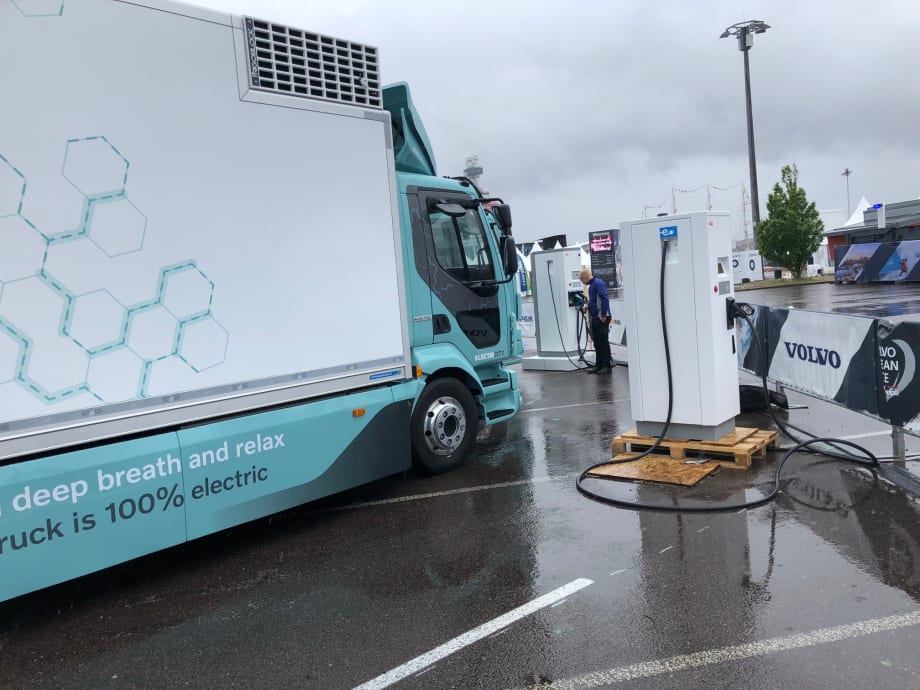
A new study will explore how best to provide EV charging on I-5 and its connecting routes for medium- and heavy-duty electric trucks, as well as to help determine what role electricity providers can play in electrifying the corridor.
Photo: Jack Roberts
With electric car ownership reaching levels not seen in over a century, and electric trucks clearly on the horizon electric utilities and municipalities on the West Coast are exploring ways to provide electric vehicle (EV) charging stations along the region’s busy Interstate 5 corridor and major roads feeding into it.
Nine electric utilities and two agencies representing more than two dozen municipal utilities are sponsoring the West Coast Clean Transit Corridor Initiative, a study to determine how best to ensure that Interstate 5 — a lifeline of goods transportation that extends more than 1,300 miles from the Canadian to the Mexican border — is equipped with sufficient charging to support electric long-haul trucks.
These utilities and municipalities say creating infrastructure for electric trucks along the corridor will improve air quality and health in the communities they serve.
In California, for example, the transportation sector accounts for nearly 80% of the state’s air pollution and more than 40% of all greenhouse gas emissions. Washington and Oregon face similar environmental challenges, transportation being the largest contributor to air pollution and greenhouse gas emissions in those states as well.
The study will explore how best to provide EV charging on I-5 and its connecting routes for medium- and heavy-duty electric trucks that are being introduced by several major vehicle manufacturers, as well as to help determine what role electricity providers can play in electrifying the corridor. Key locations for electric truck charging infrastructure will also be identified and prioritized.
Other initiative sponsors include the Los Angeles Department of Water & Power, Northern California Power Agency, Pacific Gas and Electric Company, Pacific Power, Portland General Electric, Puget Sound Energy, Sacramento Municipal Utility District, San Diego Gas & Electric and Southern California Public Power Authority.
“Many of the utilities represented in this partnership have programs to support charging electric vehicles that travel within our own territories, but for extended shipping and long-haul trucks, we need solutions that we can apply across utility territories,” said Caroline Choi, senior vice president of Corporate Affairs for Edison International and Southern California Edison, one of the utilities sponsoring the study.
“Well-planned electric charging infrastructure along I-5 is important to our region,” said Scott Bolton, senior vice president of External Affairs for Pacific Power. “The I-5 corridor is the economic backbone for transporting essential goods and services to our Oregon, Washington and California customers. We see investments in transportation electrification and electric charging infrastructure as a great way to support the economic vitality and environmental quality of communities along the corridor.”
“It’s these types of opportunities that continue to push us toward a more sustainable future,” said Bill Boyce manager of Electric Transportation for the Sacramento Municipal Utility District. “We are proud to partner on a local, regional and national level to reduce emissions from vehicles, and this effort to electrify our trade corridors will have significant benefits to the communities we serve.”
Those benefits include improved health, according to a release detailing the planned study, which referenced data showing that people who live near truck-traffic corridors experience higher rates of asthma, lung and heart disease and chronic bronchitis due largely to breathing toxic vehicle emissions, specifically diesel particulate matter.
“We are coming together on a regional level and taking the lead, working across state, county and city lines to take a significant step to address air pollution and climate change,” said Dave Robertson, vice president of Public Policy at Portland General Electric. “By ensuring customers involved in electric truck technology can expect a consistent and reliable experience up and down I-5 and its connected major arteries, we can accelerate a future where all-electric big rigs haul freight without polluting our communities.”
The study is expected to be concluded by year’s end, with implementation of recommendations expected as soon as next year.
More Fuel Smarts

How Volvo Updated Its D13 for EPA 2027 [Watch]
Volvo’s updated D13 promises lower emissions without sacrificing performance or fuel economy. Take a closer look at what changed inside the engine in this HDT Spotlight video.
Read More →
Diesel Price Spike Shortens Payback for Natural Gas Trucks, Report Says
Energy Vision estimates fleets could recover the higher purchase price of an RNG-fueled Class 8 tractor in 1.3 to 2.8 years under current fuel-price scenarios.
Read More →
Calstart Becomes Catalyst Mobility, Reflecting Broader Focus
Calstart is now Catalyst Mobility, reflecting the nonprofit’s growing national role in clean transportation, including zero-emission trucks, infrastructure and incentive programs.
Read More →

Record Diesel Prices Squeeze Trucking Fleets
Average U.S. diesel prices have climbed to nearly $6 a gallon, surpassing the 2022 record as tight refinery capacity and Middle East disruptions keep fuel costs elevated.
Read More →
How Fuel Delivery Shapes Engine Performance
Fuel delivery depends on more than what happens at the injector. For fleet, maintenance and technical professionals, looking at the full path from pump to injector can provide useful context for understanding engine performance.
Read More →
East Coast Port Launches $45M Electric Truck Push
The Port Authority of New York and New Jersey announced millions in incentives for zero-emission drayage trucks, yard tractors, and new charging hubs near the port.
Read More →
California Bill Could Shed Light on Electric Truck Prices
Why do battery-electric Class 8 trucks remain so expensive? A California bill headed to Gov. Gavin Newsom would give fleets and state agencies more visibility into what manufacturers charge.
Read More →
Detroit Opens Orders for EPA 2027 Engines
Detroit isn’t starting from scratch to meet EPA 2027 diesel emissions standards. Its Gen 6 DD13 and DD15 engines keep much of today’s platform while updating the fuel and aftertreatment systems.
Read More →
Zero-Emission Truck Corridor Planned for West Coast
California, Oregon, Washington, British Columbia and Baja California are coordinating plans for truck charging and hydrogen fueling from Canada to Mexico.
Read More →
A Closer Look at Kenworth’s Electric T880E Vocational Truck [Video]
Learn more about Kenworth's T880E battery-electric vocational truck at the Paccar Technical Center, including its range, applications, upfitting considerations, and PTO options, in this HDT Spotlight video.
Read More →