




Mercedes-Benz Truck Sets Fuel Mileage Record
A latest-generation Mercedes-Benz Actros cabover tractor and dry van combination recorded 12.10 mpg in a record-setting, seven-day, 7,900-mile run just completed at the Nardo motor-race circuit in southern Italy.
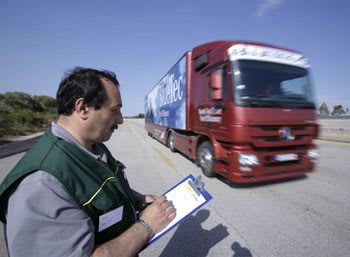
A latest-generation Mercedes-Benz Actros cabover tractor and dry van combination recorded 12.10 mpg in a record-setting, seven-day, 7,900-mile run just completed at the Nardo motor-race circuit in southern Italy.
According to Daimler Trucks in Europe, the run was observed by the Guinness World Records organization and it will appear as a world record in the "most fuel efficient 40-ton truck" category.
Loaded with a 25-tonne (55,000-pound) payload, this gives the 88,000-pound-GCW combination an economy payload factor of 0.000001503 gallonss per pound of freight hauled per mile. In European terms this is expressed as liters/tonne.km, with the Actros scoring 0.78 l/tkm.
According to Daimler, state-of-the-art Mercedes-Benz technology underpins the record-breaking results. The conventional commercial vehicle diesel engine featured the new BlueTec selective catalytic reduction emissions technology that has demonstrated 2 percent to 5 percent lower fuel consumption. An enhanced drive system promises additional potential savings with the standard Mercedes PowerShift automated transmission, computer-controlled air compressor and a governed coolant pump.
The fuel consumption test for the new Mercedes-Benz Actros, which was run under ideal conditions, was meant to show what state-of-the-art vehicle technology can achieve. At the same time, measurements using a comparable truck were taken to show the various factors responsible for the difference in fuel consumption in the test and fuel used in everyday traffic on European highways.
The fuel consumption comparison demonstrated the effects of inadequate traffic infrastructure and a lack of traffic management, incorrect vehicle configuration, inadequate vehicle maintenance and actual driving style.
The measurements in Nardo confirmed the figures from the German Association of the Automotive Industry, according to which the instantaneous fuel consumption of a 40-tonne trailer/tractor combination can triple if the vehicle is forced to stop twice every kilometer, instead of travelling unimpeded at 50 km/h (31 mph). Daimler says that truck drivers are faced with traffic jams on a daily basis, whether as a result of road capacity bottlenecks or due to accidents. The development of state-of-the-art traffic management systems could make a significant contribution in this respect.
Failure to order additional aerodynamic equipment when purchasing the vehicle can see fuel consumption increase by 10 percent, says Daimler Trucks. Correctly adjusting the wind deflectors on the cab can improve fuel consumption by up to 4 percent. The aerodynamic A-pillar paneling for the new Mercedes-Benz Actros can reduce fuel consumption by 1 percent.
Mercedes-Benz offers wide single tires, which show potential fuel savings of up to 2 percent in tests. Insufficient tire pressure can, however, increase fuel consumption by up to 8 percent.
Anticipatory driving offers potential savings between 10 to 12 percent. The test drives with the Mercedes-Benz Actros have shown that under optimum conditions, the vehicle technology accounts for just about 60 percent of the fuel consumed by a 40-tonne trailer/trailer combination. Traffic conditions, topography, vehicle configuration and maintenance make up the various factors in the remaining 40 percent or so. Traffic planners, dispatchers, fleet decision-makers and drivers can influence many of these parameters.
More Equipment

Kodiak Targets Dallas–Houston for Driverless Trucks
The company says its autonomous trucks are completing the I-45 run without a safety observer taking control. It plans to remove the observer by the end of 2026.
Read More →
Kodiak Hauls Produce in California Autonomous Truck Pilot
Kodiak AI and DTL Transport have begun hauling produce between Fresno and Los Angeles under California’s new rules for testing heavy-duty autonomous trucks. A safety driver remains behind the wheel.
Read More →
Used-Truck Remarketing Math Is Changing
Used-truck value is no longer just a concern at trade-in. Decisions made throughout a truck’s first life can influence what it’s worth years later.
Read More →
How Volvo Updated Its D13 for EPA 2027 [Watch]
Volvo’s updated D13 promises lower emissions without sacrificing performance or fuel economy. Take a closer look at what changed inside the engine in this HDT Spotlight video.
Read More →
Michelin Tire Improves Efficiency and Durability for Regional Fleets
The Michelin X Multi Energy D2 is a regional haul drive tire engineered to help fleets improve fuel efficiency, durability and traction in demanding stop-and-go operations.
Read More →
ZF Expands Commercial Vehicle Push in North America
ZF is expanding its North American commercial-vehicle presence with new transmission applications, electrification, trailer technology and autonomous-driving systems.
Read More →
Tesla Wants a Self-Driving Semi. Are Cameras Enough?
Could Tesla’s camera-only autonomous driving technology work on an 80,000-pound Semi? In this commentary, HDT's Deborah Lockridge takes a look at Tesla, Cybercab, and how autonomous trucks see the road.
Read More →Kodiak: Driverless Long-Haul Truck Launch on Track for 2026
Kodiak AI says its driverless long-haul safety case is 93% complete and it remains on track to begin commercial operations by year-end 2026.
Read More →
What DOT’s Automated Vehicle Strategy Means for Trucking
The U.S. Department of Transportation issued a new automated-vehicle strategy that outlines plans for driverless-truck regulations, cross-state freight corridors, and federal safety standards.
Read More →
East Coast Port Launches $45M Electric Truck Push
The Port Authority of New York and New Jersey announced millions in incentives for zero-emission drayage trucks, yard tractors, and new charging hubs near the port.
Read More →