





UPDATE:More details from CES
Autonomous Aurora Driver Production to Begin in 2027
Continental will begin serial production of the Aurora Driver autonomous truck control system hardware beginning in 2027.
January 5, 2024
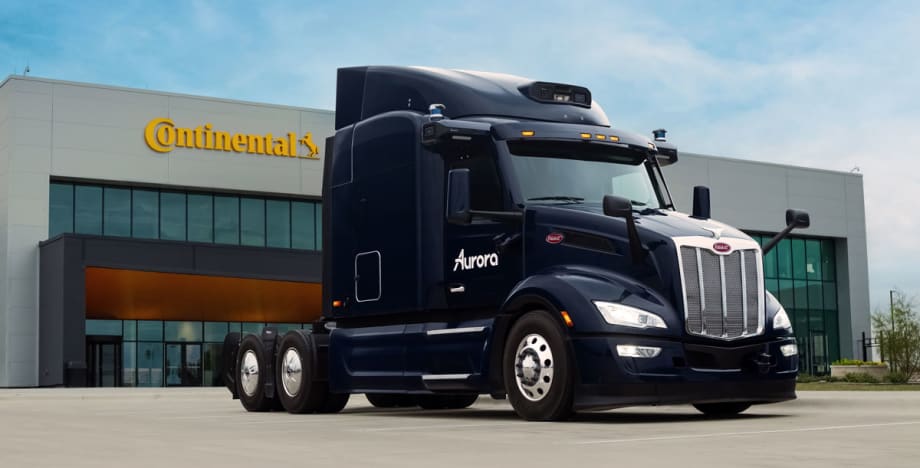
Aurora is working with Continental’s engineering team to provide an updated industrialized fallback system for its Aurora Driver autonomous truck technology.
Photo: Aurora
5 min to read
Having the expertise to develop cutting-edge autonomous truck technology and associated hardware is one thing. Having the manufacturing expertise to produce those systems at the scale needed for high-volume production and cost mitigation is something else entirely.
Which is why autonomous technology developer Aurora said its new partnership with Continental will enable it to bring its Aurora Driver autonomous truck technology to market at scale.
According to Chris Urmson, co-founder and CEO at Aurora, the autonomous technology developer has finalized the architecture, specs, and requirements of the Aurora Driver hardware. Continental will develop and manufacture that hardware “in the thousands” beginning in 2027.
An Industry-First Autonomous-Tech Partnership
Bringing new automotive-grade hardware to the market is complex, Aurora executives noted in a press release. It can often take years from the initial design work on new technology and products to reaching the end customer. Recognizing this early on, Aurora said it sought out a long-term partnership with a tier-one supplier with expertise in making reliable and serviceable hardware.
That partner is Continental, which has been working on advanced transportation technologies beyond tires for several years.
In April 2023, Aurora announced what it called an “industry-first partnership” with Continental to take its autonomous truck technology from the design phase to serial production.
Under the terms of the partnership, Continental will take Aurora’s autonomous hardware design, build it and then validate it. These efforts, in turn, will cause economies of scale to come into play, taking costs out of the hardware and sending serial production Aurora Driver hardware to the company’s OEM truck partners (Volvo and Paccar) for integration in 2027.
A $300 Million Investment and 1 Million Miles
At CES 2024 in Las Vegas, on Tuesday, Jan. 9, Aurora will officially announce that it has achieved a key milestone in this technology development process.
The company has finalized the architecture, specs, and requirements of the Aurora Driver hardware that Continental will develop and manufacture in 2027. According to an Aurora spokesperson, its work with Continental creates the foundation for how it will “deploy thousands of autonomous trucks and become a profitable company in the years to come.”
However, the company said, these developments and plans will not alter Aurora’s plans for an initial driverless launch of its autonomous truck technology at the end of 2024.
Continental has invested $300 million in its autonomous technology to date. The partnership with Continental now gives Aurora a path to deploy autonomous trucks at scale after its initial driverless launch. With Continental's automotive development and manufacturing expertise, the future Aurora Driver will be designed to deliver customer value for 1 million miles, according to the company.
“From day one, we knew we’d need to build a strong ecosystem of partners to bring this technology to market safely and at a commercial scale,” said Urmson. “Finalizing the design of our future hardware is a meaningful step toward making the unit economics of the Aurora Driver compelling and building a business for the long-term.”
A Joint Focus on Safety
Aurora said it is also working with Continental’s engineering team to provide an updated industrialized fallback system.
To operate safely without a human driver, autonomous vehicles require built-in redundancies that provide backups in the rare case a component or sensor fails. One of these redundancies is the fallback system — a specialized secondary computer that can take over operation if a failure occurs in the primary system. This dual engineering approach is intended to reduce the exposure of the main and fallback system to single points of failure. That system is expected to go into production in 2027 as part of the agreement with Continental.
“Technologies for autonomous mobility present the biggest opportunity to transform driving behavior since the creation of the automobile,” said Philipp von Hirschheydt, executive board member for the Automotive Group sector at Continental. “Achieving this milestone puts us on a credible path to deploy easy-to-service autonomous trucking systems that customers demand.”
The Path to Production in 2027
Continental and Aurora are also sharing their four-year partnership roadmap to commercialize thousands of autonomous trucks:
2023 – Blueprint and Design: Aurora and Continental align on the detailed system architecture, key requirements, and detailed technical specifications of the Aurora Driver hardware and new high-performance fallback system. This phase is complete.
2024-2025 – Build and Test: With the system architecture in hand, Continental will build initial versions of the hardware for testing at its new facility in New Braunfels, Texas, and across its global manufacturing footprint.
2026-2027 – Finalization, Start of Production, and Integration: Continental will industrialize and validate the future Aurora Driver hardware and fallback system before the Start of Production at its facilities. The hardware will leverage a wide spectrum of Continental’s extensive automotive product portfolio from sensors, automated driving control units, high-performance computers, telematics units, and more. The hardware and fallback system will be shipped to Aurora’s trucking manufacturing partners for integration into autonomous-ready vehicles. During this phase, the companies will also develop a service playbook and maintenance network for Aurora’s customers.
2027 and beyond – Deployment at Scale: Thousands of trucks integrated with the Aurora Driver are ready to autonomously haul freight across the U.S.
“Entering an exclusive partnership with Aurora was a very good decision as it is an ideal match,” von Hirschheydt added. “Being the industry’s only tier-one supplier with a commitment to industrialize autonomous hardware at scale allows us to be at the forefront of and capitalize on this groundbreaking technology.”
Continental will showcase its latest technologies, including its work with Aurora, at a structure exhibit in Central Plaza across from the Las Vegas Convention Center from Tuesday, January 9 through Friday, January 12 during CES 2024.
More Equipment

How Volvo Updated Its D13 for EPA 2027 [Watch]
Volvo’s updated D13 promises lower emissions without sacrificing performance or fuel economy. Take a closer look at what changed inside the engine in this HDT Spotlight video.
Read More →
Michelin Tire Improves Efficiency and Durability for Regional Fleets
The Michelin X Multi Energy D2 is a regional haul drive tire engineered to help fleets improve fuel efficiency, durability and traction in demanding stop-and-go operations.
Read More →
ZF Expands Commercial Vehicle Push in North America
ZF is expanding its North American commercial-vehicle presence with new transmission applications, electrification, trailer technology and autonomous-driving systems.
Read More →
Tesla Wants a Self-Driving Semi. Are Cameras Enough?
Could Tesla’s camera-only autonomous driving technology work on an 80,000-pound Semi? In this commentary, HDT's Deborah Lockridge takes a look at Tesla, Cybercab, and how autonomous trucks see the road.
Read More →
Kodiak: Driverless Long-Haul Truck Launch on Track for 2026
Kodiak AI says its driverless long-haul safety case is 93% complete and it remains on track to begin commercial operations by year-end 2026.
Read More →
What DOT’s Automated Vehicle Strategy Means for Trucking
The U.S. Department of Transportation issued a new automated-vehicle strategy that outlines plans for driverless-truck regulations, cross-state freight corridors, and federal safety standards.
Read More →
East Coast Port Launches $45M Electric Truck Push
The Port Authority of New York and New Jersey announced millions in incentives for zero-emission drayage trucks, yard tractors, and new charging hubs near the port.
Read More →
PlusAI Going Public to Fund Autonomous Truck Launch
A SPAC deal could provide PlusAI with up to $300 million as it works toward a 2027 commercial launch of factory-built autonomous trucks.
Read More →
NHTSA Moves to Rewrite Truck Fuel-Economy Rules
The National Highway Traffic Safety Administration says it lacks authority to regulate medium- and heavy-duty truck engines separately from complete vehicles, but the existing standards have not yet been eliminated.
Read More →
Detroit Opens Orders for EPA 2027 Engines
Detroit isn’t starting from scratch to meet EPA 2027 diesel emissions standards. Its Gen 6 DD13 and DD15 engines keep much of today’s platform while updating the fuel and aftertreatment systems.
Read More →