




Continental Safety Technologies Help Build Road to Autonomous Vehicles
Continental recently showed off systems that will help truck makers meet safety needs down the road, whether pushed by regulations or customer demand, as well as pave the way toward autonomous vehicles.

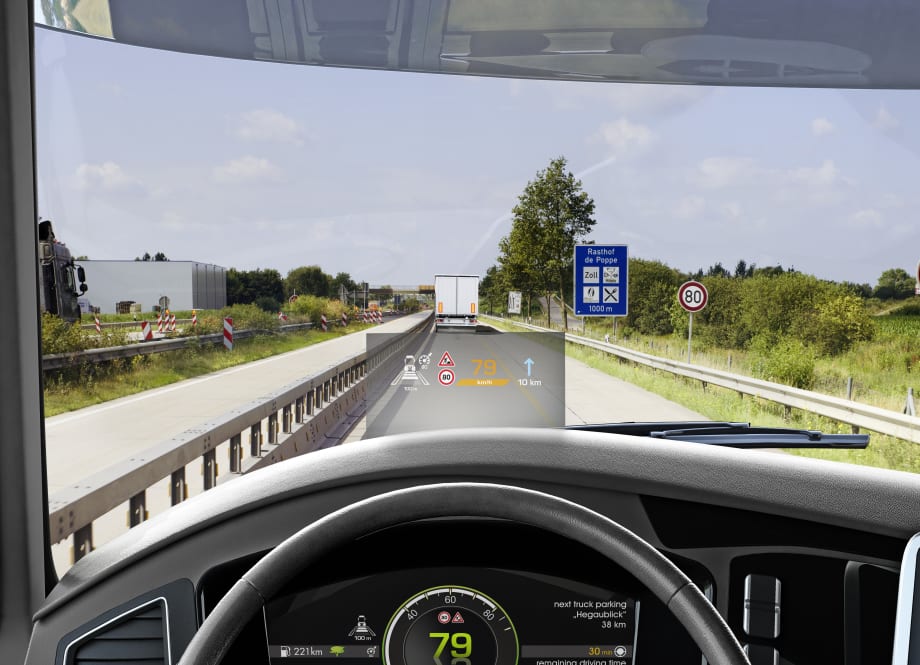
Continental's heads-up display shows vital information without the driver having to take his or her eyes off the road.
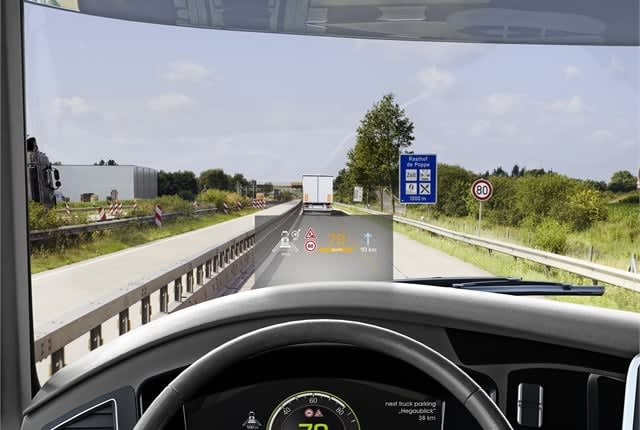
Continental's heads-up display shows vital information without the driver having to take his or her eyes off the road.
Continental recently showed off systems that will help truck makers meet safety needs down the road, whether pushed by regulations or customer demand, as well as pave the way toward autonomous vehicles.
At the IAA Commercial Vehicle Show in Hannover, Germany, this fall, Continental demonstrated a heads-up display and ProViu Detect side-camera warning to help spot pedestrians and cyclists while making right turns. And there was its Dynamic eHorizon, which anticipates the road ahead, including offering real-time data on traffic lights to help drive more fuel efficiently and safely in urban traffic.
Continental’s theme at the show was “Tradition, Trust, Transformation,” and “digitalization is one of the main drivers of transformation,” explained Christopher Schrecke, spokesman for Continental’s commercial vehicles and aftermarket business, noting that trucks can be looked at as “data carriers on wheels.”
“The question is what you make of the data.”
Heads-up display
Continental said it’s one of the world’s first companies to develop a heads-up display for commercial vehicles. It has installed the technology in its InnovationTruck concept demonstration vehicle, where it has been tested for 27,000 km, Schrecke said. Supplementing conventional instrument clusters, the display projects a color image of important driving information into his field of vision.
The display gets its data via the CAN bus. Depending on the available sources, the display choices range from speed, navigation instructions and traffic sign warnings such as passing restrictions and speed limits, to distance warnings, fuel tank levels and the driving time remaining until the next break.
Continental says a heads-up display improves safety, because the driver doesn’t have to take his or her eyes off the road, or focus on a shorter viewing distance then adjust again to the longer-distance view, which takes time and causes eye strain.
Schrecke said Continental is talking to truck makers in the U.S. about using its system.
Right-turn assist
Continental also has developed a system that assists truck drivers on right turns, eliminating blind spots where pedestrians and cyclists can be hidden. ProViu Detect not only “sees” objects in the blind spot, but also uses a complex algorithm and sensor data to classify them, evaluate how fast they are approaching the truck, and actively warn the driver when there is a risk of collision, for instance using a pulsating LED light strip in the cab that draws the driver’s attention to the trouble spot, and/or an acoustic warning signal.
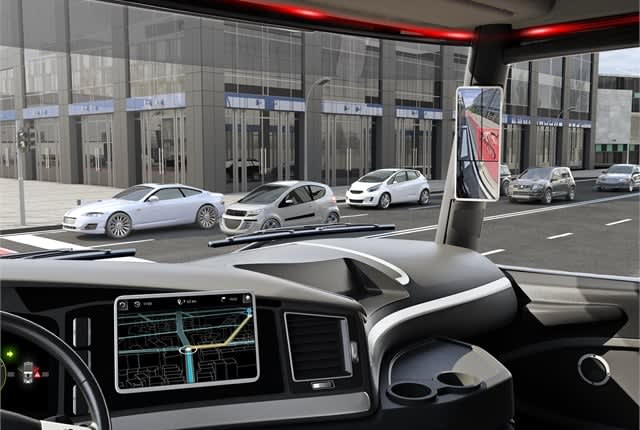
Proviu Detect combined with Continental's mirror-replacement camera displays warns drivers about bicyclists or pedestrians in a right-turn blind spot.
“The right turn is one of the most difficult tasks in city traffic,” explained Michael Ruf, head of Continental's commercial vehicles and aftermarket business. “ProViu Detect eliminates this blind spot, giving drivers a flexible system that’s also designed to meet any future legal requirements.”
The system can be upgraded with various options. It can be used in combination with Continental’s ProViu 360 camera system for all-round vehicle visibility and with ProViu Mirror, a digital wing mirror replacement (such mirror-replacement cameras are not yet legal in the U.S. but may be used in Europe.)
You can experience ProViu via virtual reality by downloading the ProViu Experience app for Apple or Android devices.
Dynamic features for eHorizon
Continental says trucks with its existing eHorizon technology, a GPS-based adaptive cruise control, have saved around 315 million liters of diesel since it was introduced in Europe in 2012. The sensor system uses topographical route data and a GPS signal to feed the truck computer information about the route ahead so driving style and speed can be adjusted automatically.

Dynamic eHorizon is seen as a step toward autonomous vehicles as well as a way to improve safety and efficiency today.
New – and a step on the road to autonomous vehicles – is the dynamic eHorizon, which adds real-time information so it can take into account dynamic events such as weather, accidents, or traffic jams.
If the data sources report a traffic jam or roadworks, for example, the dynamic eHorizon forwards this information to the control units. These then prompt the vehicle to coast or shift down a gear. This not only saves fuel, but also can prevent serious accidents by warning drivers of dangers they cannot yet see, such as the tail of a traffic jam around a bend. And with data on traffic light phases, the vehicle can implement the best driving strategy.
Ruf explained that eHorizon not only uses a Road Database but also is helping to build it. This type of sophisticated mapping, he said, will help truck makers develop autonomous vehicles.
Road Database uses information from the various vehicle sensors and combines it to create a machine-readable image of the road. It is transmitted wirelessly to a backend, which uses the data provided by several vehicles, such as lane changes or a new traffic sign, to create accurate route data, which it then transmits to all affected vehicles.
“For highly automated driving, you really need to know where you are on the road,” Ruf explained, not just rely on road markings.
More Safety & Compliance

FMCSA Pauses Biennial-Update Enforcement Amid Motus Transition
Carriers whose updates were due on or after June 1 have more time, while FMCSA works to stabilize its new registration system and warns of phishing sites impersonating its new carrier registration system, Motus.
Read More →
ZF Expands Commercial Vehicle Push in North America
ZF is expanding its North American commercial-vehicle presence with new transmission applications, electrification, trailer technology and autonomous-driving systems.
Read More →
Truck Drivers Need More Than Another Alert
Fleets have more visibility into truck health, safety events, and driver activity than ever. The next challenge is turning all that information into useful guidance for the person who has to decide what to do next.
Read More →
Tesla Wants a Self-Driving Semi. Are Cameras Enough?
Could Tesla’s camera-only autonomous driving technology work on an 80,000-pound Semi? In this commentary, HDT's Deborah Lockridge takes a look at Tesla, Cybercab, and how autonomous trucks see the road.
Read More →
What DOT’s Automated Vehicle Strategy Means for Trucking
The U.S. Department of Transportation issued a new automated-vehicle strategy that outlines plans for driverless-truck regulations, cross-state freight corridors, and federal safety standards.
Read More →
NYC Expands Speed, Pedestrian Safety Tech Across Fleet
New York City is expanding intelligent speed assistance and pedestrian-alert systems across its municipal fleet, moving the technologies from pilot programs into vehicle procurement and retrofit requirements.
Read More →
FMCSA Removes 110 Truck Driver Training Schools from Certified ELDT List
Federal regulators also are targeting more than 160 additional training providers and launching a nationwide audit of third-party CDL skills testers as part of a broader crackdown on trucking fraud.
Read More →
Beyond DOT Compliance: What Makes a Trucking Fleet Truly Safe?
A trucking fleet can follow every rule and still make unsafe decisions. The real test comes when safety conflicts with freight, productivity, or cost.
Read More →
Hours of Service Pilot Programs: FMCSA Readies for 2027 Rollout
Two pilot programs could eventually reshape hours-of-service rules, giving truck drivers options to pause their 14-hour clock or use longer split sleeper rest periods.
Read More →
New Guide Offers Pet Safety Tips for Truck Drivers
Hundreds of thousands of pets travel in truck cabs. A new safety guide from Volvo Trucks and the Center for Pet Safety offers practical advice for truck drivers who bring dogs and cats along for the ride.
Read More →