





Related: California's AB5: What Now for Truck Owner-Operators in the State?
Judge Says ABC Test Preempted by Federal Law in NFI Case
Another court decision, this time at the state level, has reinforced the trucking industry’s contention that California’s stringent new ABC test restricting independent contractor use is preempted by federal law.
January 9, 2020
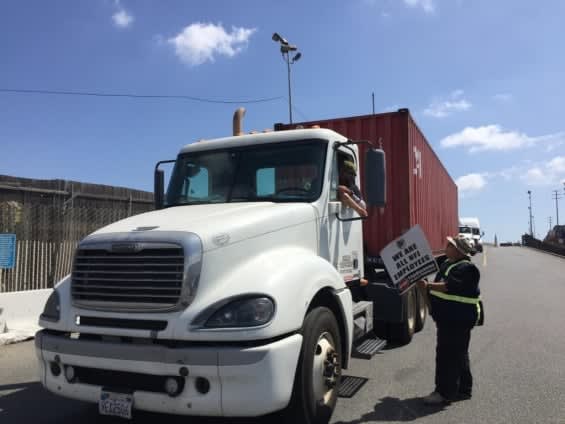
The Teamsters union has been challenging NFI's use of independent contractors, but a court ruling says new more stringent ABC test rules in California do not apply.
Photo: Teamsters
4 min to read
Another court decision, this time at the state level, has reinforced the trucking industry’s contention that California’s stringent new ABC test restricting independent contractor use is preempted by federal law.
Two years ago, the Los Angeles City Attorney’s office sued NFI Industries and its subsidiaries, Cal Cartage Transportation Express, CMI Transportation, and K&R Transportation California, for alleged misclassification of truck drivers.
Since that lawsuit was filed, California put into place a more stringent test to determine whether workers are employees or independent contractors, the ABC test, first applied in the Supreme Court’s Dynamex decision, and later codified by Assembly Bill 5.
NFI asked the judge to make a decision about whether the ABC test should be applied retroactively to the claims in the case. The judge agreed with NFI that it should not.
Prong B of the ABC test requires that a worker be classified as an employee, unless the employer establishes that the worker “performs work that is outside the usual course of the hiring entity's business.” This essentially prohibits the longstanding owner-operator model used in the trucking industry.
The California Trucking Association has challenged in court the ABC test set forth in both the Dynamex ruling and AB5. AB5 went into effect Jan. 1, but in the final hours of New Year’s Eve, U.S. District Judge Roger Benitez issued a temporary restraining order in the CTA case, preventing state officials from enforcing the law against motor carriers.
On Jan. 8, the Superior Court for the State of California for Los Angeles County granted NFI’s motion regarding federal preemption and non-retroactivity of the ABC worker classification test.
The decision marks the first ruling to reach a final decision on the validity of AB 5, said NFI’s attorneys. The Dec. 31 action in the CTA suit was merely a temporary restraining order – although Judge William Highberger cited that restraining order in his decision that the NFI case be adjudicated using the previous independent contractor classification test known as “Borello.”
The Problem With the ABC Test
Judge Highberger explained that the ABC Test “prohibits motor carriers from using independent contractors to provide transportation services” and therefore is preempted by the Federal Aviation and Administration Authorization Act (FAAA) of 1994. That law contains a preemption clause that prohibits states from enacting laws “related to a price, route, or service of any motor carrier . . . with respect to the transportation of property.”
“The requirements of the ABC test … clearly run afoul of Congress's 1994 determination in the Federal Aviation Administration Authorization Act … that a uniform rule endorsing use of non-employee independent contractors (commonly known in the trucking industry as ‘owner-operators’) should apply in all 50 states to increase competition and reduce the cost of trucking services,” Highberger wrote in his decision. (You can read the full decision here.)
Highberger noted that, “The legislative history of the FAAAA makes plain there was a desire to preempt a specific California statute which limited use of owner-operators by freight companies, such as Roadway Express, which were in competition with Federal Express, then solely regulated as an air carrier.”
The decision also was influenced by rulings of the First Circuit and the Supreme Court of Massachusetts holding that the FAAAA preempts the ABC Test in the formulation used in both Massachusetts and California in a case involving FedEx Ground contractors.
“Independent owner-operator truck drivers have been a vital part of the trucking industry, and a path to achieving the American dream, for many decades,” said Joshua Lipshutz of Gibson, Dunn & Crutcher LLP, NFI’s attorney. Judge Highberger’s decision confirms that California cannot simply eliminate that business model and force truck drivers to be employees. This is a win for trucking companies and independent truckers nationwide.”
Teamsters
The Teamsters union has been in a long-running battle with California Cartage, which was bought by NFI in 2017, alleging improper “misclassification” of truck drivers as independent contractors, claiming that in reality they should be treated as employees.
The union issued a statement saying it disagrees that the court decision is a big win for NFI and the port trucking industry in California. "While we believe Judge Highberger’s decision is wrong, the bottom line is that in every port trucker misclassification/wage theft case to date, the port truck drivers of NFI and indeed every port trucking company have been found to be employees NOT independent contractors under the California Borello test," said Julie Gutman Dickinson, local counsel to the Teamsters Port Division, in that release.
“It does not matter whether you apply the ABC test under Dynamex, AB-5, or the Borello test, they are employees under all tests. So, the effect of Judge Highberger’s finding that the ABC test is preempted does not have practical effect on the employee status of these drivers. They are clearly employees."
Editor's note: Updated 6:30 EST to add Teamsters response
More Drivers

Truck Drivers Need More Than Another Alert
Fleets have more visibility into truck health, safety events, and driver activity than ever. The next challenge is turning all that information into useful guidance for the person who has to decide what to do next.
Read More →
FMCSA Removes 110 Truck Driver Training Schools from Certified ELDT List
Federal regulators also are targeting more than 160 additional training providers and launching a nationwide audit of third-party CDL skills testers as part of a broader crackdown on trucking fraud.
Read More →
Hours of Service Pilot Programs: FMCSA Readies for 2027 Rollout
Two pilot programs could eventually reshape hours-of-service rules, giving truck drivers options to pause their 14-hour clock or use longer split sleeper rest periods.
Read More →
Medical Cards, English Proficiency Reshape Roadcheck Violations
Medical-card violations jumped to the top of the driver out-of-service list during CVSA’s 2026 International Roadcheck, while English-language proficiency violations appeared among the leading violations for the first time.
Read More →
Driver Trust Can Make or Break the Success of Fleet Safety Technology
New Teletrac Navman research suggests that onboarding, transparency about driver data, and positive feedback can play a significant role in how commercial drivers respond to safety and coaching technology.
Read More →
EEOC Sues KLLM Over Alleged Sex Discrimination in Driver Training
KLLM is facing a federal sex-discrimination lawsuit over policies the EEOC alleges put female truck driver trainees at a disadvantage.
Read More →
FMCSA Moves to Codify English Language Requirements for Commercial Drivers
By changing regulations on English-language proficiency requirements for commercial drivers, rather than relying on a guidance memo, the FMCSA said future administrations won't be able to walk back the Trump administration's stricter enforcement with just a memo.
Read More →
Drivers Put Western Star Trucks to the Test at Star Nation Experience
Watch to get an inside look at the Western Star trucks, technology, and community behind the Star Nation Experience 2026!
Read More →
Trump Administration Looks to Put More Veterans Behind the Wheel
The Freedom Haulers program pulls together existing and expanded programs at several federal agencies to recruit veterans to drive commercial heavy-duty trucks and cut the red tape for them to get a CDL, training, and employment.
Read More →
Putting Mack’s Command Steer to the Test
A test drive of Mack’s Command Steer active steering system evaluates how it can make truck driving easier and less tiring.
Read More →