




J.B. Hunt President: Cutting Carbon Emissions Now — Without Electric Trucks
Without relying on zero-emissions trucks, J.B. Hunt has committed to a 32% reduction in carbon emissions by 2032 compared to a 2019 baseline. President Shelley Simpson talked about the tough realities of zero-emission trucks at ACT Expo.

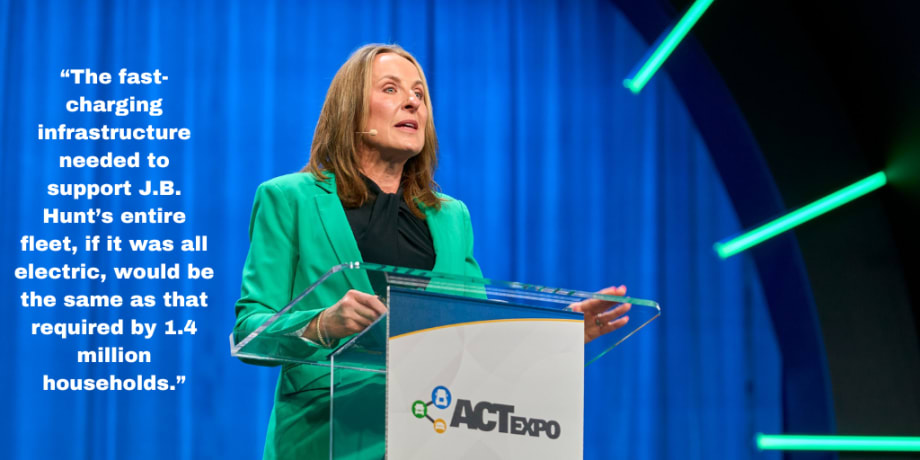
J.B. Hunt President Shelley Simpson, speaking at ACT Expo, said zero-emissions truck technology is not ready for prime time.
HDT Graphic from ACT Expo/TRC Companies Photo
Electrification is not trucking’s best decarbonization option right now, says Shelley Simpson, president of J.B. Hunt Transport Services.
Using examples from her own operation, she suggests fleets would do better by expanding the use of existing fuel-saving technologies, reducing empty and unproductive miles, and using biogenic fuels.
Speaking at ACT Expo in Las Vegas, Simpson said electrification is presently far too expensive for the benefits it produces, and the trucks themselves are uncompetitive and inefficient. Acquisition costs are up to three times that of a diesel, there are payload penalties of between 4,000 and 12,000 pounds, and charging time and frequency renders them very unproductive compared to diesels.
“It’s not economically viable to incorporate zero-emission vehicles into our fleet at scale right now,” she told a standing-room-only crowd. “But it is important that we begin to test and to pilot these technologies.”
Eye-Popping Numbers About Energy Needed for Electric Trucks
Her pointed rebuttal to what has become industry doctrine continued with an eye-popping illustration of how desperately short we are on the energy needed to power fleets of electric trucks.
Citing research from the American Transportation Research Institute, Simpson said we would need 40% more electricity than is currently generated in the U.S. today to charge the 276 million registered cars and truck in this country if they were all electric.
Simpson stressed that the electrical demands of heavy truck charging are downplayed and not well understood by non-experts. She phrased it like this:
“In order to fast-charge a single electric truck, you would need the same amount of energy it takes to power 600 homes.
“To put that into perspective, the fast-charging infrastructure needed to support J.B. Hunt’s entire fleet, if it was all electric, would be the same as that required by 1.4 million households, or about 1% of the U.S. population.
"I wonder how many families would be willing to give up their electricity just so we could charge our trucks?"
J.B. Hunt’s Three-Pronged Approach to Decarbonization Without ZEVs
Without relying on zero-emissions trucks, J.B. Hunt has committed to a 32% reduction in carbon emissions by 2032 compared to a 2019 baseline. To date, Simpson said, they have already achieved a 16% reduction in carbon emissions, the single largest contributor to those reductions being the use of biogenic fuels such as biodiesel, renewable diesel, and renewable natural gas.
“The company’s total weighted average of fuel from renewable sources is currently 24%,” she said.
In addition to the use of lower-carbon fuel sources, the J.B. Hunt fleet is a spry 2.23 years old compared to a national average of 5.5 years. This keeps the fleet in the top echelon of fuel efficiency right from the factory.
The company also uses speed limiters, automated transmissions, and various add-ons to get every benefit possible from the truck itself.
“This approach has helped us improve our sustainability metrics,” Simpson said. “Our greenhouse gas emission intensity has gone from 120 tons per million-ton-miles to 94 tons per million ton-miles since 2019. For 2023, that’s an 18% improvement.”
The Customers’ Role in J.B. Hunt’s Sustainability Strategy
Simpson said customers are interested in moving their freight more sustainably, but there’s some lack of understanding of extent of the carbon footprint associated with zero-emissions transportation.
“The carbon footprint associated with producing the [electric] truck can be four to five times more than diesel [trucks],” she said.
“And you also have to consider the carbon footprint of generating and distributing electricity. When you combine this with the operational inefficiencies, they can see the impact of [zero emissions] might not be as great as expected.”
For hydrogen fuel cell trucks, the carbon footprint from production and distribution of hydrogen also plays a significant role in the lifecycle of the solution.
“Once again, the reduction is not as great as you might think,” she said.
While zero-emissions dreams fall short of expectations, several solutions produce immediate results. However, it can take some convincing to get customers on board.
Switching some portion of the freight from road to rail via intermodal can cut emissions by 20% and costs by 15% at almost no additional cost, Simpson explained. In 2023, the company’s intermodal segment helped to avoid an estimated 3.5 million metric tons of CO2 compared to transportation by truck alone.
Further, optimized routing can lower shipping costs and the overall carbon footprint by simply reducing the amount of fuel burned unproductively.
“The J.B. Hunt 360 platform helped our drivers avoid over 3.5 million empty miles last year,” she said.
“We also offer Clean Transport, our carbon-neutral shipping program that provides customers a flexible method to acquire carbon offsetting credits. That’s equivalent to the emissions produced by their shipments.”
Sounds great, right? Yet, she said, “Since rolling this out nearly two years ago, we've had exactly zero customers interested in this program.”
The Frustrating Truck Emissions Regulatory Environment
Adding to Simpson’s frustrations are non-aligned regulatory environments. The industry faces a series of technically challenging regulations which, she argues, “are ahead of the market and maturity of zero-emission technology.
“We have concerns with this approach. [California’s] Advanced Clean Fleets rule began 2024, while the [Environmental Protection Agency’s] Phase Three [GHG] starts with 2027 model-year trucks. EPA’s rule allows for more time for the technology to mature, but when state requirements and federal requirements do not align, they create additional issues with interstate operations and commerce.”
Simpson said she felt agencies like EPA and the California Air Resources Board placed too much emphasis on advanced technology while failing to account for all the improvements that can be made with minimal use of zero-emissions technology.
Encouraging Innovation in Trucking Emissions Technology
Despite those concerns, Simpson remains optimistic.
“When we focus on all three things at once, technology policies and markets, we encourage innovation, sparking companies to get new products into the market faster,” she noted in her conclusion.
“We're watching this [zero-emissions] technology closely with expectations that the technology and the infrastructure will mature enough for there to be an economic case for adoption in the future.
“To sum it up, the benefits have to increase, and the cost has to decrease.”
More Fuel Smarts

How Volvo Updated Its D13 for EPA 2027 [Watch]
Volvo’s updated D13 promises lower emissions without sacrificing performance or fuel economy. Take a closer look at what changed inside the engine in this HDT Spotlight video.
Read More →
Diesel Price Spike Shortens Payback for Natural Gas Trucks, Report Says
Energy Vision estimates fleets could recover the higher purchase price of an RNG-fueled Class 8 tractor in 1.3 to 2.8 years under current fuel-price scenarios.
Read More →
Calstart Becomes Catalyst Mobility, Reflecting Broader Focus
Calstart is now Catalyst Mobility, reflecting the nonprofit’s growing national role in clean transportation, including zero-emission trucks, infrastructure and incentive programs.
Read More →

Record Diesel Prices Squeeze Trucking Fleets
Average U.S. diesel prices have climbed to nearly $6 a gallon, surpassing the 2022 record as tight refinery capacity and Middle East disruptions keep fuel costs elevated.
Read More →
How Fuel Delivery Shapes Engine Performance
Fuel delivery depends on more than what happens at the injector. For fleet, maintenance and technical professionals, looking at the full path from pump to injector can provide useful context for understanding engine performance.
Read More →
East Coast Port Launches $45M Electric Truck Push
The Port Authority of New York and New Jersey announced millions in incentives for zero-emission drayage trucks, yard tractors, and new charging hubs near the port.
Read More →
California Bill Could Shed Light on Electric Truck Prices
Why do battery-electric Class 8 trucks remain so expensive? A California bill headed to Gov. Gavin Newsom would give fleets and state agencies more visibility into what manufacturers charge.
Read More →
Detroit Opens Orders for EPA 2027 Engines
Detroit isn’t starting from scratch to meet EPA 2027 diesel emissions standards. Its Gen 6 DD13 and DD15 engines keep much of today’s platform while updating the fuel and aftertreatment systems.
Read More →
Zero-Emission Truck Corridor Planned for West Coast
California, Oregon, Washington, British Columbia and Baja California are coordinating plans for truck charging and hydrogen fueling from Canada to Mexico.
Read More →
A Closer Look at Kenworth’s Electric T880E Vocational Truck [Video]
Learn more about Kenworth's T880E battery-electric vocational truck at the Paccar Technical Center, including its range, applications, upfitting considerations, and PTO options, in this HDT Spotlight video.
Read More →