





Read More: Challenges of Charging Commercial Trucks
Ideanomics Completes Testing of 500kW Ultra-Fast Wireless Charging
The first Ideanomics 500kW ultra-fast charger is scheduled to enter service in 2023 at the Port of Los Angeles.
September 27, 2022
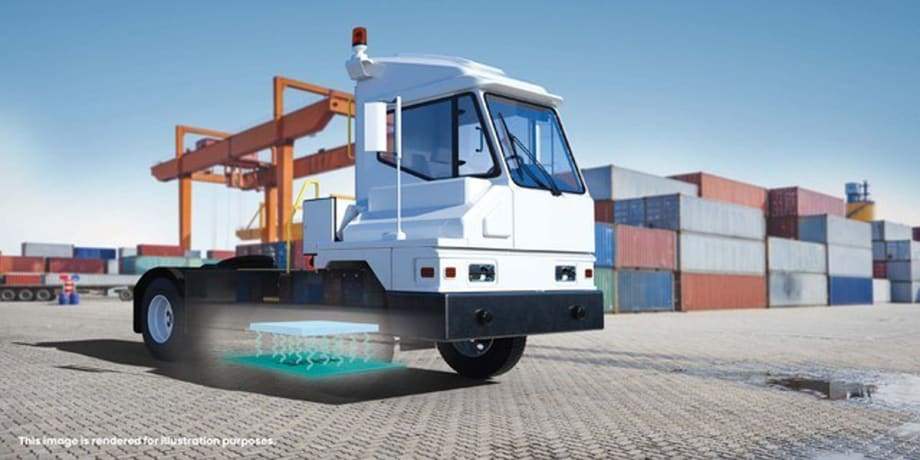
This first-of-its-kind high-power, ultra-fast wireless charging system fully charged a class 8 electric truck in less than 15 minutes.
Rendering: Ideanomics
2 min to read
An ultra-fast wireless charging system fully charged a Class 8 electric terminal tractor in about 15 minutes in a test at the Port of Los Angeles, according to Ideanomics, a company focused on driving the adoption of commercial electric vehicles.
"We're showing that today, right now, electric heavy-duty vehicles can operate 24/7, "topping off" their charge while the work is happening," said Robin Mackie, Ideanomics Mobility president, in a statement. "The benefits of this technology are crystal clear — fleet operators become more efficient by cutting out vehicle downtime otherwise spent filling up or plugging a central depot."
Construction and charger installation at the Port of Los Angeles is underway, and Ideanomics expects the first 500kW charger to enter service in 2023. Supported by an $8.4 million U.S. Department of Energy grant, the WAVE 500kW charger is being deployed as part of a consortium project.
About 12 million medium- and heavy-duty trucks are in service today in the U.S., many still powered by polluting combustion engines. The Inflation Reduction Act (IRA) provides $75 billion in programs and tax credits to electrify these vehicles, giving fleet operators the confidence to transition faster. Several of these programs and incentives include specific designations to electrify heavy-duty vehicles operating in disadvantaged communities and at ports and warehouses.
To help further accelerate the deployment of wireless charging, Ideanomics is offering an "as a service" model, partnering with the IRA, an e-commerce company, to deploy wireless charging and electric vehicles on a subscription basis. The customer pays a flat monthly fee instead of an upfront cost.
Wireless charging is an ideal solution for a fleet operator with vehicles moving along a fixed route, according to the company. Automated and unobtrusive high-power wireless charging keeps vehicles powered up during regularly scheduled stops. Additionally, it allows for smaller batteries and fewer chargers, resulting in reduced vehicle weight and costs.
Ideanomics also provides electrification solutions for ports and warehouses. Earlier this year, Ideanomics released its WareSmart platform to help Southern California warehouse operators plan and implement clean fleet technology to comply with local regulations.
The company views WAVE wireless charging as a flagship charging technology incorporating wireless charging into the design of the company's next generation of electric vehicles.
More Fuel Smarts

How Volvo Updated Its D13 for EPA 2027 [Watch]
Volvo’s updated D13 promises lower emissions without sacrificing performance or fuel economy. Take a closer look at what changed inside the engine in this HDT Spotlight video.
Read More →
Diesel Price Spike Shortens Payback for Natural Gas Trucks, Report Says
Energy Vision estimates fleets could recover the higher purchase price of an RNG-fueled Class 8 tractor in 1.3 to 2.8 years under current fuel-price scenarios.
Read More →
Calstart Becomes Catalyst Mobility, Reflecting Broader Focus
Calstart is now Catalyst Mobility, reflecting the nonprofit’s growing national role in clean transportation, including zero-emission trucks, infrastructure and incentive programs.
Read More →

Record Diesel Prices Squeeze Trucking Fleets
Average U.S. diesel prices have climbed to nearly $6 a gallon, surpassing the 2022 record as tight refinery capacity and Middle East disruptions keep fuel costs elevated.
Read More →
Sponsored•September 9, 2026
How Fuel Delivery Shapes Engine Performance
Fuel delivery depends on more than what happens at the injector. For fleet, maintenance and technical professionals, looking at the full path from pump to injector can provide useful context for understanding engine performance.
Read More →
East Coast Port Launches $45M Electric Truck Push
The Port Authority of New York and New Jersey announced millions in incentives for zero-emission drayage trucks, yard tractors, and new charging hubs near the port.
Read More →
California Bill Could Shed Light on Electric Truck Prices
Why do battery-electric Class 8 trucks remain so expensive? A California bill headed to Gov. Gavin Newsom would give fleets and state agencies more visibility into what manufacturers charge.
Read More →
Detroit Opens Orders for EPA 2027 Engines
Detroit isn’t starting from scratch to meet EPA 2027 diesel emissions standards. Its Gen 6 DD13 and DD15 engines keep much of today’s platform while updating the fuel and aftertreatment systems.
Read More →
Zero-Emission Truck Corridor Planned for West Coast
California, Oregon, Washington, British Columbia and Baja California are coordinating plans for truck charging and hydrogen fueling from Canada to Mexico.
Read More →
A Closer Look at Kenworth’s Electric T880E Vocational Truck [Video]
Learn more about Kenworth's T880E battery-electric vocational truck at the Paccar Technical Center, including its range, applications, upfitting considerations, and PTO options, in this HDT Spotlight video.
Read More →