





How to Reduce Driver Impact on Truck Fleet Maintenance Costs
Heavy Duty Parts and Labor Costs Dropped in Q2
A benchmarking report from TMC and Decisiv reveals good news for fleets as heavy-duty parts and labor costs dropped in the second quarter of 2023.
September 22, 2023
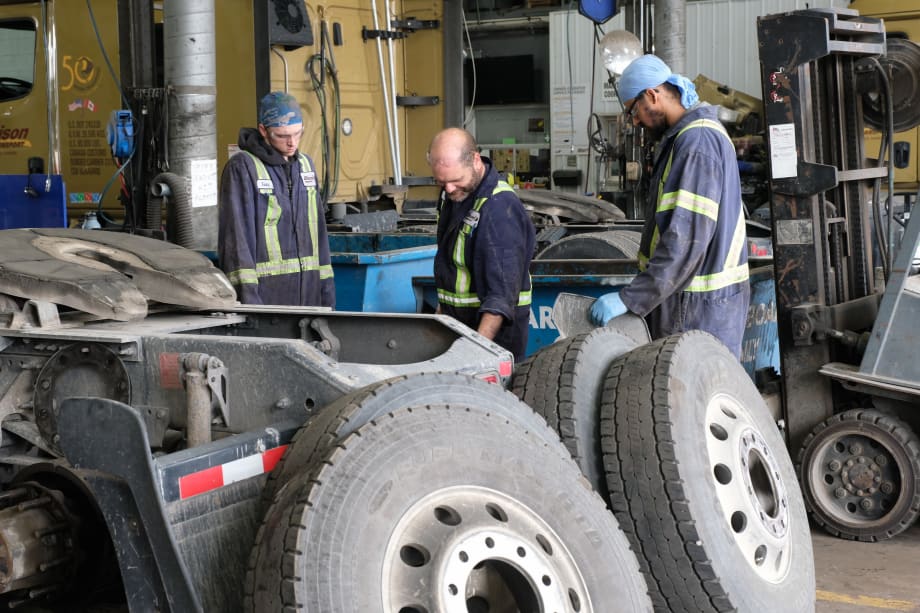
After an extended period of cost increases, the combined parts and labor costs for the top 25 VMRS codes fell 1.3% in the second quarter pf 2023 according to a new benchmarking report from TMC and Decisiv.
Photo: Jim Park
3 min to read
Trucking parts and labor expenses dropped during the second quarter of 2023, report the American Trucking Associations’ Technology & Maintenance Council and asset service management system provider Decisiv.
“With rising build rates for new equipment and less mileage reducing the need to operate aging trucks, fleets are finally seeing a definite improvement in parts and labor costs,” said Decisiv President and CEO Dick Hyatt about the data in the latest Decisiv/TMC North American Service Event Benchmark Report.
“The data that Decisiv collects and analyzes for TMC on Vehicle Maintenance Reporting Standard system level codes points to a return to normalized trade cycles and more predictable service and repair costs," Hyatt said. "Along with greater stability, the highly detailed data and reporting enabled by Decisiv SRM allows fleets and service providers to focus on ways to continue to drive down expenses.”
A Long-Awaited Decrease in Service Costs
After an extended period of cost increases, the combined parts and labor costs for the top 25 VMRS codes fell 1.3% in the second quarter from the first. Labor costs dropped for the first time in the past year, and parts costs were down for the second quarter in a row.
On a year-over-year basis, combined parts and labor costs rose only 5.57% in the second quarter of this year compared with the same period last year — far slower than the 15% increase in costs seen in 2022.
“After many months of rapidly increasing parts and labor costs, we are pleased to see this positive trend in the maintenance expense data,” said TMC Executive Director Robert Braswell.
While economic and inflation pressures are still driving parts prices and labor rates to comparatively high levels, OEMs are effectively managing fewer supply chain disruptions that had negatively impacted production capacity.
With the steady elimination of pent-up demand, fleets are finally taking delivery of new, less repair-intensive trucks. The influx of replacement vehicles and lower freight volumes are decreasing the demand for service and repair activity and consequently lowering parts and labor costs.
Operational Changes Impacting Shop Operations
The data reflecting lower parts and labor expenses in this quarter’s Decisiv TMC Benchmark Report indicated how a number of factors affected service activity, the report said. These factors impacted each other and fleet service operations:
Changes in mileage related to freight volumes.
The effect of newer versus aging trucks.
The ongoing stabilization of the supply chain.
Looking ahead, there is a growing expectation that service and repair costs will find a new equilibrium and settle into a more predictable cycle in line with what was experienced in the past.
Data on the top 10 VMRS code categories shows that engines and related systems accounted for the largest percentage of all costs in the second quarter. In total, powerplant (35.9%), exhaust (12.9%) cooling (6.1%) and fuel systems (5.3%) equaled 60.2% of costs during the quarter.
The Decisiv/TMC North American Service Event Benchmark Reports are generated using data from the Decisiv SRM platform on service and repair events for more than 7 million commercial assets operating across the U.S. and Canada.
ATA’s Technology & Maintenance Council issues the reports to its fleet members. The reports are organized based on the council’s Vehicle Maintenance Reporting Standards sorted by VMRS-coded vehicle systems and geographic location.
TMC fleet members will receive the report via email.
More Maintenance

Sponsored•September 16, 2026
Color Match Smarter: Tools That Restore & Perform
For fleet managers and collision repair professionals keeping heavy-duty trucks on the road, getting the color right the first time isn't just about appearance — it's about efficiency, turnaround time, and bottom-line results. Discover how today's digital color tools are transforming the repair process from guesswork to precision.
Read More →
Wrong Repair Prompts Recall of Freightliner, Western Star 4x2 Trucks
DTNA is recalling more than 2,400 trucks that received an incompatible software fix instead of the hardware repair required to address brake valve corrosion.
Read More →
Truck Drivers Need More Than Another Alert
Fleets have more visibility into truck health, safety events, and driver activity than ever. The next challenge is turning all that information into useful guidance for the person who has to decide what to do next.
Read More →

The Maintenance Checks Trucking Fleets Should Prioritize Before Fall Freight Picks Up
Making it through August isn’t the same as being ready for the next several months of operation. Find out what systems may have suffered from summer heat and need to be checked out before fall.
Read More →
What Three Fleets Are Doing Differently When Buying Truck Parts in 2026
With freight improving but costs still climbing, fleet maintenance executives explain how they're balancing price, quality, and supplier relationships.
Read More →
Paccar Recalls 2027 Trucks Built This Summer for Possible Electrical Problem
The nearly 6,000 Kenworth and Peterbilt trucks in the recall could potentially lose engine power, among other things.
Read More →
Will API PC-12 Oil Change Trucking Fleet Maintenance?
The new API PC-12 heavy-duty engine oil category reflects the changing demands of modern diesel engines. But fleets like Foodliner are looking to getting their own data before making decisions on adopting the new oils and questions such as extending oil drain intervals.
Read More →
Brake Safety Week to Focus on Drums and Rotors
Commercial vehicle inspectors are focusing on truck brakes during CVSA's Brake Safety Week, August 23-29.
Read More →Possible Battery-Cable Fires Prompt Recall of 15,000+ International MV and HV Trucks
On the recalled vehicles, manufacturing variations can cause the battery interconnect cable to contact the auxiliary stud and hold down the bracket.
Read More →
Rush, MCT Team Up to Grow Refrigeration Service Network
The joint venture will operate MCT's network of Carrier Transicold dealerships and mobile service locations, with the companies promising greater service capacity and uptime for refrigerated fleets.
Read More →