





Related: Senators Make Final Attempt to Pass Autonomous Vehicle Bill
Government Report Calls for 20-Year Fix of Interstate Highways
A congressionally mandated report finds the future of the Interstate Highway System so at risk that it recommends that drastic action should be taken over a period of years-- including hiking federal fuel taxes and allowing tolling and per-mile-charges on more interstate routes.
December 6, 2018
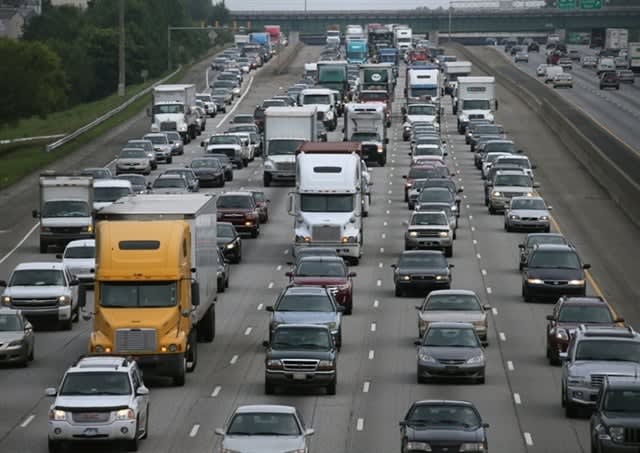
A congressionally mandated report finds the future of the Interstate Highway System at risk and recommended a 20-year plan to fix it.
Photo via U.S. DOT
6 min to read
While most government and think tank studies on the abysmal condition of U.S. roads are general in nature, a new congressionally mandated report zeroes in on the Interstate Highway System and finds the future of those ribbons of highway that tie the nation together so at risk that drastic action should be taken over a period of years-- including hiking federal fuel taxes and allowing tolling and per-mile-charges on more interstate routes.
The authors of the consensus report, which was prepared by the National Academies of Sciences, Engineering, and Medicine for the Dept. of Transportation, contend that the interstates are “threatened by a persistent and growing backlog of structural and operational deficiencies and by various looming challenges, such as the progress of automated vehicles, developments in electric vehicles, and vulnerabilities due to climate change.”
The report, titled “Renewing the National Commitment to the Interstate Highway System: A Foundation for the Future,” calls for a 20-year, multibillion dollar “blueprint for action” to save the Interstate system. This plan would include creating an “Interstate Highway System Renewal and Modernization Program,” increasing the federal fuel tax to help pay for it, and permitting tolls and per-mile-charges on more interstate routes.
“Unless a commitment is not made to remedy the system’s deficiencies and prepare for those oncoming challenges,” the authors state, “there is a real risk that the nation's interstates will become increasingly unreliable and congested, far more costly to maintain, less safe, incompatible with evolving technology, and vulnerable to the effects of extreme weather.”
“The interstates have long been the backbone of our country’s transportation system, but most of them have exceeded their design lives and in many places are worn and overused,” said Norman Augustine, former chairman and CEO of Lockheed Martin Corp. and chair of the committee that wrote the report. “These aging interstates are highly congested oftentimes and in need of reconstruction.
“Furthermore,” he added, “technological advances are offering new opportunities, but they may also undermine a principal source of income for the interstates, namely the tax on fuel. We recommend a course of action that is aggressive and ambitious, but by no means novel. Essentially, we need a reinvigoration of the federal and state partnership that produced the Interstate Highway System in the first place.”
NAS noted that while the Dwight D. Eisenhower National System of Interstate and Defense Highways constitutes about 1% of U.S. public road mileage, the interstates carry about 25% of the nation’s vehicle miles traveled-- including about one-half of the miles traveled by heavy trucks. Moreover, per vehicle mile traveled, interstate highways are the safest roads in the country. Yet because of their heavy use, they account for more than 5,000 traffic deaths per year. “Nevertheless, today they suffer from severe congestion, mainly in urban areas, and in many cases are in need of costly reconstruction.”
Challenges ahead
The study committee identified a series of challenges – both long-standing and emerging ones – that include rebuilding the system’s pavements, bridges, and other aging assets before they become unserviceable and less safe; adding more traffic capacity and demand management capabilities, especially on congested urban segments; ensuring the system’s coverage keeps pace with changes in the location of the country’s population and economic growth; improving safety as traffic volumes increase; adapting to changing vehicle technologies; adopting new user-based funding mechanisms that will generate the needed reinvestment revenues; and incorporating changing climate conditions into planning and design.
The authors point out, for example, that more than one-third of interstate bridges have been in service for more than 50 years and will require repair and renewal investments that will add significantly to the major outlays required for rebuilding the system’s original pavement foundation. In addition, large metropolitan areas are expected to continue to account for most of the country’s population growth, yet their interstates have little room to expand locally and are “likely to require innovative solutions to accommodate growing travel demand.”
The committee notes that advances in technology – ranging from more efficient and faster construction methods and more durable materials to electronic tolling and increasingly connected and automated vehicles – “could make the rebuilding of the Interstate Highway System and the allocation of its capacity more manageable, while also furthering the continual goal of increasing the system’s capacity and level of safety.”
Ramping up Investment
The report's proposed major upgrade of the Interstate Highway System would require the federal and state governments to coordinate and focus their efforts on a goal similar to the one that motivated the system’s development under the original Interstate Highway System construction program launched in the 1950s.
Therefore, the committee recommends that Congress legislate the Interstate Highway System Renewal and Modernization Program (RAMP) “to reinforce a partnership where the federal government would provide leadership, vision, and the bulk of the funding, and the states would prioritize and execute projects in their traditional role as owners, builders, and maintainers of the system.”
Recent combined state and federal capital spending on the interstates has been approximately $25 billion annually. The authors estimate that to renew and modernize these highways over the next 20 years, $45 billion to $70 billion will be required annually, depending on uncertainties, such as the rate of growth of vehicle miles traveled.
The committee notes, however, that these estimates may be low, because they do not include funding required to reconfigure and reconstruct many of the interstates' 15,000 interchanges or to make the system more resilient to the effects of climate change.
To raise the additional new revenue needed for system upgrades, the committee recommends increasing the federal fuel tax in the near term and allowing tolls or per-mile charges on interstate users. “Lifting the ban on tolling that applies to most general purpose interstate lanes would provide states and metropolitan areas with more options for raising revenue for their share of RAMP investments and for managing the traffic demand on and operations of interstate segments that offer limited opportunity for physical expansion,” the authors state.
‘Rightsizing’ the interstates
The study also calls for Congress to direct the Department of Transportation and Federal Highway Administration to establish criteria for “rightsizing” the interstates – which would extend the system’s length and scope of coverage and remediate disruptions caused by highway segments that are viewed as intrusive to local communities. “These criteria should be developed in consultation with states, local communities, highway users, and the general public and take into account the needs of growing regions and cities for improved access to the transportation network, as well as the interests of jurisdictions that have been harmed by interstate segments that divide or isolate neighborhoods.”
In addition, the committee recommends that “Congress direct DOT and FHWA – working with states, industry, and independent technical experts – to start planning for the transition to more automated and connected vehicle operations.” This effort should entail the needed research and updates to Interstate Highway System requirements and standards “to ensure that basic intelligent transportation system instrumentation is adopted on a consistent and system-wide basis, and that uniformity and other attributes of pavement markings, interchange design, and the like are capable of facilitating eventual interstate use by connected and automated vehicles.”
The National Academies of Sciences, Engineering, and Medicine are private, nonprofit institutions that provide independent, objective analysis and advice to the nation to solve complex problems and inform public policy decisions related to science, technology and medicine.
More Fleet Management

Sponsored•September 16, 2026
Color Match Smarter: Tools That Restore & Perform
For fleet managers and collision repair professionals keeping heavy-duty trucks on the road, getting the color right the first time isn't just about appearance — it's about efficiency, turnaround time, and bottom-line results. Discover how today's digital color tools are transforming the repair process from guesswork to precision.
Read More →
FMCSA Pauses Biennial-Update Enforcement Amid Motus Transition
Carriers whose updates were due on or after June 1 have more time, while FMCSA works to stabilize its new registration system and warns of phishing sites impersonating its new carrier registration system, Motus.
Read More →
Sponsored•September 14, 2026
2026 Blueprint for Countering Smarter Supply Chain Theft
Cargo theft is no longer just the cost of doing business. It's a multi-billion-dollar criminal enterprise exploiting vulnerabilities across your fleet, drivers, and supply chain.
Read More →


Sponsored•September 1, 2026
How Telematics Improves Visibility, Control, and Performance in Refrigerated Fleets
Explore how telematics help refrigerated fleets improve visibility, uptime, efficiency, compliance, and cargo protection across connected cold chain operations.
Read More →
What the U.S.-Canada Trade War Means for Trucking
Escalating U.S.-Canada tariffs could disrupt cross-border freight, reduce truck volumes, raise costs, and create new uncertainty for carriers on both sides of the border.
Read More →
What Are Trucking’s Top Concerns for 2026?
The American Transportation Research Institute wants to know what's worrying trucking fleet managers, drivers, and other stakeholders in its annual Industry Issues survey.
Read More →
American Trucking Associations Looks for a New Leader
ATA President and CEO Chris Spear abruptly left his job at the association on August 21, at a pivotal time for the trucking industry.
Read More →
Public Wi-Fi Cybersecurity Risks: How Truck Drivers and Fleets Can Protect Their Data
Public Wi-Fi can expose truck drivers and fleets to credential theft, malware, and other cyber threats. Here’s how to reduce the risk on the road.
Read More →
For Nicky Cupp, Fleet Innovation Starts With Frustration
HDT Truck Fleet Innovator Nicky Cupp turns everyday pain points at Fraley & Schilling into opportunities for better technology and smarter processes.
Read More →
Adam Buttgenbach’s Approach to Electric Trucks: Start With Where They Fit
HDT Truck Fleet Innovator Adam Buttgenbach helped PepsiCo build one of North America’s largest EV fleets by focusing on where electric trucks make operational sense.
Read More →