





HDT Fact Book 2022: Out-of-Sync Supply Chains & Logistics Transformation
Georgia to Transform Savannah Terminal to Containers Only
The Georgia Port Authority's decision to turn a Savannah terminal into a container-only facility is just one example of what's happening with the shift in container-ship traffic away from West Coast ports.
December 12, 2022
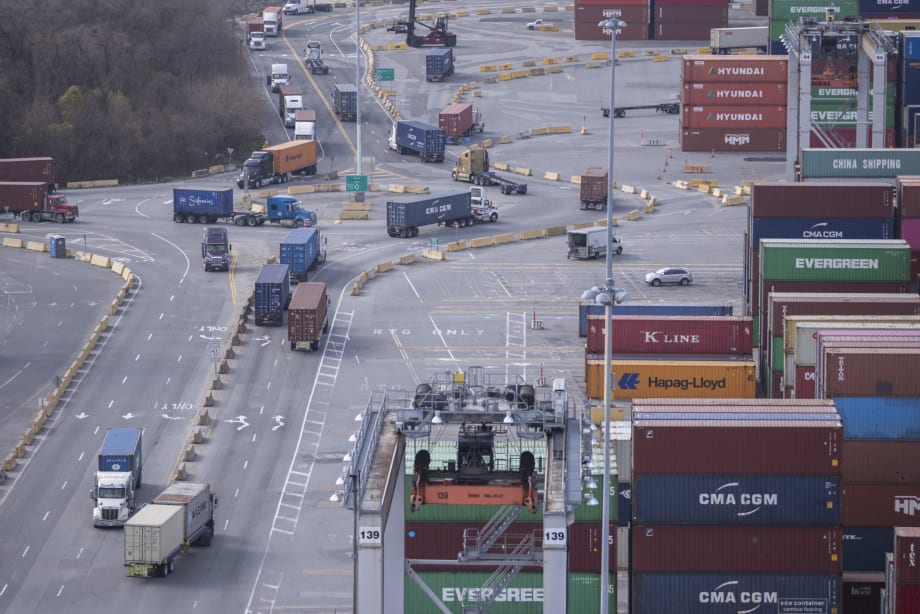
Starting in January 2023, work will begin to transition the 200-acre Port of Savannah Ocean Terminal to a container-only operation
Photo: Georgia Ports Authority
5 min to read
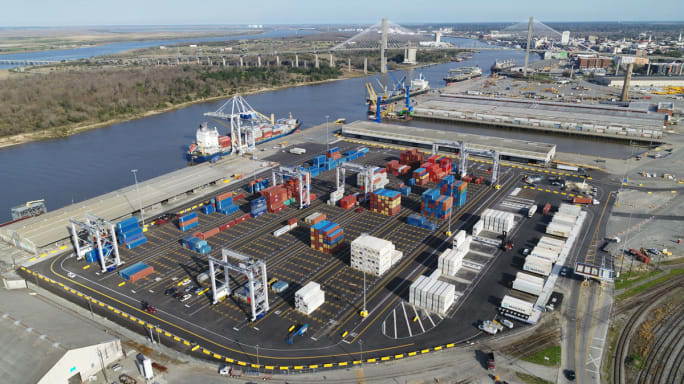
The Georgia Ports Authority will remodel the docks at Ocean Terminal in Savannah to handle two large container ships simultaneously.
Photo: Georgia Ports Authority
The Georgia Ports Authority is transforming the Port of Savannah’s Ocean Terminal into a container-only terminal as the number of containers coming into the port continues to grow and intermodal traffic continues to shift away from West Coast gateways.
For nearly 40 years, Ocean Terminal has been handling a mix of container ships and breakbulk vessels. The authority approved a plan to renovate and realign the docks at the Ocean Terminal, part of a broader effort to transform the terminal into an all-container operation, shifting most breakbulk cargo to the Port of Brunswick.
The 200-acre Ocean Terminal facility will have the docks rebuilt to provide enough berth space to serve two big ships simultaneously. Add expanded gate facilities and paving, and the project will allow for 1.5 million twenty-foot equivalent container units of annual capacity. Wharf renovations are slated to start in January 2023, with completion of the entire terminal redevelopment expected in 2026.
Earlier this year, the Savannah Harbor deepening was completed, which reduced tidal restrictions for mega-ships transiting the Savannah River. That allows vessels carrying 16,000+ twenty-foot equivalent container units to transit the river. The deeper water enables ships to load up to approximately 1,000 containers worth of additional cargo, for increased efficiency in vessel transport.
Record Container Volumes for Georgia
The Port of Savannah had its busiest October ever, handling nearly 553,000 TEUs, an increase of 9.6% compared to the same month last year.
Port officials expect container volumes to taper downward toward the end of the year. Lynch said the opening of a new container berth at Garden City Terminal next summer and volume declining from historic highs will help expedite vessel service, which saw backlogs during the height of demand.
Last month, the Georgia Ports Authority announced it had handled 552,800 twenty-foot equivalent container units in October, its second busiest month on record, after only August of this year, when the Port of Savannah handled 575,500 TEUs.
“Customers continue to bring new or expanding business to the Port of Savannah, drawn by our global connectivity and the supply chain network that links Savannah to major U.S. markets,” said GPA Executive Director Griff Lynch.
“There has been downward pressure on the total U.S. container trade related to inflation and a shift in consumer spending toward services such as restaurants and travel,” said GPA Board Chairman Joel Wooten. “However, the Port of Savannah continues to outperform relative to the national market.”
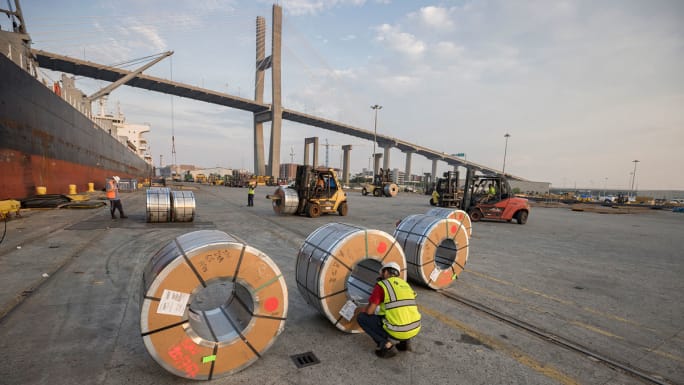
Breakbulk cargo such as vehicles and steel will shift from Savannah to the Port of Brunswick.
Photo: Georgia Ports Authority/Stephen B. Morton
East Coast vs. West Coast Ports
Savannah is only one of the East and Gulf Coast ports that have been gaining market share relative to the West Coast. According to PIERS/IHS Markit, the East Coast increased its share of the container trade from 47% in July 2021 to 48.4% in July of this year.
In addition to Savannah, Houston and Charleston, S.C. handled more import containers this year through September than a year ago, according to the Pacific Merchant Shipping Association.
“As anticipated, October was another torpid month in San Pedro Bay, even in comparison to pre-pandemic years,” the group said it its November ports report. Collectively, the two Southern California ports sustained a 26.1% fall-off in inbound loads from last October, while recording a 5% loss in outbound loads.”
At the Port of Oakland in Northern California, although inbound and outbound loads in October were up from a year ago, year to date, the port has handled 4.8% fewer containers than at this point in 2021.
“For thirty years, the ports of Los Angeles and Long Beach have had the #1 or #2 position, occasionally switching places, for container throughput in North America,” wrote PSMA Vice President Thomas Jelenić. “For the first time since 1992, the Port Authority of New York/New Jersey (PANYNJ) is likely to claim the #2 spot – and will be in spitting distance of #1.”
Why the Shift in Container Traffic to East Coast Ports?
A number of reasons have contributed to this shift, which already was happening before the COVID-19 pandemic:
- In 2016, larger locks completed at the Panama Canal started allowing larger ships carrying intermodal containers coming from Asia to access East Coast and Southeast ports. https://www.truckinginfo.com/135694/panama-canal-opens-larger-locks-impact-on-u-s-logistics-unclear
- Rising tensions on trade between the U.S. and China pushed American companies to shift more production to countries outside of China. Goods from Europe make more sense to ship into East Coast ports.
- Backups that developed at the southern California ports beginning in 2020 due to the Covid-19 pandemic prompted companies to not put all their eggs in one basket.
- The threat of a dockworkers strike this year at the California ports.
The Wall Street Journal reported that companies such as Newell, the Atlanta-based company that makes Yankee Candles and Sharpie markers, and clothing brand Abercrombie & Fitch have decided to expand distribution networks in eastern states.
Abercrombie & Fitch used to move 90% of its goods through West Coast ports, according to the WSJ. From there they were moved by rail and truck to their Ohio warehouse to be sent to fulfillment centers and stores. But after the supply-chain problems that happened as a result of the Covid-19 pandemic, which added weeks and event months to that process, the retailer started sending a larger share of goods to the East Coast and now ships 25% of its clothing through East Coast ports, primarily New York and New Jersey.
Trucking and logistics companies such as NFI are making investments to take advantage of this trend. NFI is scheduled to open a new transload and cross-docking facility in Savannah in 2023, which will be the first NFI warehousing location to use Boston Dynamics’ newest robot, Stretch. The mobile robot will begin unloading trucks and containers as a pilot program at NFI’s Savannah facility in 2023. Savannah’s not the only transload and cross-dock facility NFI has in the works in areas other than California. Additional facility openings in Virginia and Texas also slated to go live next year.
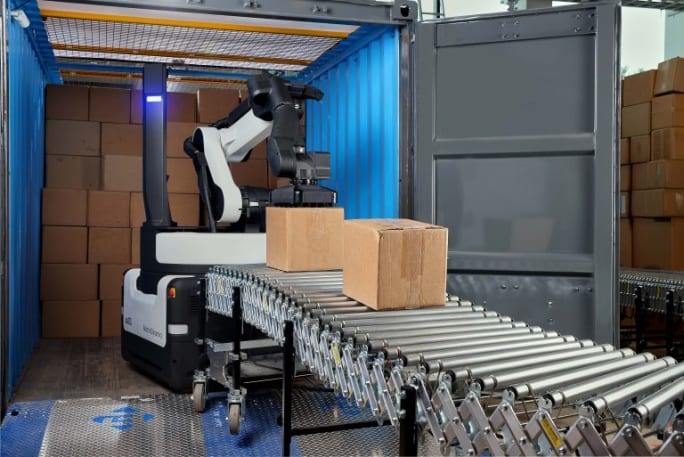
Trucking and logistics companies are ramping up transloading and warehousing operations near Savannah and other ports. NFI will pilot the use of robots in its new Savannah facility.
Photo: NFI
More Fleet Management

Geotab Links Fleet Card to Vehicle Data
The new card combines fuel discounts with telematics-based purchase controls. Geotab’s analysis also points to potential savings from choosing lower-priced fuel stops.
Read More →
How MFA Helps Protect Trucking Fleets
Multi-factor authentication adds protection when passwords are stolen. Here’s how it works and where fleets should start.
Read More →
How Better Freight Data Helps Trucking Teams Get Ahead of Disruption
Trucking and logistics teams have plenty of data. The problem is getting the right information in front of the right people soon enough to act. Better-connected data can help teams spot trouble earlier and make smarter decisions before small problems become big ones.
Read More →

Trimble: Taking Artificial Intelligence in Trucking Beyond Faster Tasks
At Insight 2026, Trimble executives argued that fleets may need to redesign workflows to get more from AI as it introduced new products and enhancements. AI’s value will depend on how fleets combine automation with their people's knowledge.
Read More →
Sponsored•September 28, 2026
Build a bulletproof fleet: Uniting ELDs and dash cams for total compliance
An ELD can prove compliance, but it cannot always prove what happened on the road. Discover how uniting accurate ELD data with AI-powered dash cam video can help your fleet strengthen compliance, defend against liability, protect drivers and reduce operational costs.
Read More →
Nominations Open for HDT Emerging Leaders
Heavy Duty Trucking is looking for accomplished trucking fleet professionals under 40 who are making an impact and helping lead the industry forward.
Read More →
Why Private Fleets Are Taking More Freight
Private fleets are putting their own trucks on demanding customers and high-cost lanes as companies seek greater control over service, costs, and capacity.
Read More →
Sponsored•September 16, 2026
Color Match Smarter: Tools That Restore & Perform
For fleet managers and collision repair professionals keeping heavy-duty trucks on the road, getting the color right the first time isn't just about appearance — it's about efficiency, turnaround time, and bottom-line results. Discover how today's digital color tools are transforming the repair process from guesswork to precision.
Read More →
FMCSA Pauses Biennial-Update Enforcement Amid Motus Transition
Carriers whose updates were due on or after June 1 have more time, while FMCSA works to stabilize its new registration system and warns of phishing sites impersonating its new carrier registration system, Motus.
Read More →
Sponsored•September 14, 2026
2026 Blueprint for Countering Smarter Supply Chain Theft
Cargo theft is no longer just the cost of doing business. It's a multi-billion-dollar criminal enterprise exploiting vulnerabilities across your fleet, drivers, and supply chain.
Read More →