




Freightliner's SuperTruck II Debuts Latest Efficiency Innovations
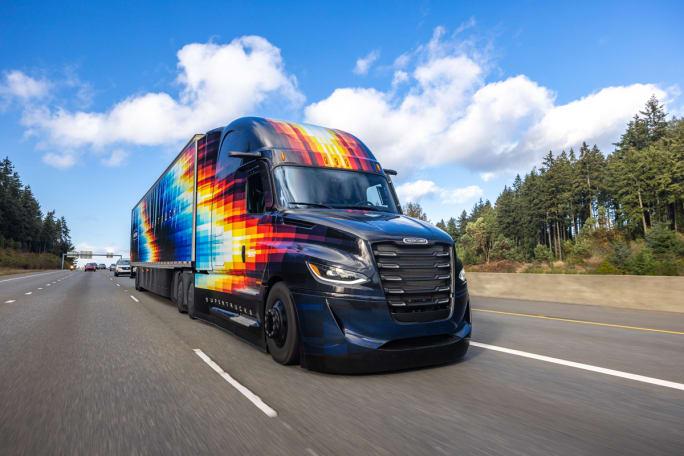
DTNA and Freightliner's SuperTruck II demonstrator truck is the most aerodynamic Freightliner ever built, and it integrates its most efficient powertrain.

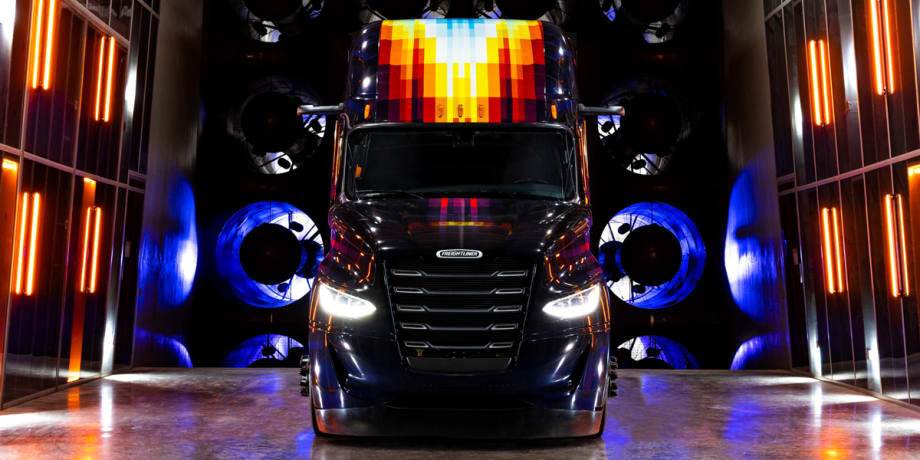
DTNA and Freightliner's SuperTruck II demonstrator truck is the most aerodynamic Freightliner ever built, and it integrates its most efficient powertrain yet.
Photo: DTNA
Daimler Truck North America and its brand Freightliner debuted the SuperTruck II, a demonstrator heavy-duty truck designed to showcase innovative features that are poised to deliver the next level of freight efficiency.
As part of the SuperTruck program co-funded by the U.S. Department of Energy with the aim to reduce emissions from on-road freight transportation, DTNA engineers were able to investigate next-generation technologies for heavy-duty commercial trucks and to clear the technical pathway for their development and potential integration into series production.
We set out to not just meet the goals of the SuperTruck II challenge, but to exceed them. The result: the Freightliner #SuperTruckIIhttps://t.co/SL5N7A5zjqpic.twitter.com/EeWkV7Ld3E
— Freightliner Trucks (@freightliner) February 1, 2023
Focus was on developing new technologies on the most promising core components and systems to improve the real-world operational efficiency. Areas for technology innovations that could potentially enter production for customers in the future were:
enhanced tractor aerodynamics
powertrain improvements
low-rolling resistance tires
energy management
“Taken all together, the combined innovations developed for the Freightliner SuperTruck II have provided us the opportunity to explore the technologies needed to meet stringent and forthcoming greenhouse gas reduction requirements in the coming years,” said Rainer Mueller-Finkeldei, DTNA’s senior vice president of engineering and technology, in a press release.
Building on the success of SuperTruck I, which overachieved DOE requirements in 2015, SuperTruck II surpassed expectations in aerodynamics, tires, powertrain and energy management, while doubling the freight efficiency of the base vehicle from the start of the SuperTruck program.
SuperTruck II: Most Aerodynamic Truck Freightliner Has Ever Built
In close collaboration between the design and engineering departments, the teams reduced the aerodynamic drag of SuperTruck II by more than 12% over SuperTruck I.
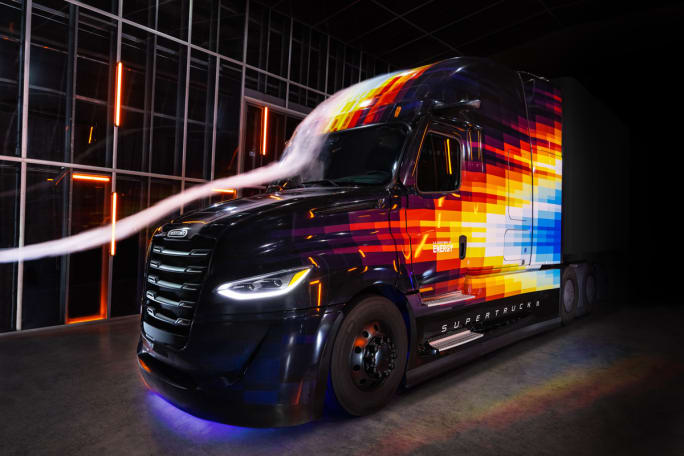
The aerodynamic drag of SuperTruck II was reduced by more than 12% over SuperTruck I.
Photo: DTNA
The aerodynamic features include:
The grille, air intakes and doors were redesigned to be as seamless and clean as possible; no sharp edges compromise the aerodynamics.
Active side extenders and a roof spoiler system closes the trailer gap by up to 4 inches at highway speeds.
Enhanced aerodynamic height control lowers the truck inches off the ground for additional aerodynamic improvements.
Thanks to federal exemption by the National Highway Traffic Safety Administration (NHTSA) for the program, by removing the exterior mirrors and integrating a mirrorless camera system the aerodynamic drag of SuperTruck II was significantly reduced. The cameras have been tested under all weather conditions and have shown “great promise in enhancing the driver’s visibility and improved vehicle safety,” which supports advocacy for future regulatory changes that would permit the widespread adoption of this advanced technology by manufacturers, DTNA officials said.
Instead of radically changing the structure of the truck, the design goal for SuperTruck II was to redefine the existing shape of the Freightliner Cascadia to maximize aerodynamic efficiency.
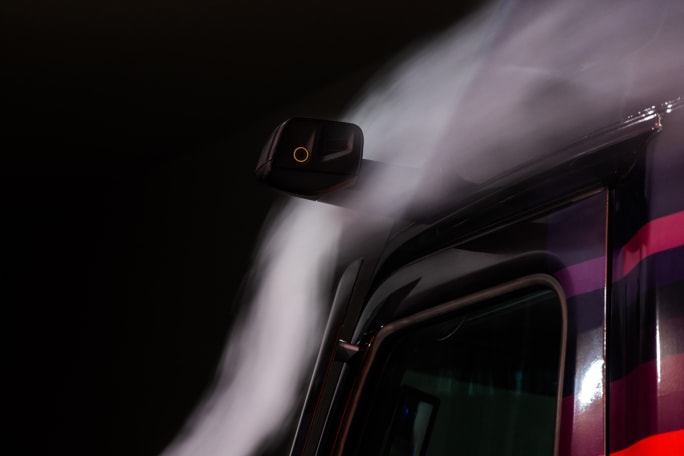
The grille, air intakes and doors of the SuperTruck II were redesigned to be as seamless as possible.
Photo: DTNA
“The designers imagined the surfaces of the truck being carved away by the wind,” said Jeff Cotner, chief designer at DTNA. “Nature has a way of creating the perfect sculptural shape, when the material is light and airy like snow or sand. This was our inspiration in creating the new expressive form language for the Freightliner brand.”
Cotner added: “Sometimes what the eye sees is not what the air sees. We let the areas most critical to aero performance design themselves and integrated the more expressive lines in the places where the drag is neutral. Our goal was to gain as much freight efficiency as possible and create a beautiful looking truck at the same time. It was important to us that we didn’t change something just for the sake of changing it.”
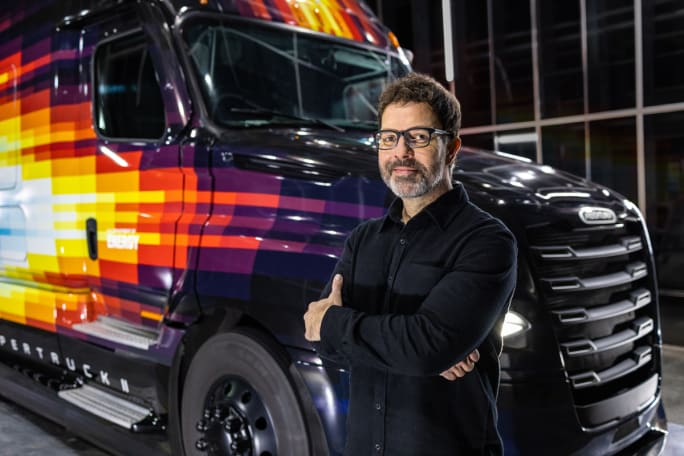
"We let the areas most critical to aero performance design themselves," said Jeff Cotner, chief designer at DTNA.
Photo: DTNA
The redesigned hood, bumper and chassis fairing all work well with the existing cab structure and now allow the air to flow undisturbed around the truck.
SuperTruck II Powertrain Efficiency Improvements
DTNA says the SuperTruck II features the most efficient powertrain Freightliner has integrated into a truck. The powertrain enables a 5.7% fuel consumption reduction over SuperTruck I.
With a non-certified prototype Detroit 13-liter engine featuring two-stage turbo and interstage cooling and a 13-speed overdrive transmission, the powertrain is able to achieve lower downspeeding and greater fuel savings through reduced drag overdrive.
One key powertrain feature of SuperTruck II is split cooling. This system consists of high temperature and low temperature cooling circuits, working in tandem with two-stage turbocharging and exhaust gas recirculation cooling on the engine. Together, these technologies result in further efficiency gains enabling more aggressive downspeeding.
A smart engine lubrication circuit minimizes internal pumping losses, thus reducing engine parasitics by actively proportioning flow to the most sensitive components.
With adaptive tandem axles another innovation helps increasing fuel efficiency. It allows increased torque from the fuel-efficient powertrains and automatically shifts from 6x4 to 6x2 at highway speeds which benefits the driver when maneuvering in low speed.
SuperTruck II Features Low-Rolling Resistance Tires
DTNA again collaborated with SuperTruck I partner Michelin on the development of brand new tires specifically designed for adaptive tandem axles to not only reduce vehicle energy consumption but also to reduce maintenance downtime due to minimized wear and tear on the tires.
Tires play a critical role to achieving that goal. By lowering the friction on the road, less fuel is needed to maintain the truck speed, DTNA officials said.
The engineers were able to significantly reduce the tractor rolling resistance by 12% over SuperTruck I.
By removing exterior mirrors and integrating a mirrorless camera system the aerodynamic drag of SuperTruck II was significantly reduced.
Photo: DTNA
In co-development with DTNA, Michelin designed tires specifically for the steer, drive and tag axles of SuperTruck II. The introduction of dynamic load shift further increases efficiency and fuel savings. With this technology, some of the load will be shifted automatically from the drive axle to the tag axle to take advantage of the tag tire low rolling resistance.
The overall design of the new tires included development of new treads and compounds that translated into more than 20% improvements in drive tire wear and tear and overall significantly improved rolling resistance.
Energy Management Features of the SuperTruck II
SuperTruck II features an innovative 48-volt electrical system with lithium-ion batteries, enabling a new electric steering system to adjust demand as needed, whether the operator is maneuvering at low speed or driving at highway speeds, or to operate during EcoSail while the engine is off.
The intelligent EcoSail feature can turn the engine off when drive power is not needed, without requiring any intervention from the driver. At the same time, if the truck is coasting down a hill while the engine is off, features like air conditioning remain in operation. As soon as power is needed, the engine will restart automatically for a seamless experience for the driver.
More 48-volt features result in decreased fuel consumption and increased driver comfort like a new electric air conditioning system that consumes 50% less energy than SuperTruck I and continues operations while the engine is turned off.
A new 48-volt starter turns on the engine with more power and speed.
Finally, the new 48-volt electrical system operates the hoteling features without the engine running while delivering 12- volt power for the standard cab items like lighting or the instrument cluster.
More Fuel Smarts

How Volvo Updated Its D13 for EPA 2027 [Watch]
Volvo’s updated D13 promises lower emissions without sacrificing performance or fuel economy. Take a closer look at what changed inside the engine in this HDT Spotlight video.
Read More →
Diesel Price Spike Shortens Payback for Natural Gas Trucks, Report Says
Energy Vision estimates fleets could recover the higher purchase price of an RNG-fueled Class 8 tractor in 1.3 to 2.8 years under current fuel-price scenarios.
Read More →
Calstart Becomes Catalyst Mobility, Reflecting Broader Focus
Calstart is now Catalyst Mobility, reflecting the nonprofit’s growing national role in clean transportation, including zero-emission trucks, infrastructure and incentive programs.
Read More →

Record Diesel Prices Squeeze Trucking Fleets
Average U.S. diesel prices have climbed to nearly $6 a gallon, surpassing the 2022 record as tight refinery capacity and Middle East disruptions keep fuel costs elevated.
Read More →
How Fuel Delivery Shapes Engine Performance
Fuel delivery depends on more than what happens at the injector. For fleet, maintenance and technical professionals, looking at the full path from pump to injector can provide useful context for understanding engine performance.
Read More →
East Coast Port Launches $45M Electric Truck Push
The Port Authority of New York and New Jersey announced millions in incentives for zero-emission drayage trucks, yard tractors, and new charging hubs near the port.
Read More →
California Bill Could Shed Light on Electric Truck Prices
Why do battery-electric Class 8 trucks remain so expensive? A California bill headed to Gov. Gavin Newsom would give fleets and state agencies more visibility into what manufacturers charge.
Read More →
Detroit Opens Orders for EPA 2027 Engines
Detroit isn’t starting from scratch to meet EPA 2027 diesel emissions standards. Its Gen 6 DD13 and DD15 engines keep much of today’s platform while updating the fuel and aftertreatment systems.
Read More →
Zero-Emission Truck Corridor Planned for West Coast
California, Oregon, Washington, British Columbia and Baja California are coordinating plans for truck charging and hydrogen fueling from Canada to Mexico.
Read More →
A Closer Look at Kenworth’s Electric T880E Vocational Truck [Video]
Learn more about Kenworth's T880E battery-electric vocational truck at the Paccar Technical Center, including its range, applications, upfitting considerations, and PTO options, in this HDT Spotlight video.
Read More →