





Knight-Swift to use Embark Truck as Part of Truck Transfer Program
FMCSA Seeks Input on Regulating Autonomous Commercial Vehicle Safety
As motor carriers begin using trucks with high levels of autonomous features in real-world operations, the Federal Motor Carrier Safety Administration is looking at how they should be regulated.
February 2, 2023
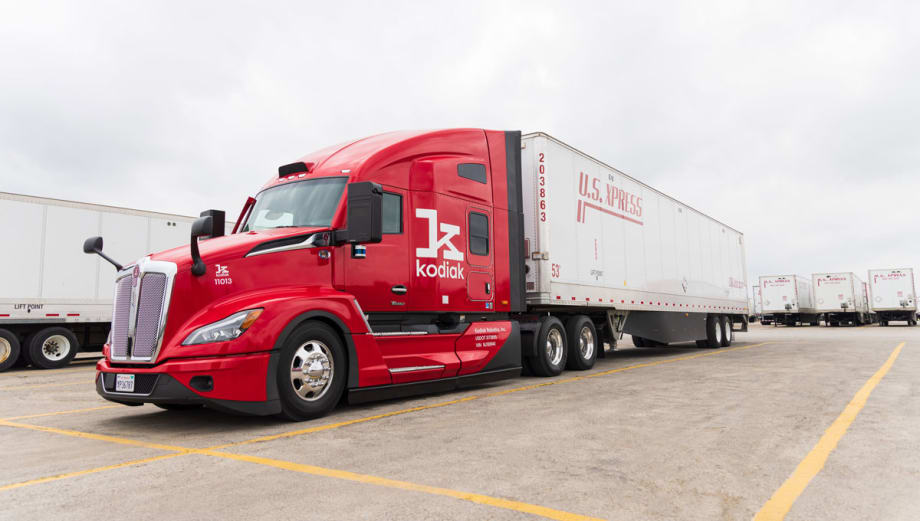
Should motor carriers operating Level 4 or 5 autonomous trucks be required to notify FMCSA?
Photo: Kodiak Robotics
7 min to read
The development of autonomous technology for commercial vehicles has advanced since the Federal Motor Carrier Safety Administration asked for comments in 2019 on how it might need to change federal regulations to accommodate automated driving systems. The agency is now asking for additional input in a supplemental rulemaking document concentrating on higher levels of autonomous operation.
“ADS developers are actively engaged in the development, testing, and limited deployment of ADS-equipped CMVs, and promoting their use in commercial motor carrier operations,” notes the agency in a new notice asking for public comment. “Although many ADS-equipped CMVs are being tested in manufacturer or developer-owned fleets, many developers and manufacturers are also working to integrate their ADS equipment into existing motor carrier fleets. To mitigate potential safety risks associated with in-service use of ADS-equipped CMVs, FMCSA is developing an appropriate regulatory framework.”
It's not the first time the agency has asked for input on automation. A 2019 advance notice of proposed rulemaking asked for comments on FMCSRs that may need to be changed to facilitate the safe introduction of ADS-equipped CMVs onto the nation's roadways.
Today, the agency is more concerned about advanced levels of autonomy — ones where there’s no driver behind the wheel.
The Department of Transportation previously adopted SAE International's definitions for the levels of driving automation. The six levels of automation range from Level 0 (driver support features but no driving automation) to Level 5 (full driving automation).
FMCSA said it does not believe there is a need to revise the FMCSRs for levels 0-3, because a licensed human CMV driver must be seated behind the wheel and ready to take over dynamic driving tasks if needed.
“The focus of this notice is Level 4 and 5 ADS-equipped CMVs, because it is only at those levels that an ADS can control all aspects of the dynamic driving task without any expectation of an intervention from a human driver,” FMCSA explained in the new supplemental notice, Safe Integration of Automated Driving Systems (ADS)-Equipped Commercial Motor Vehicles (CMVs).
FMCSA is asking questions about three areas of concern:
Notification by Motor Carriers Operating Autonomous CMVs
FMCSA is considering requiring motor carriers to notify FMCSA that they will operate ADS Level 4 or 5 commercial motor vehicles in interstate commerce without a human driver behind the wheel. Among the questions it’s asking:
Should FMCSA require motor carriers operating Level 4 or 5 ADS-equipped CMVs to notify FMCSA before operating those vehicles in interstate commerce without a human driver behind the wheel? If so, what potential methods or procedures should be established to notify FMCSA of those operations?
Before operating in interstate commerce, should motor carriers be required to submit information, data, documentation, or other evidence that demonstrates to FMCSA that motor carriers seeking to operate Level 4 or 5 ADS-equipped CMVs have appropriate safety management controls in place to operate the vehicle in accordance with the manufacturer's specifications and with Federal requirements?
What data should FMCSA collect and maintain regarding Level 4 or 5 ADS-equipped CMVs engaged in interstate transportation?
What is the current size of the Level 4 or 5 ADS-equipped CMV population? What is the anticipated size of the population within five years? Ten years?
On average, how many days are Level 4 or 5 ADS-equipped CMVs expected to be operational per year?
Oversight for Remote Assistants
At Level 5 driving automation, the ADS technology will be expected, by definition, to be capable of performing all driving functions under all conditions. For Level 4 driving automation, the ADS technology would be limited to certain operational design domains (ODD).
However, when a Level 4 CMV reaches the limit of its ODD, continued operation may require a human driver, either seated behind the wheel or located remotely, to directly control the CMV — in other words, remote drivers.
FMCSA’s position is that the FMCSRs applicable to drivers seated behind the wheel, such as drug and alcohol use and testing, CDL requirements, hours of service, distracted driving, and medical qualification standards, should continue to apply to remote drivers who are able to take control of an ADS-equipped CMV operating on a public road. This remains FMCSA's position.
However, what about remote monitors that don’t take direct control?
Some motor carriers' operational models may include someone who would remotely monitor the Level 4 or 5 ADS-equipped CMV. On an as-needed basis, this remote assistant would engage with the vehicle via telematics to assist the ADS. The remote assistant would not engage in direct control of the vehicle throttle, steering, accelerator, turn signals, lighting, or other vehicle control functions. However, the remote assistant could engage with law enforcement personnel, first responders and/or other public officials. FMCSA is asking what requirements, if any, should be imposed on these remote assistants, including:
To what extent should the federal requirements otherwise applicable to CMV drivers (such as hours-of service limitations, drug and alcohol testing, and physical qualifications), also apply to a remote assistant who is not expected to take control of the dynamic driving task of an ADS-equipped CMV operating at Level 4?
What, if any, aspects of the remote assistant job function may require FMCSA oversight, including minimum standards and/or auditing, such as training, physical qualifications, and other job-performance related measures?
Are there any qualification requirements that FMCSA should consider for remote assistants, such as related experience, for instance as a CDL holder?
Are there any specific limitations that should be imposed on the working conditions of remote assistants, such as limitations on the number of vehicles a remote assistant is simultaneously responsible for or the number of hours a remote assistant may work?
Vehicle Inspection and Maintenance
FMCSA explained that motor carriers operating Level 4 or 5 ADS-equipped CMVs must comply with existing vehicle inspection and maintenance regulations, including the requirements for pre-trip, post-trip, periodic, and roadside inspections, unless those regulations are revised. Motor carriers operating Level 4 or 5 ADS-equipped CMVs also would need a means to ensure that the ADS equipment is properly maintained and functioning.
Level 4 or 5 ADS-equipped CMVs have the potential to operate almost continuously, except for re-fueling and maintenance, so FMCSA is considering whether additional inspection requirements should be required to account for extended periods of operation without direct human observation.
At the same time, roadside inspections of Level 4 or 5 ADS-equipped CMVs would be uniquely challenging in the absence of a human driver to engage in the inspection process. For example, during a Level 1 roadside inspection, a human driver is generally required to communicate with enforcement officers and perform tasks associated with the inspection, such as testing the braking system, lighting functions, and the fifth wheel movement. The agency therefore is asking for comment to better inform its rulemaking proposals in the areas of inspection and maintenance of ADS-equipped CMVs.
The Commercial Vehicle Safety Alliance recently released a new program and procedures on inspections of ADS-equipped CMVs, and FMCSA is asking for comments on that document as well.
Should Level 4 or 5 ADS-equipped CMVs be subject to pre-trip inspection requirements for their mechanical and ADS components in addition to those specified in 49 CFR 392.7, including those which might require new inspection equipment, before such CMVs are dispatched and after a specified period of operation? If so, what methods should be used, what should be inspected, what documentation should be required, who should be responsible, and how frequently should the additional inspections be conducted?
If additional inspections, inspection equipment, or additional qualifications for inspectors are proposed, what would it cost motor carriers in time and money?
What technical barriers exist to conducting conventional roadside inspections (which require interactions with the human driver) of Level 4 or 5 ADS-equipped CMVs? What approaches currently exist or might be developed to remove those barriers?
If Level 4 or 5 ADS-equipped CMVs are not required by the states to undergo roadside inspections during operation, what information should be communicated by the motor carrier and CMV to the state inspectors? For instance, the results of potential alternative pre-trip inspections, and/or the real-time status and condition of safety-critical systems such as brakes, tires, lighting systems, steering, and ADS components.
What communication systems currently exist that would allow roadside inspection officers to receive information regarding Level 4 or 5 ADS-equipped CMVs, and what information could be transmitted via these systems regarding the mechanical condition of the CMV and other operational documentation, (such as shipping documents and origin/destination), while en route?
Under what safety situations should state inspectors and/or FMCSA receive immediate notification of an unsafe maintenance or operational issue, if any? What data and information would need to be provided in instances such as tow-away crashes or those that disable key operational features of a CMV?
Comments on these and other questions in the SANPRM must be received on or before March 20, 2023 and can be submitted here.
More Safety & Compliance

From One Generation to the Next: How Mentorship Builds Safer Truck Drivers
After three decades in trucking, Harold Perry shares what he's learned about driver safety, mentorship, and helping the next generation build confidence behind the wheel.
Read More →
FMCSA Pauses Biennial-Update Enforcement Amid Motus Transition
Carriers whose updates were due on or after June 1 have more time, while FMCSA works to stabilize its new registration system and warns of phishing sites impersonating its new carrier registration system, Motus.
Read More →
ZF Expands Commercial Vehicle Push in North America
ZF is expanding its North American commercial-vehicle presence with new transmission applications, electrification, trailer technology and autonomous-driving systems.
Read More →
Truck Drivers Need More Than Another Alert
Fleets have more visibility into truck health, safety events, and driver activity than ever. The next challenge is turning all that information into useful guidance for the person who has to decide what to do next.
Read More →
Tesla Wants a Self-Driving Semi. Are Cameras Enough?
Could Tesla’s camera-only autonomous driving technology work on an 80,000-pound Semi? In this commentary, HDT's Deborah Lockridge takes a look at Tesla, Cybercab, and how autonomous trucks see the road.
Read More →
What DOT’s Automated Vehicle Strategy Means for Trucking
The U.S. Department of Transportation issued a new automated-vehicle strategy that outlines plans for driverless-truck regulations, cross-state freight corridors, and federal safety standards.
Read More →
NYC Expands Speed, Pedestrian Safety Tech Across Fleet
New York City is expanding intelligent speed assistance and pedestrian-alert systems across its municipal fleet, moving the technologies from pilot programs into vehicle procurement and retrofit requirements.
Read More →
FMCSA Removes 110 Truck Driver Training Schools from Certified ELDT List
Federal regulators also are targeting more than 160 additional training providers and launching a nationwide audit of third-party CDL skills testers as part of a broader crackdown on trucking fraud.
Read More →
Beyond DOT Compliance: What Makes a Trucking Fleet Truly Safe?
A trucking fleet can follow every rule and still make unsafe decisions. The real test comes when safety conflicts with freight, productivity, or cost.
Read More →
Hours of Service Pilot Programs: FMCSA Readies for 2027 Rollout
Two pilot programs could eventually reshape hours-of-service rules, giving truck drivers options to pause their 14-hour clock or use longer split sleeper rest periods.
Read More →