It’s impossible to gauge the full impact of the electronic logging device mandate yet, between temporary exemptions and a phased-in enforcement period, and in fact we may not know the true effect on the industry until rates soften significantly, according to FTR analysts.
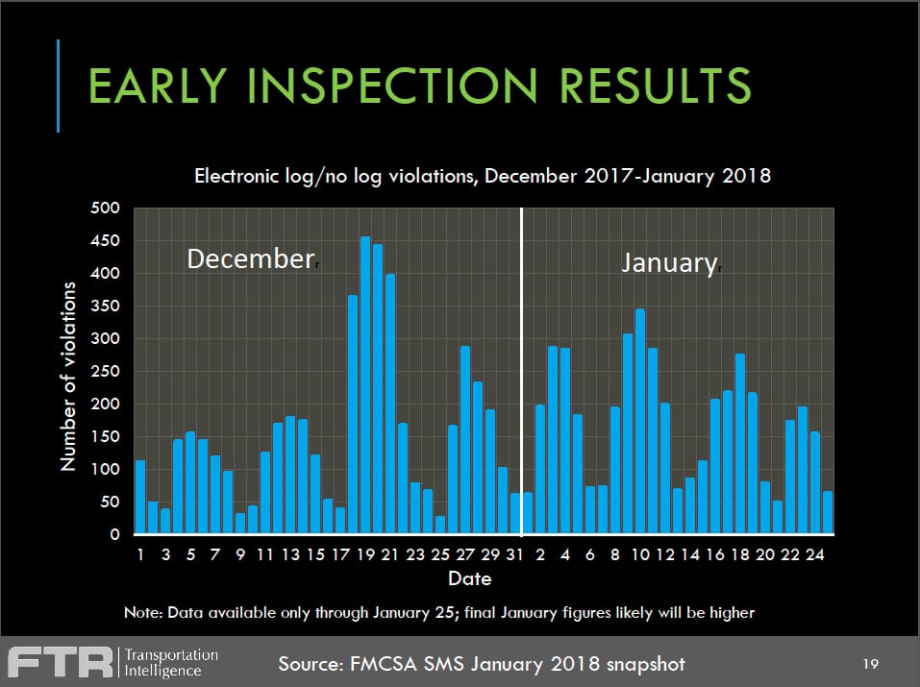
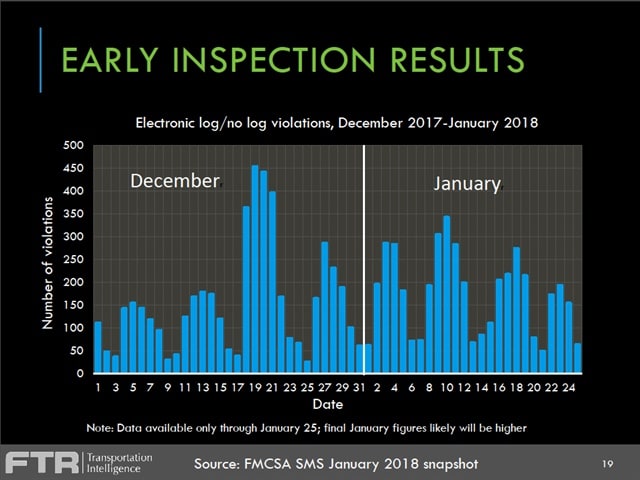
Citations have increased for violations related to AOBRDs during ELD transition.Graph courtesy FTR.
6 min to read
Citations have increased for violations related to AOBRDs during ELD transition.Graph courtesy FTR.
It’s impossible to gauge the full impact of the electronic logging device mandate yet, between temporary exemptions and a phased-in enforcement period, and in fact we may not know the true effect on the industry until rates soften significantly, according to FTR analysts.
The ELD mandate went into effect Dec. 18 and requires most interstate commercial drivers to use devices meeting Federal Motor Carrier Safety Administration specifications to track their hours of service and ensure they're not exceeding federal limits.
Ad Loading...
How many exemptions does it take to gut a rule?
In the forecasting firm’s monthly State of Freight webinar, Avery Vise, vice president of trucking research, summarized the exemptions currently in place, including a technical reprieve for UPS and one for the Motion Picture Association of America, and noted the many exemption applications that are still pending, from agriculture retailers to power and communication contractors.
The big question, he noted, is the Owner-Operator Independent Drivers Association’s petition to exempt “small business” trucking operations of less than $27.5 million in annual revenue, which would be in fact the majority, some 95% or more, of trucking companies, Vise said.
While OOIDA’s petition includes a couple of qualifiers, in reality those would not reduce the number of fleet exempted by very many, Vise said. One was that to be exempt, carriers could not have an unsatisfactory safety rating. Vise noted that if you have an unsatisfactory safety rating and aren’t implementing a plan to correct it, “you’re out of business.”
Ad Loading...
The other qualification in the OOIDA petition was that exempt carriers would have to be able to document a proven history of safety performance with no at-fault crashes. Vise said even putting aside the fact that there’s no concrete definition of what constitutes an at-fault crash, just looking at all DOT-reportable crashes, it still would only remove a small number of companies from the equation. Currently 93% of one-truck over-the-road trucking operations have had no DOT-reportable crashes in the past two years. “When you take that into account, you’re talking about an exemption that can affect tens of thousands of carriers.”
Vise said his personal feelings are that OOIDA’s petition is unlikely to succeed, but he did say it is possible, noting that a letter from 25 members of Congress went to FMCSA supporting OOIDA’s petition.
As the Trucking Alliance noted in its comments filed in opposition to the exemption, this would essentially “gut” the ELD rule.
Clay Slaughter, FTR’s new senior analyst, noted that if FMCSA were to grant OOIDA’s exemption, it might well result in a legal battle, since the ELD rules are the result of a Congressional mandate. “When an executive branch makes an exemption of a legislative mandate, we undermine the rule, and can get into a legal battle.” So such an exemption could be reversed fairly quickly by the courts.
ELD enforcement issues
While some 17 states reportedly have decided to not do any enforcement until April 1, another dozen are leaving it up to the individual officer, leaving 19 that are currently writing ELD tickets.
Ad Loading...
FMCSA asked states to use a specific violation code, 39522A, between Dec. 18 and April 1 to indicate ELD violations, which would not affect CSA scores, but would allow FMCSA to gather data on ELD use. Vise says in looking at publicly available data, that code is not appearing. Whether that means officers aren’t using it, whether FMCSA is not making that information public, or whether there’s an IT problem, he didn’t know.
Instead, Vise pointed out, data shows an increase in 3958A (no logs available) and 39515 (violations related to use of e-logs meeting the previous government spec for automatic onboard recording devices, or AOBRDs.) Those apparently will affect carrier CSA scores, unless they are challenged through the DataQs process. This tracks with what J.J. Keller reported a few weeks ago, when it noted that there are reports of drivers with AOBRDs being cited (but not fined) for ELD-related violations.
So enforcement is uneven and spotty, making it hard to get a solid picture of ELD compliance at this point in time. In addition, some operators, knowing that enforcement may be scarce and that if they do get a ticket they won’t be put out of service or have CSA points assessed, are waiting until the very last minute to comply.
This is not what the Commercial Vehicle Safety Alliance and FMCSA had in mind when they announced the phased-in enforcement, CVSA Executive Director Collin Mooney recently told Today’s Trucking.
“We are disappointed that our implementation process — our delay in implementing out-of-service conditions until April 1 — has been taken by many in the industry as the new implementation date. That wasn’t the intent,” said Mooney. “I’m disappointed in the handful of people electing to install their ELDs so they meet the regulatory definition, but then still using paper. It’s not meeting the regulatory intent.”
Ad Loading...
ELDs and capacity questions
From a broader logistics standpoint, FTR sees three principal potential effects, which have been discussed for some time:
Lost productivity due to longer transit times, as loads take longer to deliver once drivers are forced to comply with hours of service limits. This will be very lane-specific and will vary from shipper to shipper, but it will be severe in some cases.
Lost productivity due to inefficiencies such as excessive detention and driver-unfriendly shipper and receiver schedule. “This one is endemic in a lot of areas,” Vise said, especially in the refrigerated/grocery sector.
Lost capacity due to drivers/carriers leaving the market. “This could be significant, but what we’ve seen to this point is all anecdotal,” Vise noted.
It’s that third area where we may not see significant effects until A, full enforcement kicks in come April 1, and B, freight rates come down.
“I’ve had the opportunity to talk to some small carriers,” Slaughter said, “and the basic sentiment was they’re going to do what they’re doing until they’re forced to comply.”
However, Vise noted, the current high spot market rates could mitigate the impact of ELD productivity losses for small carriers. He posted an example of an owner-operator running 120,000 miles a year, 10% of those empty, at a $1.58 spot rate a year ago. Assuming a 9% productivity loss running legal under ELDs, he said, that would mean about a $15,000 penalty for that owner-operator. But looking at today’s rate of $2.05, he said, and given the same productivity penalty, that owner-operator would actually be making $30,000 more than a year ago.
Ad Loading...
“Until spot market rates drop below $1.75 a mile, the owner-operator would be better off financially” than a year ago, even being forced to abide by hours of service rules under mandatory ELDs. And that’s assuming no improvement in the empty-mile percentage, and with today’s tight capacity, it’s likely those empty miles would be less.
“We may not see the impact of ELD compliance until we get some softness” in the market, Vise said.
The dangers of beyond-ELD data
Vise also covered the shortcomings of the FMCSA’s “safe harbor” provision barring the agency from using ELD data for any purpose other than ensuring hours of service compliance. That prohibition does not apply to data from AOBRDs, nor to data carriers use from their ELD device for other business purposes.
“So FMCSA can demand that data, and they do – and they train inspectors how to go in and retrieve data from carrier GPS systems and match that against logs and other things,” Vise said.
Speeding is a good example. “We have seen instances where carriers have been given a part 392.2 violation – a catch-all for state and local violations, predominantly speeding – and in compliance reviews [fleets] have gotten substantial fines.” One carrier, he said, was assigned three of these violations, with a penalty of $17,000.
Unknown, Vise and Slaughter said, is whether enforcement officials could do the same at roadside inspections.
In the future, they added, expect others to be looking to do things with this data, such as insurance companies wanting to use it to help make decisions.
For fleet managers and collision repair professionals keeping heavy-duty trucks on the road, getting the color right the first time isn't just about appearance — it's about efficiency, turnaround time, and bottom-line results. Discover how today's digital color tools are transforming the repair process from guesswork to precision.
Carriers whose updates were due on or after June 1 have more time, while FMCSA works to stabilize its new registration system and warns of phishing sites impersonating its new carrier registration system, Motus.
Cargo theft is no longer just the cost of doing business. It's a multi-billion-dollar criminal enterprise exploiting vulnerabilities across your fleet, drivers, and supply chain.
Explore how telematics help refrigerated fleets improve visibility, uptime, efficiency, compliance, and cargo protection across connected cold chain operations.
Escalating U.S.-Canada tariffs could disrupt cross-border freight, reduce truck volumes, raise costs, and create new uncertainty for carriers on both sides of the border.
The American Transportation Research Institute wants to know what's worrying trucking fleet managers, drivers, and other stakeholders in its annual Industry Issues survey.
HDT Truck Fleet Innovator Adam Buttgenbach helped PepsiCo build one of North America’s largest EV fleets by focusing on where electric trucks make operational sense.