




Economic Panel Sees Mixed Forecast for Trucking, Economy
LAS VEGAS - A panel discussion on the economy indicated that the economy and trucking will continue to see slow but steady growth of around 2% GDP through 2013, barring something like a total financial crisis in the Eurozone or the unlikely aspect of Congress driving the country over the "financial cliff" looming at the end of the year
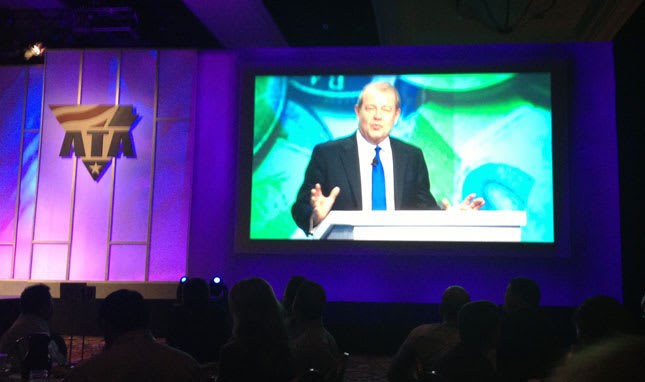
Stuart Varney moderates an economic panel during the American Trucking Associations' annual conference.
LAS VEGAS - A panel discussion on the economy indicated that the economy and trucking will continue to see slow but steady growth of around 2% GDP through 2013, barring something like a total financial crisis in the Eurozone or the unlikely aspect of Congress driving the country over the "financial cliff" looming at the end of the year.
Bob Costello, American Trucking Associations chief economist; Lawrence Yun, chief economist and senior vice president of research at the National Association of Realtors, and Gregory Daco, senior economist at IHS Global Insight, participated in the "All Eyes on the Economy" general session Tuesday during ATA's annual Management Conference and Exhibition in Las Vegas. The panel was moderated by Stuart Varney, an economic journalist who works for the Fox News Channel and the Fox Business Network.
"I think we're in for a number of quraters of medium growth," Daco said, at about 2% GDP growth for this year and 1.8% for next year - "a picture of good but not great. Compared to the rest of the world, the U.S. is the best looking horse in the glue factory."
The Fiscal Cliff
One of the biggest threats to the economy is the "fiscal cliff." This is the term used to describe what's going to happen at the end of 2012 when the terms of the Budget Control Act of 2011 are scheduled to go into effect, ending a number of temporary tax cuts and activating deep automatic spending cuts agreed upon as part of the debt ceiling deal of 2011.
Although both Democrats and Republicans have said that going over the fiscal cliff might put them in a better negotiating position, panel members felt it was unlikely they actually would let it happen.
Daco explained that IHS Global Insight is currently predicting 1.8% GDP growth for next year. However, if the country goes over the fiscal cliff, it's predicting two consecutive quarters of negative growth in 2013.
"We need Congress to act," Daco said. "And what we have assumed is that Congress will baswically kick the can down the road so the real fiscal cliff will be around july 1. That will allow the newly elected Congress and president to have time to deal with this fiscal cliff."
Leaders from the U.S. Chamber of Commerce, Business Roundtable, the National Association of Manufacturers and the National Retail Federation Wednesday said Congress needs to stop kicking the can down the road, saying the uncertainty is "like playing with replacement referees."
Other than the fiscal cliff, the main concerns are outside our borders, Daco said. A slowdown in global growth is weighing down the manufacturing sector. China is a particular concern, as is the situation in the EuroZone, with a very real chance that Greece will drop out of the EuroZone sometime in 2013.
Housing
On the good news side, Yun reported that the housing market is looking up, which is helping flatbed freight, though it still has a long way to go.
"Home sales are up about 10% from a year ago, but baed on other fundamental factors, sales should be much higher," he said. The big problem is restrictions on loan availability to potential housing buyers.
New housing starts are up about 25%, he said, "which sounds nice, but it's coming off from very low levels, so it's barely showing up on the radar," he said. "House starts basically need to double." Again, much of the problem likes in trouble getting loans, this time by homebuilders rather than home buyers.
Other positive factors, Daco reported, include strong results for light vehicle sales as well as employment gains.
Trucking
So how is all this affecting trucking? Costello reported that tonnage is up 3.7% year to date, but if you look at the number of loads, it's not up as much as tonnage. Large truckload carriers (those over $30 million in revenue) are up 0.4%, as is LTL, while small truckload carriers load volumes are down 4.6%.
"One of the reasons tonnage is growing more than the number of loads is the two strongest groups right now, tank truck and flatbed, have higher weights per load." Tank truck loads are up by 6.6% since a year ago, largely due to the oil and natural gas boom, while flatbed freight is up 5.7%. Dry van freight, however, is down by 2.6%, "and that's reflective of the broader economy, the things we're buying in the store," he said.
Fleets so far have been very cautious in adding any capacity, and the recession drove a fair amount of capacity out of the industry, Costello said. Fleets on average have increased their size by 1 % or less.
"Compared to where we were before the recession, this industry is still significantly smaller," he said, with large truckload fleets off by about 5%, small truckload carriers down by about 9%, and less-than-truckload down by 11%.
"Right now, we're not adding much capacity," he said, "and that is good news because volumes are sort of flat. When the economy takes off, we're certainly going to have to add more trucks.
"If the overall economy were to surprise us on the upside - with, say 3% GDP growth for several straight quarters - we would not have enough trucks to handle the corresponding increase in freight."
More Fleet Management

What the U.S.-Canada Trade War Means for Trucking
Escalating U.S.-Canada tariffs could disrupt cross-border freight, reduce truck volumes, raise costs, and create new uncertainty for carriers on both sides of the border.
Read More →
What Are Trucking’s Top Concerns for 2026?
The American Transportation Research Institute wants to know what's worrying trucking fleet managers, drivers, and other stakeholders in its annual Industry Issues survey.
Read More →
American Trucking Associations Looks for a New Leader
ATA President and CEO Chris Spear abruptly left his job at the association on August 21, at a pivotal time for the trucking industry.
Read More →
Public Wi-Fi Cybersecurity Risks: How Truck Drivers and Fleets Can Protect Their Data
Public Wi-Fi can expose truck drivers and fleets to credential theft, malware, and other cyber threats. Here’s how to reduce the risk on the road.
Read More →
For Nicky Cupp, Fleet Innovation Starts With Frustration
HDT Truck Fleet Innovator Nicky Cupp turns everyday pain points at Fraley & Schilling into opportunities for better technology and smarter processes.
Read More →
Adam Buttgenbach’s Approach to Electric Trucks: Start With Where They Fit
HDT Truck Fleet Innovator Adam Buttgenbach helped PepsiCo build one of North America’s largest EV fleets by focusing on where electric trucks make operational sense.
Read More →
Deen Albert: Let Automation Do the Math, People Make the Decisions
HDT Truck Fleet Innovator Deen Albert makes sure people are still at the heart of operations at Grand Island Express, even while adopting artificial intelligence tools. AI-assisted dispatch helped boost revenue 25% with the same number of trucks.
Read More →
Trimble’s New AI Agent Takes Aim at Fleet Back-Office Busywork
Arc Agent works across Trimble TMS products to automate repetitive tasks such as freight orders, maintenance, invoices, fuel costs and more.
Read More →
How HDT’s 2026 Truck Fleet Innovators Are Rethinking Fleet Operations
Meet five trucking leaders who are challenging assumptions, solving operational problems, and putting innovative ideas to work.
Read More →
Tight Trucking Capacity Pushes Rates Higher Even as Freight Volumes Fall
“Spot rates moving ahead of contract rates have historically signaled a tightening market, but we haven’t seen a capacity-driven market quite like this one,” said DAT's Dean Croke.
Read More →