




Ease Logistics Testing Automated Truck Platooning in Ohio
Ease Logistics said it will soon be the first in the U.S. to deploy connected and automated truck platooning technology on revenue-generating routes.

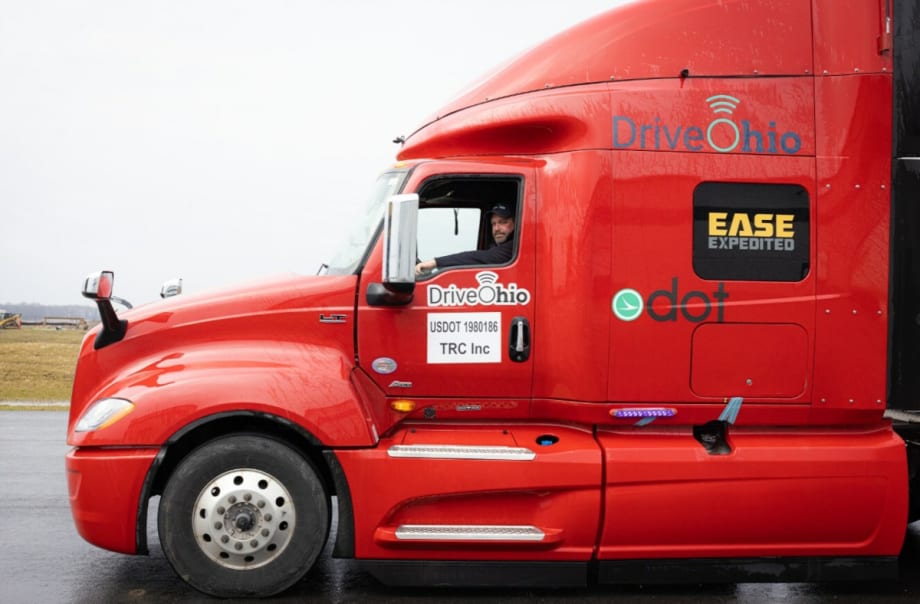
The Ease Logistics automated follower truck will be manned and connected.
Photo: Ease Logistics
Ease Logistics said it will soon be the first in the U.S. to deploy connected and automated trucking technology for truck platooning on revenue-generating routes.
Ohio-based Ease Logistics is the chosen host fleet partner for the Ohio Department of Transportation and DriveOhio's Rural Automated Driving Systems project.
Truck platooning is when two trucks are connected through automation. Both trucks are equipped with radar to detect other vehicles and monitor and adjust to the changing environment around them. Ease will use a pair of 53-foot platoon-equipped tractor-trailers, a leader and a follower truck (nicknamed Tom and Jerry) are equipped with artificial intelligence and connected by Bosch wireless vehicle-to-vehicle (V2V) technology. The lead vehicle controls the speed and the following vehicle has precisely matched braking and acceleration technology to respond to the lead vehicle’s movement.
The data generated by the Rural ADS project will be shared with the Federal Motor Carrier Safety Administration and the U.S. Department of Transportation to develop national automated driving system policies, which Ease said will help remove barriers to the safe integration of these technologies across the U.S.
"We are excited to partner with DriveOhio, ODOT, the Transportation Research Center, and Bosch to bring innovation to our roads in Ohio," says Peter Coratola Jr., Ease Logistics president and CEO. "This technology is a great stepping stone toward a safer, more efficient and effective supply chain – and safer rural roads."
Truck Platooning
In preparation for the deployment, the Ease drivers for the project have undergone a combined 400 hours of training at the Transportation Research Center. These drivers are now conducting preliminary solo runs to monitor data transmission to Ease and identify the best Ohio routes for platooning.
"This technology was thoroughly and comprehensively tested by Bosch and the TRC before being released to Ease for platooning and deployment on revenue-generating routes," said Josh McMullen, Ease Logistics corporate development manager.
Platooning mode requires that both trucks be manned with a trained Ease driver and will occur in very specific and ideal circumstances, the company reports. Weather, road conditions, and traffic will all be taken into consideration when Ease drivers choose the moment during a route to engage platooning mode.
Platooning mode disengages at the discretion of both trucks' drivers, and the driver of the follower truck can override platooning mode to take manual control at any moment. Platooning mode also disengages automatically if any vehicle drives between the two trucks.
"Our goal is to develop, pilot, and deploy new smart technology initiatives to ensure that Ohio is the leading state in smart mobility innovation," said Abbi Failla, Ease vice president of business operations.
Ease was honored as number one in transportation on Fortune's list of America's Most Innovative Companies and number 143 across all industries.
"Partnering with innovative companies like Ease to conduct real-world testing is key to unlocking the full safety and efficiency benefits that truck platooning technology can provide," said Preeti Choudhary, DriveOhio executive director.
More Equipment

How Volvo Updated Its D13 for EPA 2027 [Watch]
Volvo’s updated D13 promises lower emissions without sacrificing performance or fuel economy. Take a closer look at what changed inside the engine in this HDT Spotlight video.
Read More →
Michelin Tire Improves Efficiency and Durability for Regional Fleets
The Michelin X Multi Energy D2 is a regional haul drive tire engineered to help fleets improve fuel efficiency, durability and traction in demanding stop-and-go operations.
Read More →
ZF Expands Commercial Vehicle Push in North America
ZF is expanding its North American commercial-vehicle presence with new transmission applications, electrification, trailer technology and autonomous-driving systems.
Read More →
Tesla Wants a Self-Driving Semi. Are Cameras Enough?
Could Tesla’s camera-only autonomous driving technology work on an 80,000-pound Semi? In this commentary, HDT's Deborah Lockridge takes a look at Tesla, Cybercab, and how autonomous trucks see the road.
Read More →
Kodiak: Driverless Long-Haul Truck Launch on Track for 2026
Kodiak AI says its driverless long-haul safety case is 93% complete and it remains on track to begin commercial operations by year-end 2026.
Read More →
What DOT’s Automated Vehicle Strategy Means for Trucking
The U.S. Department of Transportation issued a new automated-vehicle strategy that outlines plans for driverless-truck regulations, cross-state freight corridors, and federal safety standards.
Read More →
East Coast Port Launches $45M Electric Truck Push
The Port Authority of New York and New Jersey announced millions in incentives for zero-emission drayage trucks, yard tractors, and new charging hubs near the port.
Read More →
PlusAI Going Public to Fund Autonomous Truck Launch
A SPAC deal could provide PlusAI with up to $300 million as it works toward a 2027 commercial launch of factory-built autonomous trucks.
Read More →
NHTSA Moves to Rewrite Truck Fuel-Economy Rules
The National Highway Traffic Safety Administration says it lacks authority to regulate medium- and heavy-duty truck engines separately from complete vehicles, but the existing standards have not yet been eliminated.
Read More →
Detroit Opens Orders for EPA 2027 Engines
Detroit isn’t starting from scratch to meet EPA 2027 diesel emissions standards. Its Gen 6 DD13 and DD15 engines keep much of today’s platform while updating the fuel and aftertreatment systems.
Read More →