Digging Deeper into NACFE's Run on Less Truck Fuel-Efficiency RoadShow
It's possible to average over 10 mpg in real-world, over-the-road truck freight operations, but that doesn't mean it's easy to maximize fuel economy, according to a new, in-depth report from the North American Council for Freight Efficiency analyzing its Run on Less fuel-efficiency roadshow.
by Staff
March 4, 2018
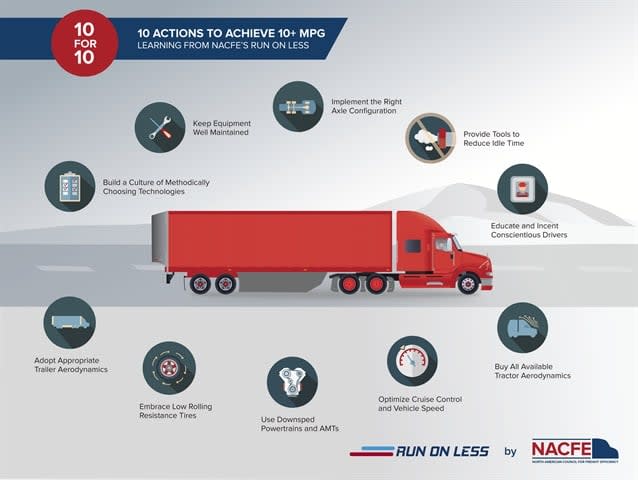
10 actions truck fleets can take away from the Run on Less report on how to improve fuel efficiency.Graphic: NACFE
5 min to read
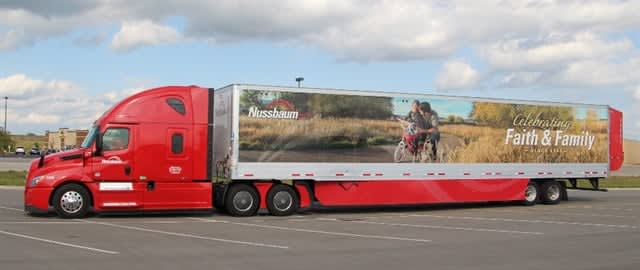
Nussbaum Transportation used several different trailers during the run.Photo: NACFE
The North American Council for Freight Efficiency released an in-depth report on its Run on Less fuel-efficiency roadshow. The three-week event last fall demonstrated that it’s possible to get 10-plus mpg in real-world Class 8 freight-hauling operations. The report released at the Technology & Maintenance Council’s annual meeting March 4 digs into the strategies used by the seven participating fleets.
During the 17-day run, seven trucks from participating fleets Albert Transport, PepsiCo’s Frito-Lay Division, Hirschbach, Mesilla Valley Transportation, Nussbaum Transportation, Ploger Transportation and U.S. Xpress, averaged 10.1 mpg, exceeding the 9 mpg goal and saving $2,877 gallons of fuel and $7,193 compared to the national average of 6.4 mpg for the over-the-road tractor-trailer population.
Ad Loading...
NACFE drew the following conclusions from the Run on Less event:
10 mpg does happen in the real world
Conditions matter and need to be understood for decision-making
High mpg requires efforts in many areas
Telematics reports and data logging are worthwhile investments.
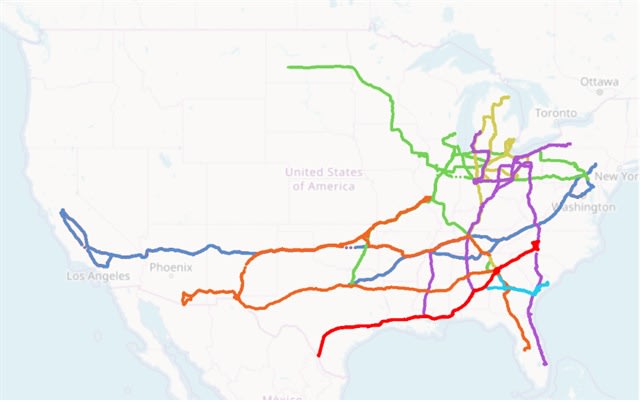
The 17-day Run on Less fuel-efficiency event featured diverse truck routes, all converging in Atlanta.(Routes displayed using the MyGeodata Cloud online tool.)
Fuel-efficient truck specs
The trucks, which were 2015 model year or newer, used commercially available technologies. Including engines and engine ratings for maximum fuel efficiency, downsped powertrains, considerable attention to aerodynamics, and in some cases idle reduction equipment, including solar panels.
Ad Loading...
Some of the specifications employed across the seven participants were quite similar, others very diverse. Features that were common across all seven included:
All-inclusive tractor aerodynamics, including sloped hoods, bumper dams, aerodynamic mirrors, chassis fairings, full height roof fairings, cab extenders, vented mud flaps and drive wheel fairings with wheel covers.
Low rolling resistance tires on most wheel ends.
Automated manual transmissions.
Downsped powertrains at 2.67 at faster.
Low viscosity engine lubrication.
Engine programing for idle shutdown and diesel-fired heaters for idle reduction during cold weather.
All trailers used automatic tire pressure systems.
All employed some sort of trailer aerodynamics under and back of the trailer.
Telematics of various kinds were used on all the equipment.
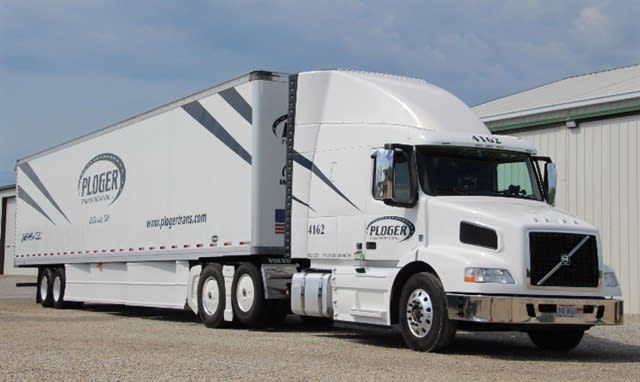
Ploger Transportation typically has multiple stops daily.Photo: NACFE
Some of the specs that were diverse across the fleets were:
Axle configurations, with fleets using 4x2, 6x4, 6x2 tag and 6x2 liftable.
Engine size, from 11 to 13 and 15L engines.
Idle reduction technologies. Battery HVAC was the most common choice, but one used a diesel APU and two had no idle reduction technology for hot weather.
Tires were diverse with respect to wide-based and duals, as well as differing tire choices for 6x2 drive and tag axles.
Trailer aerodynamics. The trailers used three different tail devices. Side skirts were predominant but one trailer used an undertray device. The Frito-Lay trailer was a high-cube drop frame to maximizing loading and incorporated side skirts, a trailer tail and a nose cone.
Most drivers used various driver behavior tools in the cab. In some cases, a driver used multiple devices.
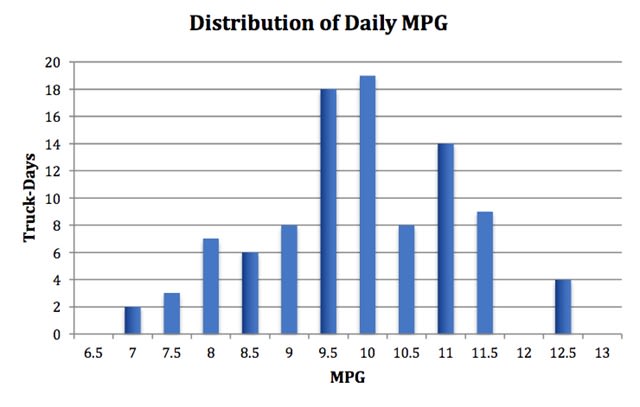
While the most common daily average was around 10 to 10.5 mpg, factors such as load, weather, and terrain meant some days were much better or worse.Graph: NACFE
Truck drivers are key to high mpg – but it's not easy
“The drivers who participated in Run on Less are some of the best at maximizing mpg,” notes the NACFE report. “It takes skill and experience to make use of the technology, and even among this group, it can be strenuous. In fact, drivers commented that maximizing fuel economy takes constant vigilance. One driver mentioned how tiring it was to be on his ‘A’ game for the entire Run… Another driver lamented the fuel he wasted hurrying to a hoped for overnight stop where there turned out to be no parking. He ended up stopping earlier than planned. A driver also noted that he did not get his truck washed during the event because he did not want to waste fuel while waiting in line, another example of the lengths drivers went to maximize mpg during Run on Less.”
Ad Loading...
NACFE expands mission
The North American Council for Freight Efficiency announced an expanded organizational strategy, including an updated brand identity and website. In addition to the Confidence Reports it has previously done, which provide unbiased analysis on currently available fuel-saving technologies and practices, NACFE is now expanding into guiding future change in trucking, which it's cauling Guidance Reports.
“With ‘NACFE 2.0’, we believe we can add a great deal of value in guiding the development and eventual implementation of future technologies," said Mike Roeth, NACFE executive director. “We are in the process of gathering data and conducting interviews for a Guidance Report on electric trucks, which we plan to release this spring.”
NACFE Run on Less Fuel Efficiency Conclusions
The team collected and showed data on the conditions and speed during Run on Less in part to demonstrate that the Run on Less trucks were not operated in carefully controlled settings but in the real world where wind, elevation changes, and other factors can and do impact fuel efficiency.
The trucks covered a total of 50,107 miles at an average gross weight of 55,498 lbs. Five truck-days (one truck on one day equals truck-day) were between 7 and 8 mpg and four truck-days were between 12.5 and 13 mpg. The trucks totaled 543,903 feet in elevation gain, and dealt with various weather conditions, including the effects from Hurricanes Harvey and Irma. The overall average speed was 54 mph.
After evaluating the results of the Run, NACFE offered the following recommendations for actions the industry should take:
Use downsped powertrains and automated transmissions
Educate and incentivize conscientious drivers
Buy all available tractor aerodynamics
Adopt appropriate trailer aerodynamics
Optimize cruise control and vehicle speed
Keep equipment well maintained
Implement the right axle configuration
Embrace low-rolling-resistance tires
Provide tools to reduce idle time
Build a culture of methodically choosing technologies
“Run on Less demonstrated that 10.1 mpg is possible in real-world applications,” said Mike Roeth, executive director of NACFE. “The results are now detailed, and I challenge fleets to take advantage of available fuel-saving technologies, manufacturers to continue to ramp up their efforts in developing fuel-efficient products, and other industry stakeholders to support them in the work of raising the average fuel economy of all fleets.”
Ad Loading...
10 actions truck fleets can take away from the Run on Less report on how to improve fuel efficiency.Graphic: NACFE
Run on Less was a joint effort between NACFE and Carbon War Room, which is now a part of Rocky Mountain Institute. The mission of the initiative is to double the freight efficiency of North American goods movement through the elimination of market barriers to information, demand, and supply.
On the Resources page on the new nacfe.org, you will find an Executive Study, Full Report, a summary video, a dataset for the Results of the Run, and other details of what NACFE learned from the Run.
Volvo’s updated D13 promises lower emissions without sacrificing performance or fuel economy. Take a closer look at what changed inside the engine in this HDT Spotlight video.
Energy Vision estimates fleets could recover the higher purchase price of an RNG-fueled Class 8 tractor in 1.3 to 2.8 years under current fuel-price scenarios.
Calstart is now Catalyst Mobility, reflecting the nonprofit’s growing national role in clean transportation, including zero-emission trucks, infrastructure and incentive programs.
Average U.S. diesel prices have climbed to nearly $6 a gallon, surpassing the 2022 record as tight refinery capacity and Middle East disruptions keep fuel costs elevated.
Fuel delivery depends on more than what happens at the injector. For fleet, maintenance and technical professionals, looking at the full path from pump to injector can provide useful context for understanding engine performance.
The Port Authority of New York and New Jersey announced millions in incentives for zero-emission drayage trucks, yard tractors, and new charging hubs near the port.
Why do battery-electric Class 8 trucks remain so expensive? A California bill headed to Gov. Gavin Newsom would give fleets and state agencies more visibility into what manufacturers charge.
Detroit isn’t starting from scratch to meet EPA 2027 diesel emissions standards. Its Gen 6 DD13 and DD15 engines keep much of today’s platform while updating the fuel and aftertreatment systems.
California, Oregon, Washington, British Columbia and Baja California are coordinating plans for truck charging and hydrogen fueling from Canada to Mexico.
Learn more about Kenworth's T880E battery-electric vocational truck at the Paccar Technical Center, including its range, applications, upfitting considerations, and PTO options, in this HDT Spotlight video.