





Related: Daimler's Electric Trucks Come in Three Sizes (photos)
Daimler Says Battery-Electric Trucks Key to Zero Emissions Commercial Transport
Battery-electric vehicles are the key to zero-emission commercial transportation in North America, according to Daimler Trucks North America, which is moving forward with battery-electric vehicle commercialization, contending that hydrogen fuel cells aren’t ready for prime time.
April 24, 2019
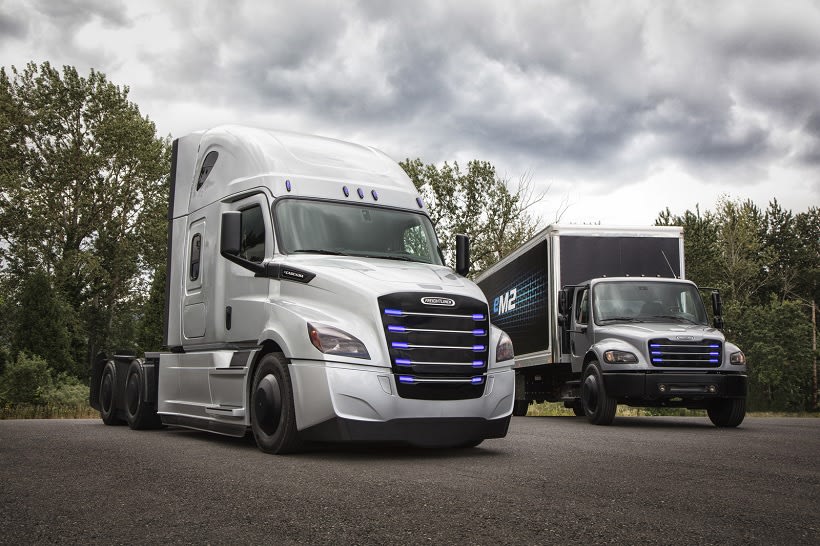
Daimler Trucks North America says battery-electric vehicles like the eCascadia and eM2 are the key to zero-emissions commercial transportation.
Photo courtesy Daimler Trucks North America
4 min to read
Battery-electric vehicles are the key to zero-emission commercial transportation in North America, according to Daimler Trucks North America, which is moving forward with battery-electric vehicle commercialization, contending that hydrogen fuel cells aren’t ready for prime time.
“The road to emissions-free transportation is going to be driven with battery-electric vehicles. I believe the future is electric,” said Roger Nielsen, president and CEO of DTNA, speaking to a crowd assembled in Long Beach for the ACT Expo April 24.
The company announced it will begin converting its Portland manufacturing plant to produce electric Freightliners, “to enable rapid scale-up of thoroughly tested and validated electric vehicles,” it said in a release.
The company sees potential for hydrogen fuel cells to extend battery-electric truck range, but does not see it as viable in the near term, Nielsen explained. Although DTNA’s vision of electric vehicles does not exclude fuel cells, he said, “I can see a glimpse of it over the horizon, but it will not be this generation of engineers who will be delivering it.”
Nielsen’s view on hydrogen fuel cell trucks contrasts with that of Trevor Milton, founder and CEO of Nikola, who says the company can deliver hydrogen fuel cell heavy-duty trucks in just a few years. And Toyota and Kenworth just two days previous unveiled their joint fuel-cell project truck designed for port drayage.
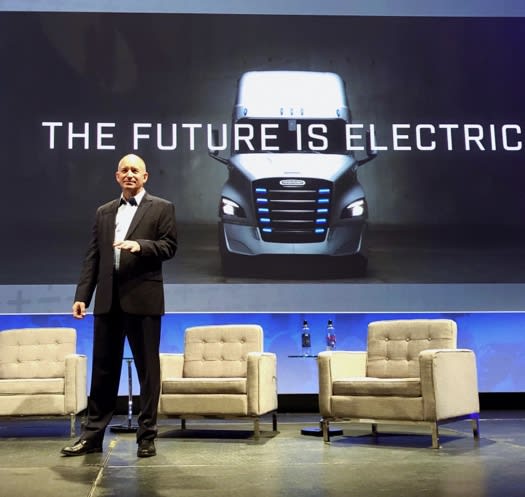
Daimler Trucks North America President and CEO Roger Nielsen: “We’re not compromising and launching prototypes into space here. We will continue testing with our real customers here in North America.”
Nielsen also told the audience that the road to emissions-free driving, for DTNA at least, does not include plug-in hybrids. Near-zero-emissions natural gas medium- and heavy-duty vehicles are currently available and will continue from Freightliner as an interim solution until full commercialization of the battery-electric Freightliner eM2 and eCascadia.
DTNA unveiled the eM2 and eCascadia last summer. The Freightliner eM2 truck is an electrified solution for local distribution, pickup and delivery, food and beverage delivery, and last-mile logistics applications. The Freightliner eCascadia is a Class 8 tractor designed for local and regional distribution and drayage. Both trucks enter series production in 2021. The Freightliner eCascadia and eM2 are part of Daimler Trucks’ global electrified truck initiative, joining the company’s Thomas Built Buses all-electric Saf-T-Liner eC2 school bus, the FUSO eCanter, and the Mercedes-Benz eActros.
How do we get there?
To hasten the arrival of zero-emission commercial transport, three goals must first be achieved, Nielsen said. First, the industry must work together to establish a common battery-electric vehicle charging infrastructure. Daimler AG is a founding member of CharIN, an organization whose aim is to standardize charging requirements for electric vehicles, including commercial vehicles.
Second, batteries must become cheaper, lighter, and more powerful. DTNA is leveraging its global network to develop proprietary batteries for its commercial vehicles that meet the standards of quality, durability, and integration that customers demand.
Finally, he said, the real cost of ownership for customers must be strengthened through increased incentives, decreased maintenance costs, and cheaper energy costs. Organizations like the South Coast Air Quality Management District (SCAQMD) will be instrumental in creating a viable business case for electric trucks. A $16M grant from SCAQMD partially funds the Freightliner Electric Innovation Fleet.
The key to ensuring electric vehicles are ready for commercialization is testing, Nielsen noted. With its first electric truck already in customer hands, DTNA plans to put nearly 50 on the road by the end of the year. This includes a test fleet and the Freightliner Electric Innovation Fleet shared between Penske and NFI. (Penske took delivery of its first eM2 in December.)
Affiliated brands Fuso and Mercedes-Benz trucks have already begun deliveries of the battery-electric eCanter and eActros in Asia, Europe, and North America. By the end of 2019, over 150 battery-electric vehicles powered by Daimler will be deployed for testing, co-creation and collaboration worldwide.
“For our engineers, these early customer partners are our test drivers. We want them to test these vehicles to their extremes. We want to see the failures so we can engineer solutions,” said Nielsen.
Last year DTNA formed the Freightliner Electric Vehicle Council composed of 30 customers with strong use-cases for electric trucks to further drive its sustainable transportation program. The company is working with the council members to ensure a holistic approach to launching electric trucks. Members of the customer council benefit from co-development of deployment strategies for battery electric vehicles including applicable use cases, current legislation and requirements for facilities, charging infrastructure, and service support
Readying for electric truck production
To enable rapid scale-up of thoroughly tested and validated electric vehicles, DTNA announced it will convert the Portland manufacturing plant to produce electric Freightliners. The plant lies just blocks from DTNA’s headquarters. The plant renovations begin next year, with series production scheduled to begin in 2021.
The company’s decision to bring electric vehicle production to Portland was based on multiple factors, including Portland’s proximity to the huge demand for electric vehicles in California. In addition to production, the Portland manufacturing facility will also host a battery storage facility and an electric vehicle co-creation center, where the e-consulting team will collaborate with customers. Here they will integrate electric trucks into their fleets from order intake through the second life of the truck.
DTNA’s school bus division, Thomas Built Buses (TBB), is nearly ready to begin producing Proterra-powered Saf-T-Liner eC2s. The buses will be assembled at TBB’s school bus manufacturing plant in High Point, North Carolina.
More Fuel Smarts

How Volvo Updated Its D13 for EPA 2027 [Watch]
Volvo’s updated D13 promises lower emissions without sacrificing performance or fuel economy. Take a closer look at what changed inside the engine in this HDT Spotlight video.
Read More →
Diesel Price Spike Shortens Payback for Natural Gas Trucks, Report Says
Energy Vision estimates fleets could recover the higher purchase price of an RNG-fueled Class 8 tractor in 1.3 to 2.8 years under current fuel-price scenarios.
Read More →
Calstart Becomes Catalyst Mobility, Reflecting Broader Focus
Calstart is now Catalyst Mobility, reflecting the nonprofit’s growing national role in clean transportation, including zero-emission trucks, infrastructure and incentive programs.
Read More →

Record Diesel Prices Squeeze Trucking Fleets
Average U.S. diesel prices have climbed to nearly $6 a gallon, surpassing the 2022 record as tight refinery capacity and Middle East disruptions keep fuel costs elevated.
Read More →
Sponsored•September 9, 2026
How Fuel Delivery Shapes Engine Performance
Fuel delivery depends on more than what happens at the injector. For fleet, maintenance and technical professionals, looking at the full path from pump to injector can provide useful context for understanding engine performance.
Read More →
East Coast Port Launches $45M Electric Truck Push
The Port Authority of New York and New Jersey announced millions in incentives for zero-emission drayage trucks, yard tractors, and new charging hubs near the port.
Read More →
California Bill Could Shed Light on Electric Truck Prices
Why do battery-electric Class 8 trucks remain so expensive? A California bill headed to Gov. Gavin Newsom would give fleets and state agencies more visibility into what manufacturers charge.
Read More →
Detroit Opens Orders for EPA 2027 Engines
Detroit isn’t starting from scratch to meet EPA 2027 diesel emissions standards. Its Gen 6 DD13 and DD15 engines keep much of today’s platform while updating the fuel and aftertreatment systems.
Read More →
Zero-Emission Truck Corridor Planned for West Coast
California, Oregon, Washington, British Columbia and Baja California are coordinating plans for truck charging and hydrogen fueling from Canada to Mexico.
Read More →
A Closer Look at Kenworth’s Electric T880E Vocational Truck [Video]
Learn more about Kenworth's T880E battery-electric vocational truck at the Paccar Technical Center, including its range, applications, upfitting considerations, and PTO options, in this HDT Spotlight video.
Read More →