




Cummins Taking Long View on Alternative Power
Cummins sees itself as a technology company that has been very successful in commercializing diesel power. Through decades of change and disruption, the company has adapted and moved ahead. The next wave of change is no different, and Cummins believes the outcome will be no different.

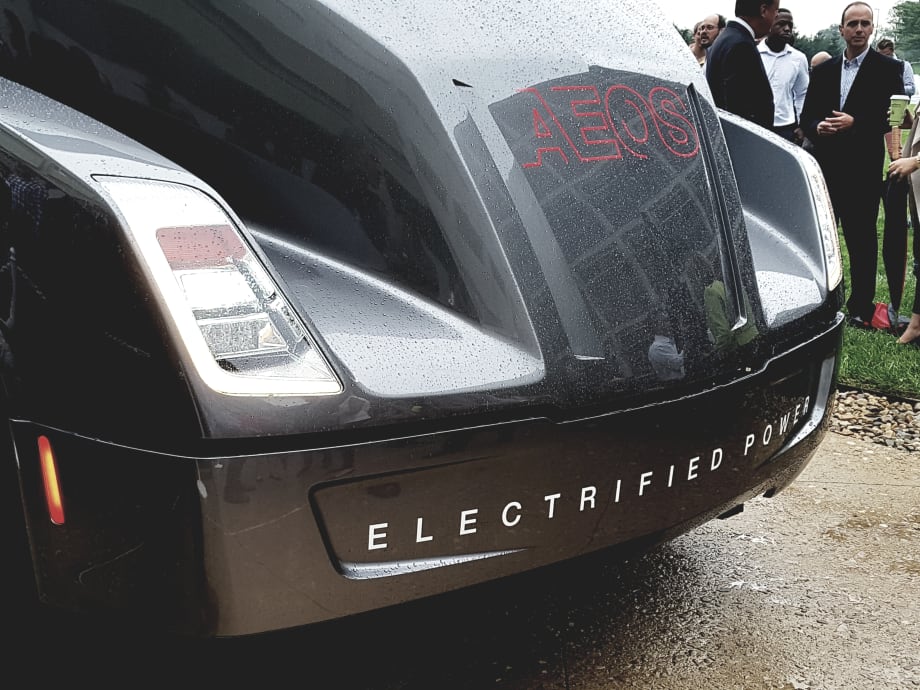
Cummins has developed an electric technology demonstration vehicle. Photos: Jim Park
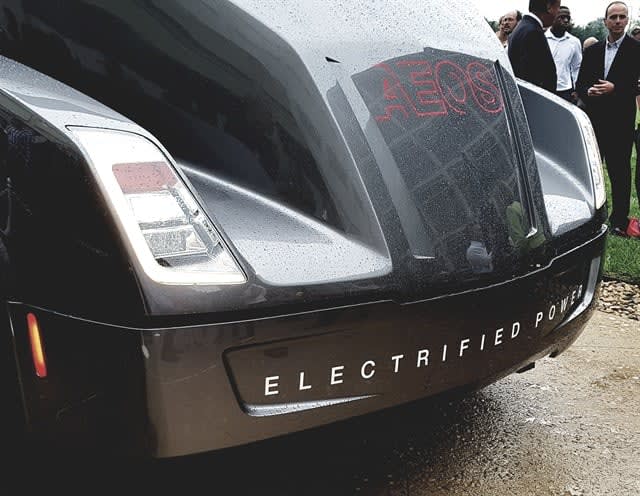
Cummins has developed an electric technology demonstration vehicle. Photos: Jim Park
COLUMBUS, IND. — For 98 years, Cummins has been powering trucks and buses around the globe, and the company said on Aug. 29 that it has every intention of being in that same position 98 years from now. Cummins executives stressed that they will continue to deliver the right powertrain for any marketplace anytime in the future, regardless of the energy source.
"Energy diversity is the key to the future, and a one-size-fits-all approach is no longer viable," said Jennifer Rumsey, vice president and chief technical officer. "At this point in time, we believe there is a place for a wide range of technologies from diesel and natural gas to electric.
"These technologies will evolve in the coming years," she continued, "and Cummins is capable and ready for this range of power technologies to meet our customers' needs today and in the future."
The message was clear; anyone who believes Cummins' best days are behind it had better think again. These are certainly good times for the engine maker, currently holding a 37% market share in the heavy-duty engine space where a heavy presence of captive engines can leave the independent engine maker at a pricing disadvantage.
Brett Merritt, executive director, EBU On-Highway Business, said the company commands nearly 80% of the North American medium-duty market and more than 90% of the school and transit bus markets.
"Cummins is a technology company, first and foremost," he said. "Whether you're talking about diesel combustion, emissions catalysis or controls integration, we have the technical expertise combined with market knowledge to deliver technical innovations in the future."
And to that end, the company is investing $700 million annually in research and development to stay on the leading edge of emerging technologies -- some of which involves marrying proven diesel technology with battery and electric technologies that meet regulatory requirements, societal demands, and customers' needs.
Cummins is quite confident that diesel engines will be powering heavy trucks for many years to come, especially in the long-haul sector.
"Twenty years from now, we will still be using internal combustion engines running on conventional fuels or unconventional fuels," said Srikanth Padmanabhan, president of Cummins' Engine Business, noting that they may not be the engines that we are familiar with today. "By that time, all ICE will have some form of mild hybridization and/or accessory drives, but ICE will continue to be an important player in global transportation."
Padmanabhan said that whichever technologies may emerge in the next 15 to 20 years. it will be Cummins' responsibility to make sure customers get the right technology, not just a new technology for technology's sake,but something reliable and efficient that meets both the customers' and society's needs.
Energy Diversity
While electrification has seen very heavy exposure in the mainstream press in the past couple of years, Padmanabhan said Cummins has been working on this for over two decades.
"Electrification makes sense in some areas, but not all," he said. "We know from real data and real-life experience where it works, where it makes sense and why we should use it."
Cummins seems well placed to explore the potential for electrification because of its previous experience in power generation as well as engine design and development. Batteries supplemented with some form of high-efficiency, low-emission ICE seem best able to bridge the gap between 100-mile local trucks and 300-mile regional trucks.
The company is now developing a high-efficiency spark-ignited engine that it says can deliver diesel-like performance and durability across a range of liquid fuels, like ethanol, methanol, and gasoline, while meeting the most stringent emissions requirements.
Natural gas and diesel both figure prominently in this research.
Engineers and scientists are also investigating the viability of alternatives like bio-fuels, synthetic fuels, and hydrogen. And, with its partners, Cummins is looking at projects focused on Proton Exchange Membrane and Solid Oxide Fuel Cell technologies.
"Cummins is partnering with a few different fuel cell providers to develop that technology," said Rumsey. "We have been working for a number of years on those technologies."
Diesel Still Has a Future
Next spring, Cummins will introduce the 12-liter X12 engine, which will boast the highest power-to-weight ratio in the industry. It's targeted at vocational, regional and weight-sensitive bulk-haul applications. It’s 600lbs lighter than the closest 13L engine and 150 lbs lighter than the closest 11L engine.
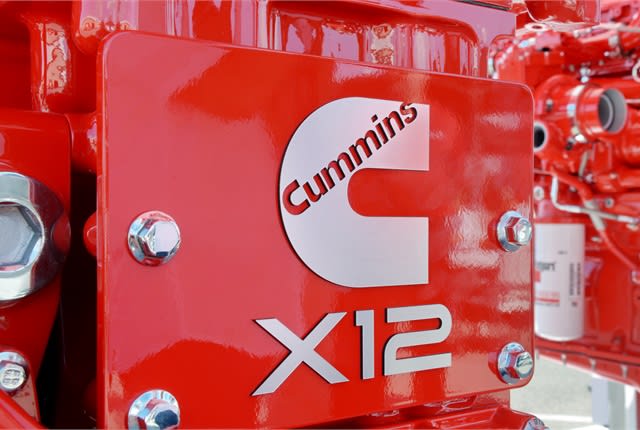
The X12 engine will come to market in the spring of 2018.
The X12 is derived from the ISG first introduced in 2013 as a global engine platform. It made its first appearance a year later in a joint venture with the world’s largest independent engine maker, Beiqi Foton Motor Co. Ltd. of China. Foton now uses the ISG diesel in a new truck series developed with Daimler. Cummins said the engine in ISG trim already has more than a billion miles under its belt and is ready to take on North America.
While on a tour of the technical center, reporters were shown, but were not allowed to photograph, the next generation X15 engine, slated to launch in 2022. Cummins said it will be capable of meeting 2027 GHG rules five years ahead of the legislated requirement --and without using the feared waste heat recovery system. This 15 L engine will be 300 lbs lighter than the current X15, with the height of a 13 L engine, ensuring efficient installations in future ultra-aero trucks, both conventional and cabover.
And natural gas remains a viable alternative to diesel, in a way similar to electric vehicles. It's still best suited to shorter ranges and a return-to-base operationwith a fuel supply. Range is limited by the size of the fuel tanks, but it does work in many instances, and it can be used to power range-extended battery electric vehicles.
Cummins revealed its latest Near Zero natural gas engines during the media event in Columbus. According to Cummins, end users will find the Near Zero natural gas engines are an equivalent performance option to diesel and, like the latest clean-diesels, these produce little to no emissions. Cummins said it managed a 90% reduction in NOx, getting output down to just 0.02 gm/bhp/hr.
A growing crowd of observers seems ready to pronounce diesel engines a marooned technology while electric systems seem poised to emerge as the power technology of choices. Cummins, however, would beg to differ.
Padmanabhan sees diesel as a safe bet for at least the next 20 years, and likely far beyond that. It's simply has no equal in terms of energy density, portability, and flexibility.
Used as a range extender with battery electric systems, diesels can be made to run at near-zero emissions levels because they operate at a steady state, with zero transient cycles to worry about. Diesels will emerge with varying degrees of hybridization and with various off-engine accessory drives that help to minimize parasitic losses.
And trucks as a whole will become more efficient, which will require less power to run at highway speeds, so smaller displacement engines could well find a home in heavy-duty long-haul applications, with much improved fuel efficiency.
"We succeeded during previous major disruption periods because Cummins is a technology company that embraces change, and capitalizes on that change with the right technology that matters in the marketplace and to our customers," said Padmanabhan. He doesn't see that changing anytime soon.
Related: Cummins Unveils Class 7 All-Electric Daycab Tractor
More Fuel Smarts

How Volvo Updated Its D13 for EPA 2027 [Watch]
Volvo’s updated D13 promises lower emissions without sacrificing performance or fuel economy. Take a closer look at what changed inside the engine in this HDT Spotlight video.
Read More →
Diesel Price Spike Shortens Payback for Natural Gas Trucks, Report Says
Energy Vision estimates fleets could recover the higher purchase price of an RNG-fueled Class 8 tractor in 1.3 to 2.8 years under current fuel-price scenarios.
Read More →
Calstart Becomes Catalyst Mobility, Reflecting Broader Focus
Calstart is now Catalyst Mobility, reflecting the nonprofit’s growing national role in clean transportation, including zero-emission trucks, infrastructure and incentive programs.
Read More →

Record Diesel Prices Squeeze Trucking Fleets
Average U.S. diesel prices have climbed to nearly $6 a gallon, surpassing the 2022 record as tight refinery capacity and Middle East disruptions keep fuel costs elevated.
Read More →
How Fuel Delivery Shapes Engine Performance
Fuel delivery depends on more than what happens at the injector. For fleet, maintenance and technical professionals, looking at the full path from pump to injector can provide useful context for understanding engine performance.
Read More →
East Coast Port Launches $45M Electric Truck Push
The Port Authority of New York and New Jersey announced millions in incentives for zero-emission drayage trucks, yard tractors, and new charging hubs near the port.
Read More →
California Bill Could Shed Light on Electric Truck Prices
Why do battery-electric Class 8 trucks remain so expensive? A California bill headed to Gov. Gavin Newsom would give fleets and state agencies more visibility into what manufacturers charge.
Read More →
Detroit Opens Orders for EPA 2027 Engines
Detroit isn’t starting from scratch to meet EPA 2027 diesel emissions standards. Its Gen 6 DD13 and DD15 engines keep much of today’s platform while updating the fuel and aftertreatment systems.
Read More →
Zero-Emission Truck Corridor Planned for West Coast
California, Oregon, Washington, British Columbia and Baja California are coordinating plans for truck charging and hydrogen fueling from Canada to Mexico.
Read More →
A Closer Look at Kenworth’s Electric T880E Vocational Truck [Video]
Learn more about Kenworth's T880E battery-electric vocational truck at the Paccar Technical Center, including its range, applications, upfitting considerations, and PTO options, in this HDT Spotlight video.
Read More →