





Related: TMC and the PIT Group Announce Research Partnership
Canada’s First Truck Platoon Hits the Road
The PIT Group transportation research group worked with both Canadian and U.S. partners to perform Canada’s first ever commercial platoon vehicle trial run.
November 15, 2018
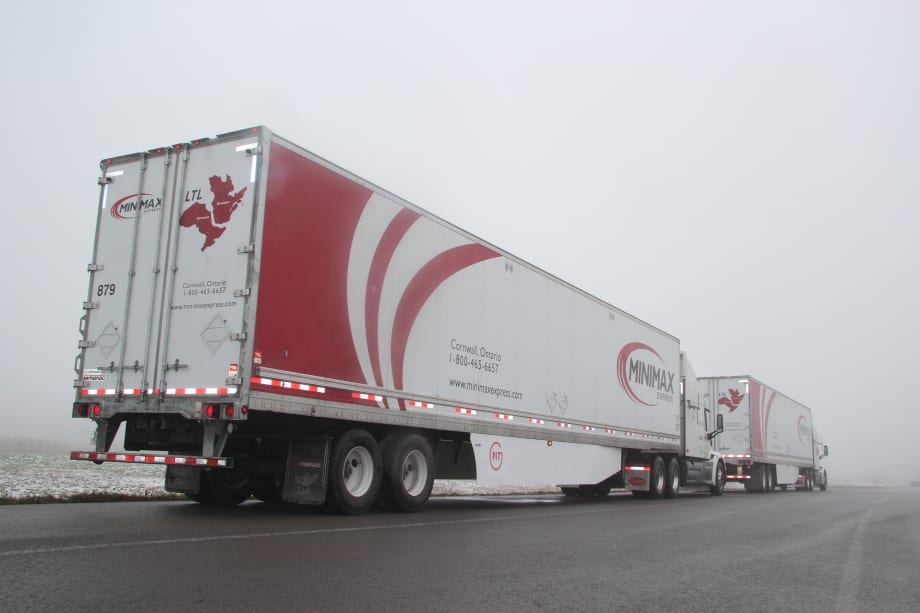
The PIT Group took part in successful highway platooning tests between October 29, and November 2, 2018, on highways around Montreal, La Tuque, Trois-Rivières and Blainville, Quebec.
Photo: PIT Group
4 min to read
FPInnovations’ transportation division PIT Group, Transport Canada, Auburn University, and Minimax Express Transportation recently collaborated to perform Canada’s first ever on-road commercial vehicle platoon trial.
The successful highway platooning tests took place between October 29 and November 2 on highways around Montreal, La Tuque, Trois-Rivières and Blainville, Quebec. The platoon consisted of two heavy duty transport trucks. Truck platooning is an emerging fuel-saving technology in which the trucks, driven in a convoy, are linked by a computer system that maintains the desired distance between trucks, as well as controls acceleration and braking, reacting faster than a driver usually can. Drivers were at the wheels of both trucks the entire time, but in the future, only one driver will be at the wheel of the lead truck followed by automated trucks. However, that technology is several years away from being a reality.
The technology, designed by Alabama’s Auburn University mechanical engineering department, has already been successfully tested on highways in the United States. A minimum distance of 20 meters was kept between the two trucks, which allows a passenger vehicle to safely cut in between the trucks. The platooned trucks disassembled at highway entrances and exits. In all, the truck platoon travelled approximately 1000 km on highways with regular vehicle traffic.
“We’ve driven the trucks under different weather conditions before but this was a first for us driving in a combination of rain, ice and snow,” said James Johnson, a research engineer at Auburn University. “The automated braking and acceleration worked well in the weather conditions and we’re pleased with how the trucks performed throughout the testing.”
To address safety concerns, escort vehicles led and followed the platooned trucks and system engineers from Auburn University accompanied both drivers, who received prior training. The test team was also in constant radio communication with the drivers. The platooning system combines sensors, measurements from a radar, and GPS data with other information such as brake and throttle status shared over dedicated short-range radio communications (DSRC).
‘’Auburn’s system is very reliable and we were able to spend most of our time on the road with the platooning mode engaged,” says Proust. “This is a great achievement. It’s a little soon to make a conclusion on the data that was gathered but the system reacted properly to vehicle cut-ins and to road conditions.’’
The goal of truck platooning is twofold: aerodynamic drag is reduced on all the trucks leading to significant fuel efficiency on highways, as well as a reduction in tailpipe emissions. Eventually, the technology will lead to automated following trucks, reducing the number of drivers needed by transport companies, which have been struggling for years with a shortage of skilled drivers and is showing no signs of abating.
“We’ve been in business for the past 28 years and the issue of recruiting drivers has never been so real,” says Yves Poirier, president of Minimax Express Transportation. “We’ve had to refuse business opportunities due to a lack of drivers. Our industry needs to find a way to attract new workers.’’
Truck platooning is not yet legal in Canada but testing of the technology is permitted in certain provinces such as Quebec. Some American states such as Georgia and Tennessee have already legalized platooning with drivers at the wheel. “Following the feedback from these preliminary tests, Transport Canada will be circulating a proposal later this year for developing national safety guidelines for truck platooning trials,” added Jeff Patten, chief of road research and development at Transport Canada.
“We believe the testing we performed in conjunction with our Canadian partners helped us move forward in validating the technology,” said David Bevly, Auburn University mechanical engineering professor and director of the GPS and Vehicle Dynamics Laboratory. “Specifically, it provided us with a unique opportunity to test in conditions that were new to us, and we’re grateful for the assistance of Transport Canada and FPInnovations. We look forward to working with them again.”
After the success of the first highway platooning tests, PIT Group will continue highway testing while also working with the company’s forestry division on testing the technology on forest roads to address the chronic labour shortage in that industry as well.
More Fuel Smarts

How Volvo Updated Its D13 for EPA 2027 [Watch]
Volvo’s updated D13 promises lower emissions without sacrificing performance or fuel economy. Take a closer look at what changed inside the engine in this HDT Spotlight video.
Read More →
Diesel Price Spike Shortens Payback for Natural Gas Trucks, Report Says
Energy Vision estimates fleets could recover the higher purchase price of an RNG-fueled Class 8 tractor in 1.3 to 2.8 years under current fuel-price scenarios.
Read More →
Calstart Becomes Catalyst Mobility, Reflecting Broader Focus
Calstart is now Catalyst Mobility, reflecting the nonprofit’s growing national role in clean transportation, including zero-emission trucks, infrastructure and incentive programs.
Read More →

Record Diesel Prices Squeeze Trucking Fleets
Average U.S. diesel prices have climbed to nearly $6 a gallon, surpassing the 2022 record as tight refinery capacity and Middle East disruptions keep fuel costs elevated.
Read More →
Sponsored•September 9, 2026
How Fuel Delivery Shapes Engine Performance
Fuel delivery depends on more than what happens at the injector. For fleet, maintenance and technical professionals, looking at the full path from pump to injector can provide useful context for understanding engine performance.
Read More →
East Coast Port Launches $45M Electric Truck Push
The Port Authority of New York and New Jersey announced millions in incentives for zero-emission drayage trucks, yard tractors, and new charging hubs near the port.
Read More →
California Bill Could Shed Light on Electric Truck Prices
Why do battery-electric Class 8 trucks remain so expensive? A California bill headed to Gov. Gavin Newsom would give fleets and state agencies more visibility into what manufacturers charge.
Read More →
Detroit Opens Orders for EPA 2027 Engines
Detroit isn’t starting from scratch to meet EPA 2027 diesel emissions standards. Its Gen 6 DD13 and DD15 engines keep much of today’s platform while updating the fuel and aftertreatment systems.
Read More →
Zero-Emission Truck Corridor Planned for West Coast
California, Oregon, Washington, British Columbia and Baja California are coordinating plans for truck charging and hydrogen fueling from Canada to Mexico.
Read More →
A Closer Look at Kenworth’s Electric T880E Vocational Truck [Video]
Learn more about Kenworth's T880E battery-electric vocational truck at the Paccar Technical Center, including its range, applications, upfitting considerations, and PTO options, in this HDT Spotlight video.
Read More →