




California Postpones Periodic Smog Test Check for Trucks
The California Air Resources Board has delayed the first periodic testing deadline for the Clean Truck Check Program to Jan. 1, 2025. But registration and fee requirements remain in place.

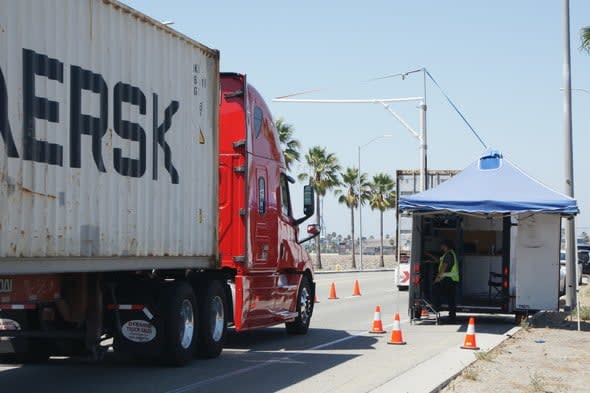
California has deployed emissions monitoring devices to monitor the exhaust of heavy-duty vehicles as they pass and flag potential violators of emissions regulations.
Photo: CARB
The California Air Resources Board has delayed the first periodic testing deadline for the Clean Truck Check Program to Jan. 1, 2025.
However, this does not delay requirements to register and pay fees for 2023. The rollout of DMV registration holds for non-compliance is beginning to ramp up, notes the California Trucking Association.
Fleets must also still plan to pay fees for 2024, which will be due in the later half of this year.
Late last year, CARB extended the Clean Truck Check reporting deadline to the end of January 2024.
About Clean Truck Check
Clean Truck Check, previously called the Heavy-Duty Inspection and Maintenance Program, is the commercial truck version of the state’s smog check for light-duty vehicles. It covers nearly all non-gasoline vehicles with a gross vehicle weight rating over 14,000 pounds operating in the state.
As HDT reported previously, the program is being implemented in three phases.
The first phase started Jan. 1, 2023, with the deployment of Remote Emissions Monitoring Devices. These monitor the exhaust emissions of passing heavy-duty vehicles and flag potential high emitters. Vehicles flagged must undergo an additional emissions test to verify their emissions-control equipment is functioning properly.
Phase 2 started Oct. 1 and requires vehicle owners to enter their vehicles in CARB’s Clean Truck Check database. There is an initial annual compliance fee of $30 per vehicle. That deadline originally was Dec. 31 and was extended to Jan. 31, but it is now in effect. All trucks driving in California need proof of compliance to continue operating.
Phase 3 of Clean Truck Check is what’s being delayed in this most recent postponement. It will require heavy-duty vehicle owners to conduct periodic emissions testing.
CARB's Periodic Truck Emissions Testing
Vehicles subject to semi-annual testing under the Clean Truck Check regulations will be required to submit periodic testing every six months.
California-registered vehicles’ compliance deadline will be the vehicles’ DMV registration expiration date. Vehicles registered outside of California have compliance deadlines based on their last VIN digit.
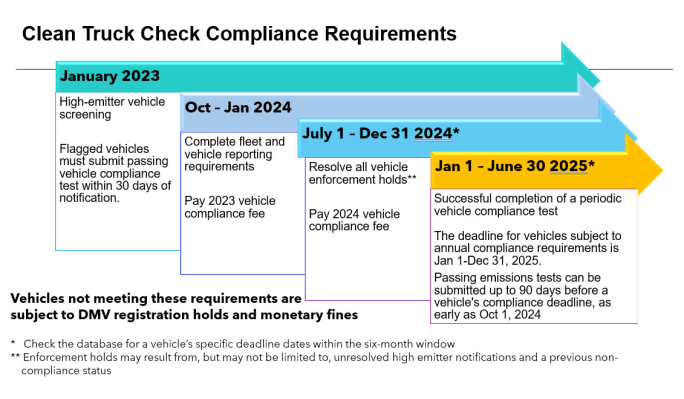
All trucks driving in California need proof of compliance that they've registered in the Clean Truck Program and paid the initial compiance fee to continue operating.
Source: CARB
Periodic testing requirements are effective Oct. 1, 2024. For example, a vehicle with a compliance deadline of Feb. 1, 2025, may submit a passing emissions test as early as November 3, 2024, according to CARB. Tests may be submitted no more than 90 days prior to the vehicle’s compliance deadlines.
Compliance testing must be performed by a CARB credentialed tester who has completed CARB’s free online Tester Training Course and scored at least 80% on the accompanying exam. The certification must be renewed every two years.
If you only operate for short periods of time in California, CARB offers a five consecutive day pass for each vehicle, once per calendar year. The 5-day pass must be submitted 7 business days before entering California.
For more information, see CARB’s guidance on how to comply with Clean Truck Check for vehicle owners subject to semi-annual testing.
More Maintenance

Color Match Smarter: Tools That Restore & Perform
For fleet managers and collision repair professionals keeping heavy-duty trucks on the road, getting the color right the first time isn't just about appearance — it's about efficiency, turnaround time, and bottom-line results. Discover how today's digital color tools are transforming the repair process from guesswork to precision.
Read More →
Wrong Repair Prompts Recall of Freightliner, Western Star 4x2 Trucks
DTNA is recalling more than 2,400 trucks that received an incompatible software fix instead of the hardware repair required to address brake valve corrosion.
Read More →
Truck Drivers Need More Than Another Alert
Fleets have more visibility into truck health, safety events, and driver activity than ever. The next challenge is turning all that information into useful guidance for the person who has to decide what to do next.
Read More →
The Maintenance Checks Trucking Fleets Should Prioritize Before Fall Freight Picks Up
Making it through August isn’t the same as being ready for the next several months of operation. Find out what systems may have suffered from summer heat and need to be checked out before fall.
Read More →
What Three Fleets Are Doing Differently When Buying Truck Parts in 2026
With freight improving but costs still climbing, fleet maintenance executives explain how they're balancing price, quality, and supplier relationships.
Read More →
Paccar Recalls 2027 Trucks Built This Summer for Possible Electrical Problem
The nearly 6,000 Kenworth and Peterbilt trucks in the recall could potentially lose engine power, among other things.
Read More →
Will API PC-12 Oil Change Trucking Fleet Maintenance?
The new API PC-12 heavy-duty engine oil category reflects the changing demands of modern diesel engines. But fleets like Foodliner are looking to getting their own data before making decisions on adopting the new oils and questions such as extending oil drain intervals.
Read More →
Brake Safety Week to Focus on Drums and Rotors
Commercial vehicle inspectors are focusing on truck brakes during CVSA's Brake Safety Week, August 23-29.
Read More →
Possible Battery-Cable Fires Prompt Recall of 15,000+ International MV and HV Trucks
On the recalled vehicles, manufacturing variations can cause the battery interconnect cable to contact the auxiliary stud and hold down the bracket.
Read More →
Rush, MCT Team Up to Grow Refrigeration Service Network
The joint venture will operate MCT's network of Carrier Transicold dealerships and mobile service locations, with the companies promising greater service capacity and uptime for refrigerated fleets.
Read More →