




Biden-Harris Administration Announces Major Infrastructure Progress
The Biden-Harris Administration has nearly doubled its original goal to repair or replace 10 of the nation’s most economically significant bridges.

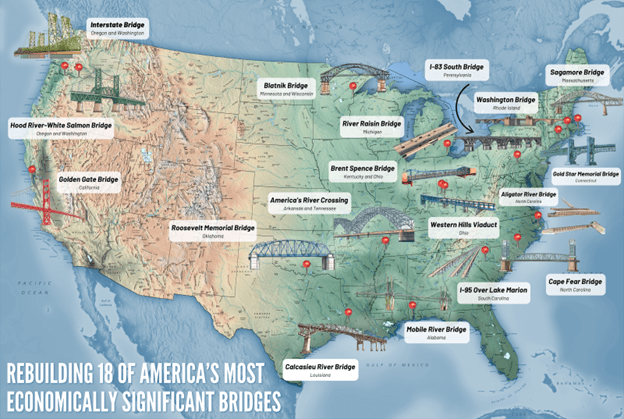
A total of 18 bridges have been awarded U.S. Department of Transportation grants of $100 million or more so far under the Build it Back Better infrastructure funding plan.
Map: U.S. DOT
During a news conference at the River Raisin Bridge in Monroe, Michigan, on December 9, U.S. Transportation Secretary Pete Buttigieg released a new report detailing 18 of the most economically significant bridges that are being rebuilt or repaired with funding from the Biden-Harris Administration.
In November of 2021, in anticipation of the passage of the bipartisan Infrastructure Law, President Biden announced that funding from this historic legislation would fix up to 10 of the most economically significant bridges in the nation. In addition, the funds would be used to improve safety and efficiency, strengthen supply chains and support America’s economic competitiveness, and restore critical connections that are vital to commuters, emergency responders, truck drivers, and public transit riders.
Infrastructure Investments in Action
Three years later, the Biden-Harris Administration has surpassed that goal, Buttigieg said, funding more than 11,400 bridge projects across the country. These include 18 of the nation’s most economically significant bridges.
Each of these 18 bridges was awarded a U.S. Department of Transportation grant of $100 million or more, has a total estimated project cost of greater than $250 million, and is vital to American supply chains and the economy.
Collectively, these 18 bridges are crossed by more than 1.2 million vehicles a day and an estimated 57.2 million trucks annually.
Federal funding for these projects comes from the Bipartisan Infrastructure Law’s Bridge Investment Program and the Bridge Formula Program. Altogether, these investments represent the largest dedicated investments in the nation’s bridges since the Eisenhower era – as well as the Infrastructure for Rebuilding America (INFRA) Grant Program, and the National Infrastructure Project Assistance (Mega) Program.
“For commuters, for truck drivers, for anyone who uses America’s interstate highways, our bridges are essential to keep people and goods moving—and the Biden-Harris Administration has taken unprecedented steps to repair and rebuild these critical structures,” Buttigieg said. “We’ve made good on our promise to address our country’s most economically significant bridges—and are now going beyond our initial goal of ten bridge megaprojects—while also delivering much-needed repairs to thousands of other bridges nationwide to make driving safer and supply chains stronger."
Secretary Buttigieg was joined by Mayor Robert Clark of Monroe, Michigan, and leaders from the Michigan Department of Transportation (MDOT) to make this announcement at the River Raisin Bridge, one of the 18 bridges included in the report.
Replacing the River Raisin Bridge
On October 21, 2024, USDOT announced $196 million in INFRA funding to replace the deteriorating River Raisin Bridge along I-75. The new structure will feature a new crossing to accommodate estimated future traffic, update and replace six existing structures. It will include two bridges over Class I railroad lines – with new ones designed for a 100-year lifespan. The project will also reconstruct over two miles of roadway to improve safety and the efficiency of freight movement along this vital U.S.-Canada trade corridor.
The River Raisin Bridge serves as a vital connection point between Detroit and Toledo. It currently serves approximately 61,000 vehicles daily, with 25% being truck traffic.
I-75 is also an important component of the wider transportation landscape in Southeastern Michigan, which includes railroads and the Port of Monroe. If the bridge were not replaced and closed, it would lead to a loss of approximately $58 million in Gross Regional Product and $129 million in loss of Michigan business output/sales.
View the full report detailing all 18 bridge projects here.
The 18 of the most economically significant bridges that are being rebuilt or repaired with funding from the Biden-Harris Administration include:
Alabama: I-10 Mobile River Bridge and Bayway Multimodal Project
Arkansas and Tennessee: America’s River Crossing: I-55 over the Mississippi River
California: Golden Gate Suspension Bridge Seismic Retrofit
Connecticut: Gold Star Memorial Bridge Northbound Structure Rehabilitation
Louisiana: I-10 Calcasieu River Bridge Replacement
Michigan: River Raisin Bridge and Interstate 75 Revitalization Project
Massachusetts: Sagamore Bridge Project
North Carolina: Lindsay C. Warren (Alligator River) Bridge Replacement
North Carolina: Replacement of the Cape Fear Memorial Bridge
Ohio: Western Hills Viaduct Replacement
Ohio and Kentucky: Brent Spence Bridge Corridor Project
Oklahoma: Roosevelt Memorial Bridge Investment Project
Oregon and Washington: Hood River – White Salmon Bridge Replacement Project
Oregon and Washington: Interstate Bridge Replacement Project
Pennsylvania: I-83 South Bridge Replacement Project
Rhode Island: Washington Bridge Replacement Project
South Carolina: Replacement of I-95 over Lake Marion
Wisconsin and Minnesota: Blatnik Bridge Replacement Project
When President Biden signed the Bipartisan Infrastructure Law in November 2021, he committed to delivering once-in-a-generation investments to rebuild America's infrastructure and competitiveness.
To date, nearly $570 billion in Bipartisan Infrastructure Law funding has been announced for over 66,000 projects and awards in all 50 states, D.C., and U.S. territories.
More Safety & Compliance
A Camera Isn't a Safety Program. Here's What Brokers Are Screening for Now
Footage alone may not be enough to pass broker vetting processes. Here's what counts as a defensible safety program now.
Read More →
Marijuana and Trucking’s Drug-Testing Dilemma
Marijuana is getting stronger, laws are changing, and drug tests still can’t reliably establish impairment. What does that mean for truck drivers and the fleets that employ them?
Read More →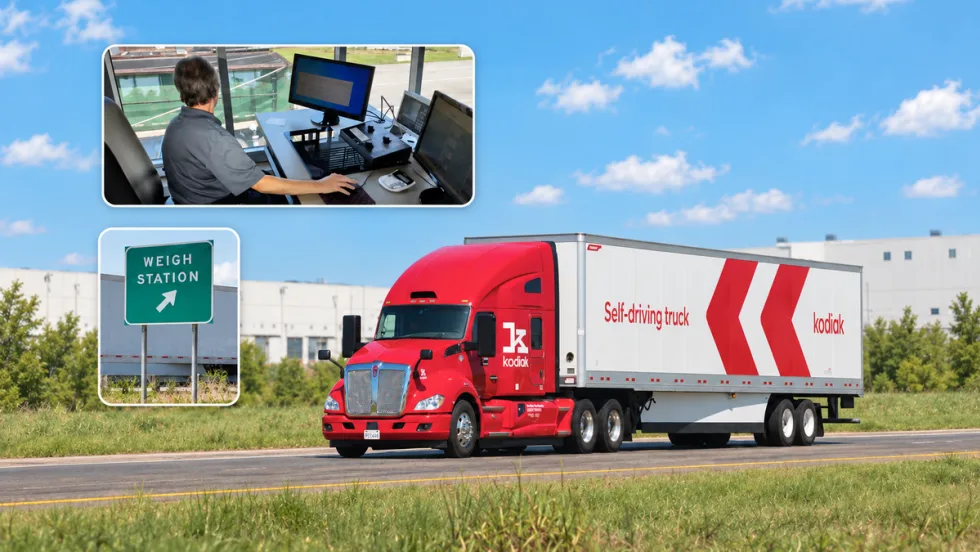
PrePass, Kodiak Connect Driverless Trucks to Roadside Enforcement
The system will allow enforcement agencies to verify Enhanced Inspection information and decide whether Kodiak’s autonomous trucks can bypass roadside screening sites.
Read More →

From One Generation to the Next: How Mentorship Builds Safer Truck Drivers
After three decades in trucking, Harold Perry shares what he's learned about driver safety, mentorship, and helping the next generation build confidence behind the wheel.
Read More →
FMCSA Pauses Biennial-Update Enforcement Amid Motus Transition
Carriers whose updates were due on or after June 1 have more time, while FMCSA works to stabilize its new registration system and warns of phishing sites impersonating its new carrier registration system, Motus.
Read More →
ZF Expands Commercial Vehicle Push in North America
ZF is expanding its North American commercial-vehicle presence with new transmission applications, electrification, trailer technology and autonomous-driving systems.
Read More →
Truck Drivers Need More Than Another Alert
Fleets have more visibility into truck health, safety events, and driver activity than ever. The next challenge is turning all that information into useful guidance for the person who has to decide what to do next.
Read More →
Tesla Wants a Self-Driving Semi. Are Cameras Enough?
Could Tesla’s camera-only autonomous driving technology work on an 80,000-pound Semi? In this commentary, HDT's Deborah Lockridge takes a look at Tesla, Cybercab, and how autonomous trucks see the road.
Read More →
What DOT’s Automated Vehicle Strategy Means for Trucking
The U.S. Department of Transportation issued a new automated-vehicle strategy that outlines plans for driverless-truck regulations, cross-state freight corridors, and federal safety standards.
Read More →
NYC Expands Speed, Pedestrian Safety Tech Across Fleet
New York City is expanding intelligent speed assistance and pedestrian-alert systems across its municipal fleet, moving the technologies from pilot programs into vehicle procurement and retrofit requirements.
Read More →