





From the archives (2018): Daimler Talks Truck Sales, Tariffs, and Globalism
What Would Trump's North American Tariffs Mean for Trucking?
Tariffs and trade wars were a controversial part of Donald Trump’s first term as president, and he's just vowed to slap tariffs on the U.S. largest trade partners, Canada and Mexico. What could that mean for trucking?
November 26, 2024
Image: HDT Graphic
3 min to read
Tariffs and trade wars were a controversial part of Donald Trump’s first term as president, and although we’re still nearly two months away from the start of his second term, he’s already making good on his campaign promises to impose tariffs. And that could have consequences for trucking.
Trump said Nov. 25 that he will sign an executive order immediately after his inauguration introducing a 25% tariff on all goods coming from Mexico and Canada and a 10% tariff on goods from China.
“This Tariff will remain in effect until such time as Drugs, in particular Fentanyl, and all Illegal Aliens stop this Invasion of our Country!” he wrote on his social media platform, Truth Social.
Officials in China, Mexico and Canada quickly responded with criticism, in some cases threatening tariffs on U.S. goods in response.
Mexican President Claudia Sheinbaum reminded people of how the country reacted in 2018 to Trump’s steep tariffs on its steel exports by imposing matching tariffs on U.S. steel, plus other products such as pork. The two countries eventually reached a deal to drop those tariffs.
The Trouble With Tariffs
Economists have warned that tariffs like these could drive up inflation and result in higher consumer prices.
Tariffs are taxes on merchandise shipped to the U.S. from other countries. They are not paid by the countries from which the goods are shipped, as Trump has said, but instead are paid by importers. And those importers typically pass those costs on to buyers.
Mexico and Canada are the United States’ two largest trading partners. For 2024 to date, they account for 28.5% of U.S. imports by value and 33.4% of U.S exports by value.
“And, of course, these are the two countries where the trade is conducted primarily by truck rather than intermodal container, aircraft, etc.,” notes Avery Vise, VP of trucking for FTR Research.
Some observers point out that these tariffs could violate a trade treaty Trump himself signed (and bragged about) during his first term, the US-Mexico-Canada Agreement, or USMCA.
Trump has said he wants to renegotiate that deal, which allows for a review of the agreement in 2026.
The USMCA replaced the North American Free Trade Agreement that went into effect in 1995.
According to the American Trucking Associations, U.S. trade with Canada and Mexico has surged since the enactment of NAFTA. The value of goods traveling via truck across both borders has risen 276%, totaling over $996 billion in 2023.
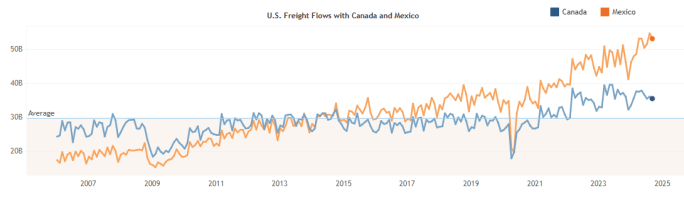
Freight flowing by truck between the U.S., Canada, and Mexico
Source: U.S. DOT Bureau of Transportation Statistics
Tariffs and Trucking
In the short term, trucking could see increased transportation of goods between now and inauguration day, as manufacturers seek to move Mexican and Canadian inventories that ultimately would be purchased anyway into the U.S., Vise said.
There’s a question longer-term about how tariffs might affect truck makers with plants in Mexico or who source parts and components from countries affected by the tariffs. Published reports indicate the move could significantly affect U.S. automakers, and it could affect truck makers as well.
“A major portion of Class 8 production for the U.S. market occurs in Mexico, and that is in addition to all the component production,” Vise said.
However, tariffs can’t be hitting truck makers by surprise, and they no doubt have been looking at ways to adjust.
For instance, according to published reports, Daimler Truck North America told analysts shortly after the election that all of its Freightliner, Western Star and Thomas Built Buses models can be made at either its U.S. or Mexican plants, so production could be shifted if needed.
More Fleet Management

Sponsored•September 16, 2026
Color Match Smarter: Tools That Restore & Perform
For fleet managers and collision repair professionals keeping heavy-duty trucks on the road, getting the color right the first time isn't just about appearance — it's about efficiency, turnaround time, and bottom-line results. Discover how today's digital color tools are transforming the repair process from guesswork to precision.
Read More →
FMCSA Pauses Biennial-Update Enforcement Amid Motus Transition
Carriers whose updates were due on or after June 1 have more time, while FMCSA works to stabilize its new registration system and warns of phishing sites impersonating its new carrier registration system, Motus.
Read More →
Sponsored•September 14, 2026
2026 Blueprint for Countering Smarter Supply Chain Theft
Cargo theft is no longer just the cost of doing business. It's a multi-billion-dollar criminal enterprise exploiting vulnerabilities across your fleet, drivers, and supply chain.
Read More →


Sponsored•September 1, 2026
How Telematics Improves Visibility, Control, and Performance in Refrigerated Fleets
Explore how telematics help refrigerated fleets improve visibility, uptime, efficiency, compliance, and cargo protection across connected cold chain operations.
Read More →
What the U.S.-Canada Trade War Means for Trucking
Escalating U.S.-Canada tariffs could disrupt cross-border freight, reduce truck volumes, raise costs, and create new uncertainty for carriers on both sides of the border.
Read More →
What Are Trucking’s Top Concerns for 2026?
The American Transportation Research Institute wants to know what's worrying trucking fleet managers, drivers, and other stakeholders in its annual Industry Issues survey.
Read More →
American Trucking Associations Looks for a New Leader
ATA President and CEO Chris Spear abruptly left his job at the association on August 21, at a pivotal time for the trucking industry.
Read More →
Public Wi-Fi Cybersecurity Risks: How Truck Drivers and Fleets Can Protect Their Data
Public Wi-Fi can expose truck drivers and fleets to credential theft, malware, and other cyber threats. Here’s how to reduce the risk on the road.
Read More →
For Nicky Cupp, Fleet Innovation Starts With Frustration
HDT Truck Fleet Innovator Nicky Cupp turns everyday pain points at Fraley & Schilling into opportunities for better technology and smarter processes.
Read More →
Adam Buttgenbach’s Approach to Electric Trucks: Start With Where They Fit
HDT Truck Fleet Innovator Adam Buttgenbach helped PepsiCo build one of North America’s largest EV fleets by focusing on where electric trucks make operational sense.
Read More →