




Daimler Talks Truck Sales, Tariffs, and Globalism
Daimler Trucks execs emphasized the benefits of global collaboration as the OEM develops new electric and automated truck technology, at the same time warning of the potential negative effects of tariffs and trade wars.

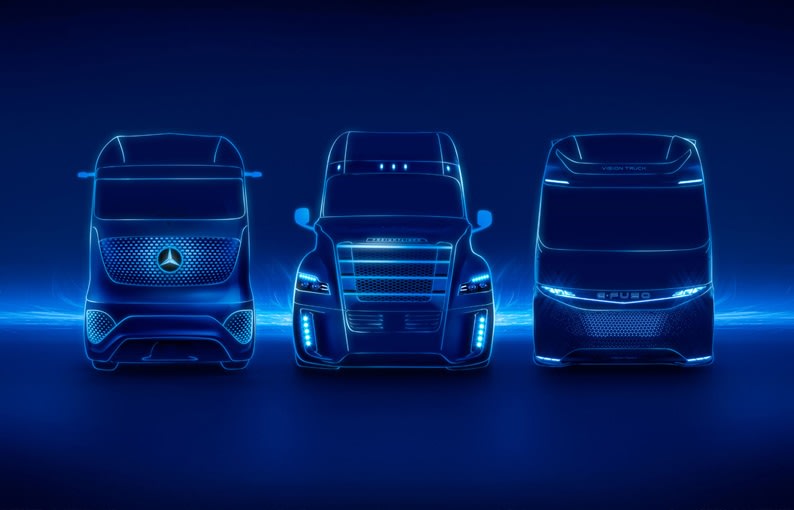
Daimler Trucks executives spoke about its plans for the future of trucks as well as the effects of tarriffs and trade wars at its Captial Market & Technology Day media Q&A.
Image courtesy Daimler Trucks
Daimler Trucks execs emphasized the benefits of global collaboration as the OEM develops new electric and automated truck technology, at the same time warning of the potential negative effects of tariffs and trade wars, in a wide-ranging Q&A with media capping Daimler Trucks’ Capital Market & Technology Day June 6 in Portland, Oregon.
For starters, it’s been a busy year so far for truck sales. ACT Research recently reported that as of May, Class 8 truck orders are being booked at a 475,000-unit rate year to date. “For all practical purposes we’re sold out for 2018 and are reaching the level where the supply chain becomes our constraint,” said Roger Nielsen, president and CEO of Daimler Trucks North America.
“We identified the bottlenecks and have our staff and experts on site at suppliers to make sure we can keep pace,” he added. “And we’ve gone the whole year without having to lose one click in our production; we’ve been very successful in managing the supply chain, but it has been a challenge.”
When asked about the cyclical nature of the truck sales market, Nielsem said, “What comes up must come down. We see a pretty healthy market in 2018 and 2019, but I remind everyone that 2016 was pretty not so good and ‘17 could have been better; are we now getting reward for two more difficult years? The good thing that you can say is the extreme cycles in 2006 and 2009, with the 2006 peak and the absolute deep valley, if you look at the cycles after that we oscillate a little less heavily.”
Truck sales around the world are a little more mixed, he said, especially given the recent truck driver strike and other problems in Brazil that likely have set back that country’s economic recovery. Turkey’s another trouble spot, but Europe and India are doing well.
Global scale
Daimler’s new E-Mobility Group and Automated R&D Center will both draw on the knowledge of Daimler companies throughout the world, such as Mercedes-Benz in Europe and Fuso in Japan.
“There’s a lot of tech from Japan and Europe in those trucks,” said Martin Daum, head of Daimler Truck & Bus, referring to the new eCascadia and eM2 trucks going into fleet testing later this year. “But we had a dedicated and passionate American workforce that put those trucks together.”
Explaining the collaborative approach, he said, “When we develop in one place a solution, we take it to the other place and improve it and hand it back to the first place, and so on. Especially in an area where no one has to defend any turf and we all are in search of the best solution,” as is the case with e-mobility and automation.
While Daimler may have made big announcements about its plans for e-mobility and automation at the same event, Daum said to not necessarily expect the two to merge. “Both technologies have their own problems,” he said. “Combining the two of them, you are not necessarily helping the cause. You eat an elephant by going bit by bit. We produce the best possible electric truck and the best possible automated truck, and only then maybe we look at putting them together.”
Daum also stressed the evolutionary nature of technology development, especially of automated vehicles. There’s a big difference, he said from running an automated truck on a limited regular dedicated highway route and one where you can just send it the address and tell it to go.
“I’m always skeptical of a CEO who says, ‘Within 3 years it will revolutionize the industry. Nope. It’s an evolutionary development, and it starts today and ends 20 or 30 years down the road.”
Tariffs and trade wars
When asked about the latest tariffs from the Trump administration and the response from other countries to impose tariffs of their own, Daum said he was concerned – and not just about this country. “To me this is one of the big mistakes we tend to do, we become more nationalistic. I think the true solution is we become more global. All problems we face are global problems, and we solve them together.”
Manufacturing companies such as Daimler, he said, don’t think in terms of national borders anymore. “As more barriers and tariffs [are imposed], the more cumbersome our life is. We can work around it, but it’s the customers and ultimately the citizens of those countries who suffer, because they have to pay more. When I look around the globe, the more tariffs you build up, the more expensive life inside the country gets.”
Nielsen added that the steel and aluminum tariffs “definitely will increase costs in the United States, and eventually they have to find their way through the entire value chain.”
Related: Daimler Trucks North America to Build Electric Cascadia, M2 Trucks
More Equipment

How Volvo Updated Its D13 for EPA 2027 [Watch]
Volvo’s updated D13 promises lower emissions without sacrificing performance or fuel economy. Take a closer look at what changed inside the engine in this HDT Spotlight video.
Read More →
Michelin Tire Improves Efficiency and Durability for Regional Fleets
The Michelin X Multi Energy D2 is a regional haul drive tire engineered to help fleets improve fuel efficiency, durability and traction in demanding stop-and-go operations.
Read More →
ZF Expands Commercial Vehicle Push in North America
ZF is expanding its North American commercial-vehicle presence with new transmission applications, electrification, trailer technology and autonomous-driving systems.
Read More →
Tesla Wants a Self-Driving Semi. Are Cameras Enough?
Could Tesla’s camera-only autonomous driving technology work on an 80,000-pound Semi? In this commentary, HDT's Deborah Lockridge takes a look at Tesla, Cybercab, and how autonomous trucks see the road.
Read More →
Kodiak: Driverless Long-Haul Truck Launch on Track for 2026
Kodiak AI says its driverless long-haul safety case is 93% complete and it remains on track to begin commercial operations by year-end 2026.
Read More →
What DOT’s Automated Vehicle Strategy Means for Trucking
The U.S. Department of Transportation issued a new automated-vehicle strategy that outlines plans for driverless-truck regulations, cross-state freight corridors, and federal safety standards.
Read More →
East Coast Port Launches $45M Electric Truck Push
The Port Authority of New York and New Jersey announced millions in incentives for zero-emission drayage trucks, yard tractors, and new charging hubs near the port.
Read More →
PlusAI Going Public to Fund Autonomous Truck Launch
A SPAC deal could provide PlusAI with up to $300 million as it works toward a 2027 commercial launch of factory-built autonomous trucks.
Read More →
NHTSA Moves to Rewrite Truck Fuel-Economy Rules
The National Highway Traffic Safety Administration says it lacks authority to regulate medium- and heavy-duty truck engines separately from complete vehicles, but the existing standards have not yet been eliminated.
Read More →
Detroit Opens Orders for EPA 2027 Engines
Detroit isn’t starting from scratch to meet EPA 2027 diesel emissions standards. Its Gen 6 DD13 and DD15 engines keep much of today’s platform while updating the fuel and aftertreatment systems.
Read More →