





Related: NTSB Spreads Skagit Bridge Blame, Soft-Pedals Real Problem
Industry Group Recommends How to Better Prevent Bridge Hits
Recommendations have been issued on how to help prevent vertical-clearance “bridge hits,” like the one by a truck that caused the Skagit River bridge collapse in Washington State back in 2013.
October 3, 2019
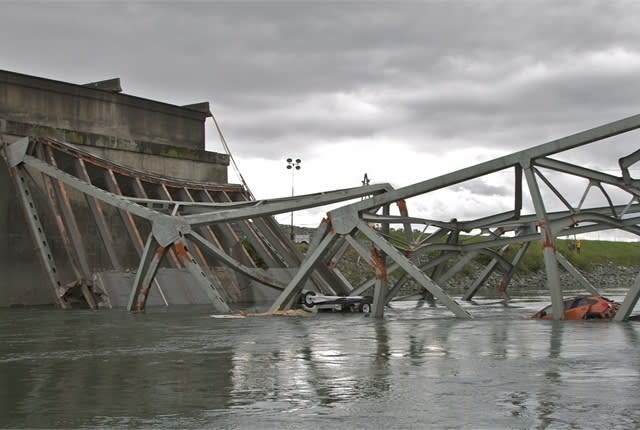
A tractor-trailer with an over-height load struck multiple overhead braces on the Skagit River bridge, causing it to collapse.
Photo: NTSB
3 min to read
Recommendations on how to help prevent vertical-clearance “bridge hits,” like the one that caused the Skagit River Bridge collapse in Washington State back in 2013, have been issued by a working group of safety and highway stakeholder groups.
The working group, which began studying the issue in May, was comprised of 20 representatives from the Commercial Vehicle Safety Alliance, the American Association of State Highway and Transportation Officials, the National Pilot Car Association, the North American Pilot Vehicle Safety Alliance, and the Specialized Carriers and Riggers Association, per an Oct. 2 news release from SCRA.
The group was charged to develop recommendations in light of the national Transportation Safety Board’s investigation after the Skagit River Bridge collapse and other advocacy issues related to industry operations, according to SCRA.
Studied by the group were bridge hits by vehicles; oversize/overweight (OS/OW) load transportation and pilot escort vehicle operations, and inspection of OS/OW loads.
Among the many recommendations presented in the working group’s summary are these four key ones:
Support for Pilot Escort Vehicle Operator certification. States which do not currently require PEVO certification should take the requirement under consideration
Establish a national centralized database to record bridge hit incidents related to vertical clearance
Given the increasing volume and size of current OS/OW loads, it is recommended that standards established in the Manual of Uniform Traffic Control Devices be expanded to include the marking of vertical clearance on all bridges that have less than 20’ of clearance
Establish a national centralized database of certified pilot escort drivers accessible by law enforcement
In the summary, the members state that they have closed the group and “lend the result of their work to the various organizations with the audience and scope of duty to act upon these recommendations.
"Failing to act and simply turn a blind eye and allow the devoted work of these professionals to collect ‘dust on a shelf’ would be a travesty,” they continue. “We all have a responsibility to end the status quo related to the safe movement of OSOW loads. Bridge strikes due to vertical clearance issues continue to rise. The damage caused has resulted in serious injury and fatalities and billions of dollars of repair costs which far too often are left to an ever-decreasing transportation budget.”
On May 23, 2013, a large tractor-trailer combination with an over-height load struck multiple overhead braces on the Skagit River bridge, which carriers Interstate 5 over the river to link the cities of Mount Vernon and Burlington, Washington.
The impact severely damaged the structure, causing one span of the nearly 60-year-old bridge to collapse into the river. Two cars on the span fell into the water. While there were no fatalities, three persons had to be pulled from the water and they suffered minor injuries. The bridge was later repaired at a cost of $19.8 million.
More Safety & Compliance

FMCSA Pauses Biennial-Update Enforcement Amid Motus Transition
Carriers whose updates were due on or after June 1 have more time, while FMCSA works to stabilize its new registration system and warns of phishing sites impersonating its new carrier registration system, Motus.
Read More →
ZF Expands Commercial Vehicle Push in North America
ZF is expanding its North American commercial-vehicle presence with new transmission applications, electrification, trailer technology and autonomous-driving systems.
Read More →
Truck Drivers Need More Than Another Alert
Fleets have more visibility into truck health, safety events, and driver activity than ever. The next challenge is turning all that information into useful guidance for the person who has to decide what to do next.
Read More →
Tesla Wants a Self-Driving Semi. Are Cameras Enough?
Could Tesla’s camera-only autonomous driving technology work on an 80,000-pound Semi? In this commentary, HDT's Deborah Lockridge takes a look at Tesla, Cybercab, and how autonomous trucks see the road.
Read More →
What DOT’s Automated Vehicle Strategy Means for Trucking
The U.S. Department of Transportation issued a new automated-vehicle strategy that outlines plans for driverless-truck regulations, cross-state freight corridors, and federal safety standards.
Read More →
NYC Expands Speed, Pedestrian Safety Tech Across Fleet
New York City is expanding intelligent speed assistance and pedestrian-alert systems across its municipal fleet, moving the technologies from pilot programs into vehicle procurement and retrofit requirements.
Read More →
FMCSA Removes 110 Truck Driver Training Schools from Certified ELDT List
Federal regulators also are targeting more than 160 additional training providers and launching a nationwide audit of third-party CDL skills testers as part of a broader crackdown on trucking fraud.
Read More →
Beyond DOT Compliance: What Makes a Trucking Fleet Truly Safe?
A trucking fleet can follow every rule and still make unsafe decisions. The real test comes when safety conflicts with freight, productivity, or cost.
Read More →
Hours of Service Pilot Programs: FMCSA Readies for 2027 Rollout
Two pilot programs could eventually reshape hours-of-service rules, giving truck drivers options to pause their 14-hour clock or use longer split sleeper rest periods.
Read More →
New Guide Offers Pet Safety Tips for Truck Drivers
Hundreds of thousands of pets travel in truck cabs. A new safety guide from Volvo Trucks and the Center for Pet Safety offers practical advice for truck drivers who bring dogs and cats along for the ride.
Read More →