





Related: What is the Impact of Legal Marijuana on the Trucking Industry?
ATRI Study Looks at Legal Marijuana's Impact on Fleet Operations
A new study by ATRI details issues and solutions related to marijuana-impaired driving, documenting the most promising methods to identify and deter drivers who may use the drug.
March 14, 2019
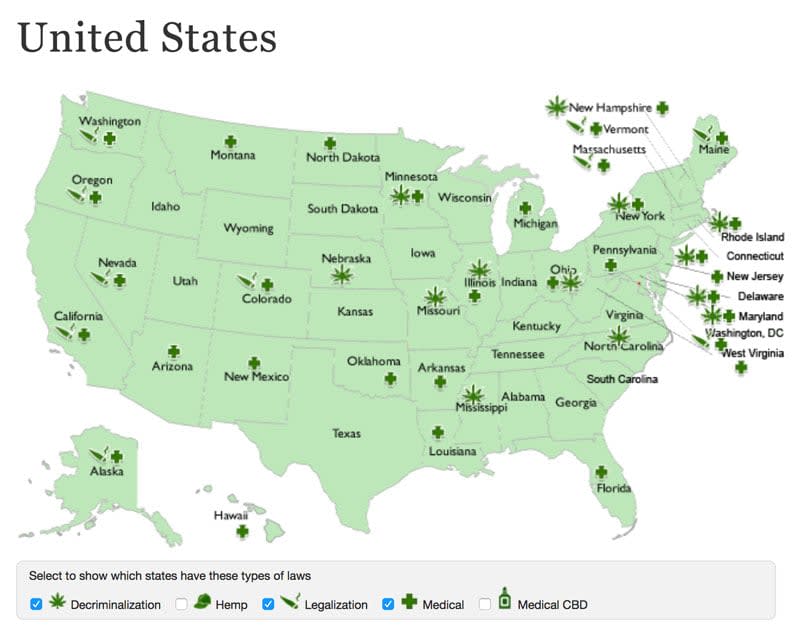
Some form of marijuana use is legal in a majority of states today -- complicating fleet operations and potentially inceasing unsafe driving nationwide, an ATRI study has found.
4 min to read
One of the greatest societal changes in the United States over the past decade has been the push to legalize marijuana for both recreational and medical use. These efforts have largely been focused on changing state laws. And regardless of where you stand on the issue of marijuana use, those initiatives have been impressive: Today, according to DISA, a workplace drug testing service, there are only 14 states where marijuana use is completely illegal. And as legalization leads to more widespread use, the chances of users getting behind the wheel while under the influence of the drug rise as well.
To help fleets deal with these new substance abuse issues, the American Transportation Research Institute (ATRI) has published research detailing issues and solutions related to marijuana-impaired driving. The group says this issue is a top safety research priority identified by ATRI’s Research Advisory Committee (RAC) in 2018.
ATRI’s research sought to document the most promising methods to identify and deter marijuana-impaired driving. The study recommends: increased data collection on the frequency and impacts of marijuana-impaired driving; public education and information on the risks of impaired driving; better equipping law enforcement and the court system to intercept and ultimately prosecute impaired drivers; and targeting tax revenue generated from marijuana sales to fund these activities.
“It is extremely concerning to motor carriers and our drivers that recreational marijuana is legal in so many states, yet as the ATRI report documents, a valid and widely accepted breathalyzer-type test is not available to law enforcement,” said Mike Card, president of Combined Transport, Inc. “ATRI’s study clearly defines a role for federal and state leaders to support law enforcement and others in keeping the roadways safe from those who choose to drive high.”
In particular, the report highlights the importance of training law enforcement to identify and collect evidence of marijuana-impaired driving, particularly through the development of more drug recognition experts (DREs).
“As ATRI’s research identifies, a key tool for combating drugged drivers is deploying additional drug recognition experts,” said Mark Savage, Deputy Chief of the Colorado State Patrol. “A DRE can bring critical evidence to prosecutors that other tests simply cannot measure."
The report notes that marijuana impairment behind the wheel causes drivers to exhibit poor judgment, decreased motor coordination and decreased reaction time. Likewise, the report says, marijuana impairment while driving is likely to become a larger problem as legal access to the drug increases.
Recent national statistics for marijuana-positive drug tests, for instance, indicate that 2.6 percent of drug tests were marijuana-positive in 2017 – a 4% year-over-year increase from 2016. Marijuana-positive drug tests for federally-mandated, safety-sensitive occupations have also increased by nearly 8% from 2016 to 2017 (0.78% in 2016 to 0.84% in 2017). The largest increases in marijuana positivity rates were observed in states that recently enacted recreational marijuana laws.
One problem, the report notes, is that determining impairment is very different – and indeed, difficult – compared to determining if a driver is operating a vehicle under the influence of alcohol. The report notes that standard drug testing mechanisms today can easily identify past marijuana use by measuring metabolites. But that testing mechanism cannot provide law enforcement officers with evidence of active impairment or intoxication.
Thus, a simple blood or breathalyzer test – commonly employed by law enforcement when alcohol impairment is suspected – is not ideal for identifying drivers operating under the influence of marijuana. This is due to the body’s mechanisms for processing marijuana’s intoxicant agent, THC. Of the states that have legalized recreational marijuana, most have chosen to set limits on the amount of acceptable THC in blood tests when testing for driver impairment. However, there are several issues related to such tests.
The National Highway Transportation Safety Administration (NHTSA), for instance, offers evidence that some state laws allow an individual to be charged with a DUI if they test positive for THC derivatives in urine following arrest, which indicates marijuana use in the past 30 days but not necessarily recent marijuana use.
To counter these problems, the report notes that states with legal recreational marijuana are applying for federal funds for numerous areas impacted by increased access to marijuana, including:
Law enforcement training to better identify drug-impaired driving;
Law enforcement overtime for drug-impaired driving enforcement;
Phlebotomy technicians to draw blood samples from suspected impaired drivers;
Drug toxicology personnel, equipment and facilities to test suspected impaired drivers for drugs;
Judge and prosecutor training on drug-impaired driving; and
Public outreach on the dangers of drug-impaired driving.
The full ATRI report can be downloaded for free here.
More Fleet Management

Sponsored•September 16, 2026
Color Match Smarter: Tools That Restore & Perform
For fleet managers and collision repair professionals keeping heavy-duty trucks on the road, getting the color right the first time isn't just about appearance — it's about efficiency, turnaround time, and bottom-line results. Discover how today's digital color tools are transforming the repair process from guesswork to precision.
Read More →
FMCSA Pauses Biennial-Update Enforcement Amid Motus Transition
Carriers whose updates were due on or after June 1 have more time, while FMCSA works to stabilize its new registration system and warns of phishing sites impersonating its new carrier registration system, Motus.
Read More →
Sponsored•September 14, 2026
2026 Blueprint for Countering Smarter Supply Chain Theft
Cargo theft is no longer just the cost of doing business. It's a multi-billion-dollar criminal enterprise exploiting vulnerabilities across your fleet, drivers, and supply chain.
Read More →


Sponsored•September 1, 2026
How Telematics Improves Visibility, Control, and Performance in Refrigerated Fleets
Explore how telematics help refrigerated fleets improve visibility, uptime, efficiency, compliance, and cargo protection across connected cold chain operations.
Read More →
What the U.S.-Canada Trade War Means for Trucking
Escalating U.S.-Canada tariffs could disrupt cross-border freight, reduce truck volumes, raise costs, and create new uncertainty for carriers on both sides of the border.
Read More →
What Are Trucking’s Top Concerns for 2026?
The American Transportation Research Institute wants to know what's worrying trucking fleet managers, drivers, and other stakeholders in its annual Industry Issues survey.
Read More →
American Trucking Associations Looks for a New Leader
ATA President and CEO Chris Spear abruptly left his job at the association on August 21, at a pivotal time for the trucking industry.
Read More →
Public Wi-Fi Cybersecurity Risks: How Truck Drivers and Fleets Can Protect Their Data
Public Wi-Fi can expose truck drivers and fleets to credential theft, malware, and other cyber threats. Here’s how to reduce the risk on the road.
Read More →
For Nicky Cupp, Fleet Innovation Starts With Frustration
HDT Truck Fleet Innovator Nicky Cupp turns everyday pain points at Fraley & Schilling into opportunities for better technology and smarter processes.
Read More →
Adam Buttgenbach’s Approach to Electric Trucks: Start With Where They Fit
HDT Truck Fleet Innovator Adam Buttgenbach helped PepsiCo build one of North America’s largest EV fleets by focusing on where electric trucks make operational sense.
Read More →