




Allison Celebrates 100 Years by Promoting Today’s Products
The future is bright for the fully automatic transmission in commercial vehicles, say executives at Allison Transmission, even as they’re saluting their company’s founder and honoring accomplishments in this, the company’s centennial year.

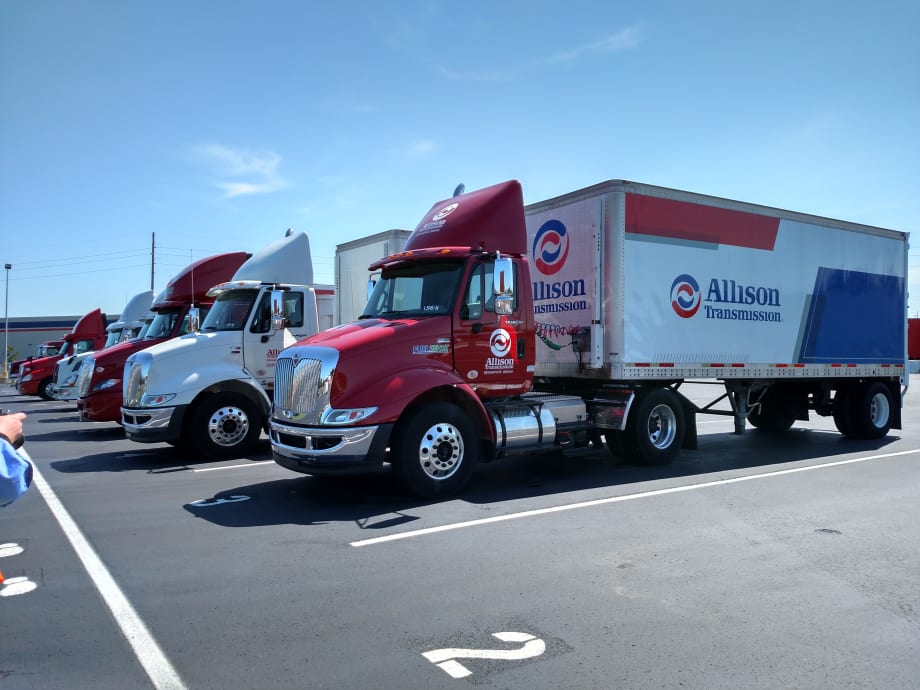
Red tractors have Allison transmissions, white ones have competitors’ products. Visitors can experience the difference. Photo by Tom Berg.
Red tractors have Allison transmissions, white ones have competitors’ products. Visitors can experience the difference.Photo by Tom Berg.
The future is bright for the fully automatic transmission in commercial vehicles, partly because of government and customer pressure to increase fuel economy, say executives at Allison Transmission, even as they’re saluting their company’s founder and honoring accomplishments in this, the company’s centennial year.
The 100th anniversary is being marked by corporate and civic events, from a proclamation by Indiana’s legislature to a “media day” on Friday, where executives told press reporters the Allison story. Today’s emphasis is on improved fuel economy and safety made possible by Allison’s torque converter-equipped powershift products, they said.
Allison is a leading manufacturer of fully automatic transmissions for commercial vehicles, including light, medium and heavy trucks, as well as transit and intercity buses, executives said. It has delivered 6 million transmissions and its products are used by 15,000 fleets around the world.
Its main production facilities are in Indianapolis, and others are in Hungary and India; the company does business in 80 countries. Quality is paramount in importance, executives said, and the same processes are used in all its plants. In 2014 its revenue was $2.12 billion with net income of $479.1 million.
100 Years at Allison
Allison Transmission’s history dates to Sept. 14, 1915, when James Allison, already a successful industrialist, established a machine shop and “experimental” works down the street from the Indianapolis Motor Speedway, which he and three associates had founded to test automobiles four years earlier.
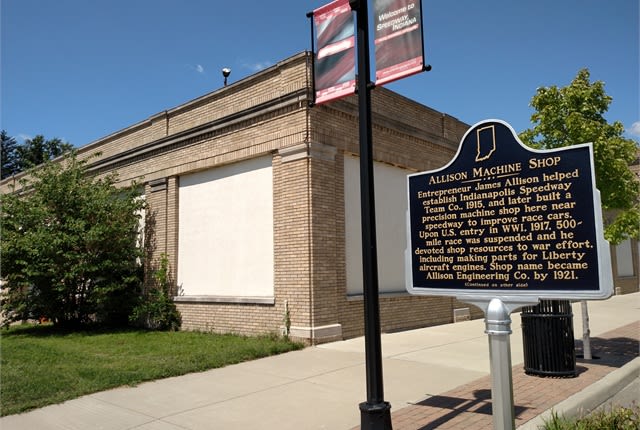
Historical marker on Main Street in Speedway, Ind., commemorates the building that housed James Allison’s machine shop and “speedway team.” Today’s Allison Transmission headquarters is several blocks away in Indianapolis. Photo by Tom Berg
Allison called his company the Indianapolis Speedway Team Co. and his focus was on racing, but that was interrupted by America’s entry into the Great War – now called World War I -- in 1917. Allison’s shop produced parts and tooling for Liberty engines used by many Allied airplanes in the war. He briefly turned back to racing at the war’s end in late 1918, and his car won the 1919 Indy 500. He then sold his cars and concentrated on engineering aircraft and marine products.
In 1928 Allison died at age 54, and in ’29 General Motors bought the company, thus beginning a long ownership and association. Aircraft engines became the Allison Division’s largest business, and during World War II it produced 70,000 V-1710 models.
During the war, the U.S. Army wanted automatic gear boxes to make its battle tanks move faster and maneuver better, said Eric Dickerson, today’s public relations manager. It asked GM and Allison to develop one. The first one, a cross-drive hydraulic unit for the then-new M-41 Patton tank, was built in 1949. Since then the company has made transmissions for most of the U.S. military’s armored and tactical wheeled vehicles.
Development of marine transmissions and V-drive transmissions for buses was also done in the mid to late ‘40s. Automatics for trucks and buses came in the early 1950s, leading to the hydraulically controlled LT, MT and HT series of the 1960s, ‘70s and ‘80s. “World” transmissions with electronic controls were introduced in the ‘90s and their successors continue today.
GM sold Allison in 2007 to a pair of private equity firms, Carlyle Group and Onex Corp., which pumped considerable money into the company for further development and expansions.
“My husband and I both were long-time General Motors employees, and when GM sold us, we thought the world was coming to an end,” said Melissa Sauer, a marketing executive. “But the equity firms invested more money in Allison since then than everything GM did in the last 50 years of ownership.”
“Thanks to investment from our corporate parents, we had a lot of development going on in 2009,” during the depths of the Great Recession, said Larry Dewey, chairman, president and chief executive officer.
Carlyle and Onex sold their majority stock ownership in March 2012, and Allison Transmission Holdings Inc. became a public company with its shares trading on the New York Stock Exchange.
Fuel Economy Today's Focus
Fuel economy is Allison’s current focus, Dewey said.
“We doubled down and tripled down on fuel economy a couple of years ago,” he said, “with transmission products and electric hybrids for buses. Even with lower fuel prices, fuel is still a significant expense” for users.
Engineers devised electronic advances called FuelSense for its line of 1000 to 4000 series truck and bus automatics that the company says can improve economy up to 20%. FuelSense improvements have also been applied to the TC10, a heavy duty automatic for use in regional/local tractors – an application marketers now call “metro.”
“We want the TC10 to be as good in fuel economy over-the-road as manual transmissions."
“We want the TC10 to be as good in fuel economy over-the-road as manual transmissions,” Dewey said, and fleet users report it is about 1.5% better. In stop-and-go traffic, fleets say the TC10 is 3% to 5% better than manuals, which should pay off its premium price in two to three years.
“We have people come in here and tell us they’re getting 20% better,” he said. “Well, I love my product, but I don’t know that I would say that.”
Like the 6-speed full automatics, the 10-speed TC10 also reduces maintenance costs because its torque converter cushions the driveline better than clutches in manual and automated gearboxes. And the TC10 improves safety because a driver needn’t worry about which gear he’s in and changing to the next one. Drivers are more relaxed and can better focus on traffic and, in general, doing their jobs.
Navistar International is the only current customer for the TC10, but there’s interest from other original equipment manufacturers, Dewey said.
“Prototypes are running elsewhere, here and overseas, including Australia,” he said. “And we’re in very active negotiations with one or two OEMs here.”
Allison is selling the TC10 against both manual and automated transmissions, and it is superior to both, Dewey contends. “We’re able to demonstrate in single digits, and sometimes in double digits, increases in productivity” over manuals because the TC10 is effortless to operate, and it shifts more quickly and smoothly than automated manual gearboxes.
Looking to the future, Dewey said, the Phase 2 greenhouse-gas and fuel economy proposals from the Environmental Protection Agency and the National Highway Traffic Safety Administration will be “very challenging. We’re working closely with EPA… we’ve done a ton of work” on optimizing powertrains.
A fleet of trucks and tractors on a nearby demonstration track was waiting for reporters to see and feel how Allison products performed against competitors. Watch for a video on Truckinginfo about the experience.
More Fuel Smarts

How Volvo Updated Its D13 for EPA 2027 [Watch]
Volvo’s updated D13 promises lower emissions without sacrificing performance or fuel economy. Take a closer look at what changed inside the engine in this HDT Spotlight video.
Read More →
Diesel Price Spike Shortens Payback for Natural Gas Trucks, Report Says
Energy Vision estimates fleets could recover the higher purchase price of an RNG-fueled Class 8 tractor in 1.3 to 2.8 years under current fuel-price scenarios.
Read More →
Calstart Becomes Catalyst Mobility, Reflecting Broader Focus
Calstart is now Catalyst Mobility, reflecting the nonprofit’s growing national role in clean transportation, including zero-emission trucks, infrastructure and incentive programs.
Read More →

Record Diesel Prices Squeeze Trucking Fleets
Average U.S. diesel prices have climbed to nearly $6 a gallon, surpassing the 2022 record as tight refinery capacity and Middle East disruptions keep fuel costs elevated.
Read More →
How Fuel Delivery Shapes Engine Performance
Fuel delivery depends on more than what happens at the injector. For fleet, maintenance and technical professionals, looking at the full path from pump to injector can provide useful context for understanding engine performance.
Read More →
East Coast Port Launches $45M Electric Truck Push
The Port Authority of New York and New Jersey announced millions in incentives for zero-emission drayage trucks, yard tractors, and new charging hubs near the port.
Read More →
California Bill Could Shed Light on Electric Truck Prices
Why do battery-electric Class 8 trucks remain so expensive? A California bill headed to Gov. Gavin Newsom would give fleets and state agencies more visibility into what manufacturers charge.
Read More →
Detroit Opens Orders for EPA 2027 Engines
Detroit isn’t starting from scratch to meet EPA 2027 diesel emissions standards. Its Gen 6 DD13 and DD15 engines keep much of today’s platform while updating the fuel and aftertreatment systems.
Read More →
Zero-Emission Truck Corridor Planned for West Coast
California, Oregon, Washington, British Columbia and Baja California are coordinating plans for truck charging and hydrogen fueling from Canada to Mexico.
Read More →
A Closer Look at Kenworth’s Electric T880E Vocational Truck [Video]
Learn more about Kenworth's T880E battery-electric vocational truck at the Paccar Technical Center, including its range, applications, upfitting considerations, and PTO options, in this HDT Spotlight video.
Read More →