




Aeva to Supply 4D Lidar for Autonomous Daimler Trucks
Aeva will supply its latest 4D Lidar technology to Daimler Truck and collaborate with Torc Robotics to provide SAE Level 4 autonomous vehicle capabilities for the Freightliner Cascadia.

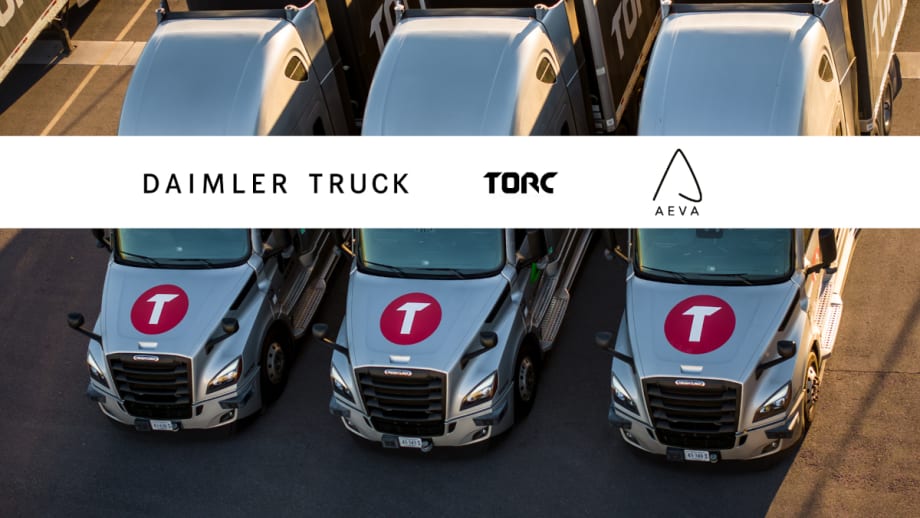
The multi-year collaboration between Daimler Truck, Aeva, and Torc Robotics begins in the first quarter of 2024.
Photo: Daimler Truck
Daimler Truck has selected Aeva as the supplier of long and ultra-long-range Lidar for its autonomous commercial vehicle program and will integrate the sensors into its production process.
Aeva will supply its latest Atlas 4D Lidar technology to Daimler Truck and collaborate with Torc Robotics, an independent subsidiary of Daimler Truck, to enable SAE Level 4 autonomous vehicle capabilities beginning with the Class 8 Freightliner Cascadia truck platform.
“Selecting the right Lidar technology is a crucial strategic decision to safely deploy autonomous trucks on the road. Together with Torc, we are well on track to offer autonomous trucks to the U.S. market by 2027,” said Joanna Buttler, head of global autonomous technology group at Daimler Truck.
Torc Robotics will sell its virtual driver technology and Mission Control services as a subscription to customers. Its driving software will use Aeva’s perception software, built around Aeva’s instant velocity data, to detect objects faster, further away, and with higher accuracy.
The multi-year collaboration begins in the first quarter of 2024. with Aeva’s start of production by 2026 and Daimler Truck production ramping up by 2027.
4D Lidar
Daimler Trucks said Aeva’s unique Frequency Modulated Continuous Wave (FMCW) 4D Lidar technology uses a low-power continuous laser beam to simultaneously measure range and velocity for every point. This enables automated vehicles to unlock new levels of safety and vehicle automation, according to the truck maker, by instantaneously discriminating between static and dynamic points and knowing the precise velocity of dynamic objects.
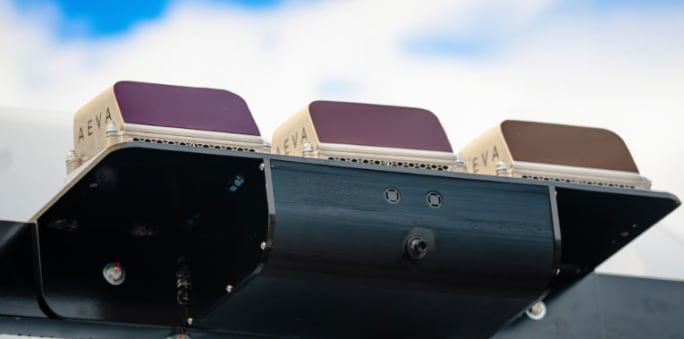
Aeva will supply its latest Atlas automotive grade 4D LiDAR technology to Daimler Truck and collaborate with Torc Robotics.
Photo: Daimler Truck
“Aeva is pioneering the commercialization of FMCW Lidar technology, a key differentiator for long range detection and object identification. This means Torc’s virtual driving software can now rely on significantly higher resolution as well as farther and clearer detection of objects plus instant velocity detection, which are crucial to safely deploy autonomous trucks at scale,” said Peter Vaughan Schmidt, CEO at Torc Robotics.
Multiple Sensors
Daimler Truck and Torc’s trucks are equipped with sensor sets from a combination of three technologies:
Lidar
Radar
Cameras
The truck manufacturer said this enables safe handling adapted to the respective situation on highways, surface roads, and ramps as well as when turning at controlled intersections.
More Equipment

How Volvo Updated Its D13 for EPA 2027 [Watch]
Volvo’s updated D13 promises lower emissions without sacrificing performance or fuel economy. Take a closer look at what changed inside the engine in this HDT Spotlight video.
Read More →
Michelin Tire Improves Efficiency and Durability for Regional Fleets
The Michelin X Multi Energy D2 is a regional haul drive tire engineered to help fleets improve fuel efficiency, durability and traction in demanding stop-and-go operations.
Read More →
ZF Expands Commercial Vehicle Push in North America
ZF is expanding its North American commercial-vehicle presence with new transmission applications, electrification, trailer technology and autonomous-driving systems.
Read More →
Tesla Wants a Self-Driving Semi. Are Cameras Enough?
Could Tesla’s camera-only autonomous driving technology work on an 80,000-pound Semi? In this commentary, HDT's Deborah Lockridge takes a look at Tesla, Cybercab, and how autonomous trucks see the road.
Read More →
Kodiak: Driverless Long-Haul Truck Launch on Track for 2026
Kodiak AI says its driverless long-haul safety case is 93% complete and it remains on track to begin commercial operations by year-end 2026.
Read More →
What DOT’s Automated Vehicle Strategy Means for Trucking
The U.S. Department of Transportation issued a new automated-vehicle strategy that outlines plans for driverless-truck regulations, cross-state freight corridors, and federal safety standards.
Read More →
East Coast Port Launches $45M Electric Truck Push
The Port Authority of New York and New Jersey announced millions in incentives for zero-emission drayage trucks, yard tractors, and new charging hubs near the port.
Read More →
PlusAI Going Public to Fund Autonomous Truck Launch
A SPAC deal could provide PlusAI with up to $300 million as it works toward a 2027 commercial launch of factory-built autonomous trucks.
Read More →
NHTSA Moves to Rewrite Truck Fuel-Economy Rules
The National Highway Traffic Safety Administration says it lacks authority to regulate medium- and heavy-duty truck engines separately from complete vehicles, but the existing standards have not yet been eliminated.
Read More →
Detroit Opens Orders for EPA 2027 Engines
Detroit isn’t starting from scratch to meet EPA 2027 diesel emissions standards. Its Gen 6 DD13 and DD15 engines keep much of today’s platform while updating the fuel and aftertreatment systems.
Read More →