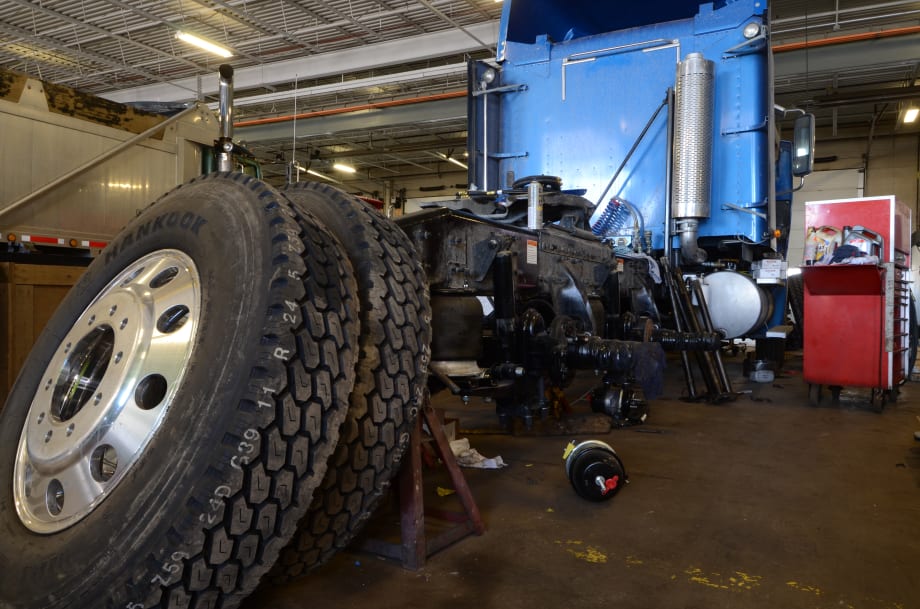
A little extra diligence in the shop, or a bit of mechanical assistance, can help fleets avoid the irritants associated with loose wheel bearings, like irregular tire wear, premature brake relining and even wheel-offs.
Proper bearing adjustment is precice work requiring specialised tools.
7 min to read
Proper bearing adjustment is precice work requiring specialised tools.
The difference between good and bad in the wheel bearing world is a very fine line — about the width of a couple of human hairs, to be imprecise. That's not much of a margin considering the potential consequences. Loose or improperly adjusted wheel bearings could be the source of several problems.
Ad Loading...
More accurately, they should be called symptoms, as the problem itself is the loose bearing.
Symptoms of loose bearings could include:
Ad Loading...
Iirregular wear on the inside edge of an inside dual tire.
Irregular cupping on steer tire shoulders (caused by a negative camber condition).
Premature wheel-seal failure.
Persistent intermittent ABS fault codes.
Brake lining wear that appears as tapered wear on the inside edge of the top shoe and the outside edge of the lower shoe.
Take tire or brake problems, for example. Uneven brake lining wear usually won't prevent the truck from stopping. It will, however, degrade brake performance because you're lessening the contact area between the lining face and the drum. In the case of disc brake rotors, the less-than-true running of the wheel and rotor relative to the pads will cause one pad to remain in contact with the rotor, eventually wearing both parts prematurely.
It's the same for the ABS tone or exciter ring. With the wheel flopping around on the end of the axle, if the tone ring isn't in very close proximity to the sensors, it will generate a fault code prompting the light to come on.
Wheel Bearing Problems Often Overlooked
Tom Runels, principal engineer, Global Development, Bendix Spicer Foundation Brake, says the bearings' culpability in these and other wheel-end related maintenance matters is often overlooked.
"It's hard for some to conceive that such small amount of bearing endplay can have such a dramatic impact on all those other components," he says. "Even if you double the TMC's recommended endplay of 5 thousandths of an inch, 10-thou would still be an almost imperceptible amount of movement without measuring it.
Ad Loading...
"The truth is people usually become alert to a problem only when it becomes visibly obvious. Lining wear, tire edge wear and ABS faults are both visible and obvious. Loose bearings usually aren't."
Loose wheel bearings are likely a more common problem than we'd expect, especially with the type of hub system that requires manual bearing adjustment.
Mike Beckett of MD Alignment in Des Moines, Iowa sees trucks all the time with various tire issues, including edge wear and cupping associated with bearings. He claims that no less than 80 percent of trucks and trailers, new and in-service, have loose wheel bearings.
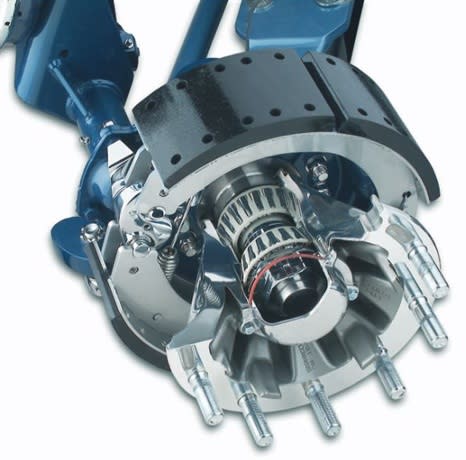
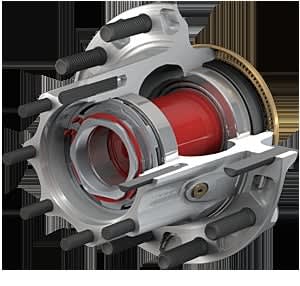
The Dana Spicer UHS Unitized Hub System is factory filled with synthetic grease and sealed to avoid lubrication intervals, bearing adjustment and seal replacement.
The difference between too loose or too tight, according to The Technology and Maintenance Council's Recommended Practice RP 618 for wheel bearing adjustment, is between one and five thousandths of an inch (.001 - .005). To achieve the desired amount of end play, RP 618 offers a nine-step process. If all nine steps are followed, you'll get there. If not …
"First of all, far too few shops use a dial indicator to verify end play," Beckett says. "Secondly, they follow RP 618, but usually leave out step 8 — the dial indicator part. They torque the wheel nut on, back it off, torque it again, and then back off 1/4 or 1/2 a turn of the nut. That's where they get into trouble."
Ad Loading...
Bearing installation and adjustment procedures for non-preset bearing sets described in The Technology and Maintenance Council's Recommended Practice RP 618 are a nine-step process requiring some diligence on the technician's part.
To achieve the accepted .001 to .005 endplay on the bearing, you need a calibrated torque wrench and a dial indicator. On top of that, RP-618 assumes the spindle threads are in like-new condition and haven't stretched or deformed, and that the thread face is free of oil, rust or dirt that could influence the torque. That could be a large assumption. If wheel bearings are leaving the shop too loose or too tight, problems are imminent.
"The one- to five-thou range recommended by RP 618 is a compromise between too loose and too tight," says Mark Stangl, global product manager of the automotive and heavy duty aftermarket at Timken Company. "At zero, we're into preload and we can't measure that. Between zero and one thou, we could be measuring deflection and still be in preload. Between one and five, we know the bearing is not preloaded, and it's not too loose that it will cause other problems downstream."
End-play Vs. Pre-load
Everybody knows that loose wheel bearings aren’t the end of the world. A little annoying and inconvenient at times, costly in terms of tire wear, leaky seals etc., but short of having the wheel come right off, there's little real threat to a loose wheel bearing.
On the other hand, excessive preload can fail a bearing within a few hundred miles. And that could be part of the problem, Beckett tells us.
Ad Loading...
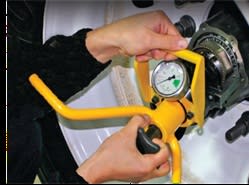
Dr. Preload's bearing adjustment tool provides a precise range to set bearing preload.
"Techs reluctant to over tighten a wheel bearing may err on the side of caution, preferring a slightly loose bearing to one that is too tight. Nobody wants to lose a wheel," he says.
Preload — the opposite of end play — is where there is no hub movement at all relative to the axle. In a perfect world, the bearing would be loaded so there was zero endplay. But preload cannot be easily measured (rolling torque is an option, but that has its own set of variables), so it can't be determined that the bearing isn't in fact dangerously tight.
Ray Piascik, vice president of marketing and sales at Temper Axle Products Corp., insists measured and consistent preload is achievable. His company has developed a system called Dr. Preload that, with the use of a proprietary locknut and retainer ring, can measure preload precisely and repeatedly, then lock the bearing at that setting.
"We've done some testing trying to achieve preload with torque wrench procedures, and we concluded it can't be done reliably or repeatedly," Piasik says. "Just a slight slip of the wrench and you can go very high on preload. That's really bad for bearings."
Dr. Preload is a measuring tool that allows technicians to set measureable and consistent bearing preload in about a minute per wheel-end, without torque wrenches and dial indicators. It does require a proprietary nut and lock ring, but the system is available for any wheel hub currently available.
Ad Loading...
Hubs That Make Installation Easier
Some hubs, such as ConMet's Preset Plus or the Dana Spicer UHS Unitized Hub System, make correct installation easier and more accurate.
According to Roger Maye, national service manager for Consolidated Metco, PreSet hubs make correct installation easier and more accurate.
When you torque the spindle nut on a PreSet hub assembly, you are applying a load through the cone races of the inner and outer bearings and the precision-machined bearing spacer, against the shoulder of the spindle. Because of the machining of the hub and the specially toleranced components, the bearing endplay adjustment is built into the hub assembly.
"ConMet's PreSet hubs are all pre-assembled and tested at the factory," says Maye. "When the hub is installed onto the spindle, as long as the instructions are followed and the correct torque values are applied to the spindle nuts, there's almost no way to install these hubs incorrectly."
Conmet's Preset Plus hubs are factory set to ensure the correct bearing adjustment, if proper procedures are followed.
Installation procedures are different from those in RP 618 because this is a different design. There's no need to verify bearing end play because the machining of the hub, the specially toleranced bearings, and the bearing spacer are designed to work together to set the bearing end play Maye says.
Ad Loading...
"Light controlled preload provides the optimal bearing settings for maximum bearing and seal life," Maye stresses.
"Preload is difficult to accurately measure. We measure it with specialized equipment before the hub assembly leaves the factory, so we know it's in spec when it is installed in the field."
Setting wheel bearings correctly requires diligence on the technician's part, and of course adherence to procedures and the right tools. It wouldn't be too much of a stretch to suggest this isn't always the case — and the preponderance of the problems mentioned above should be a hint that bearing adjustment isn't always done correctly.
Where there's literally a hair's breadth — okay, maybe two or three, depending on how thick your hair is — between right and wrong, can you really afford not to do it right?
More Information on Wheel Installation
TMC offers no fewer than three Recommended Practices that specifically detail wheel installation procedures and hardware requirements: RP-217C, RP-222C and RP-237.
All of the wheel and rim manufacturers and tire producers, as well as the Tire and Rim Association, the Society of Automotive Engineers and the Occupational Safety and Health Administration to name just a few, have published guidelines for fleets and tire technicians to follow.
For fleet managers and collision repair professionals keeping heavy-duty trucks on the road, getting the color right the first time isn't just about appearance — it's about efficiency, turnaround time, and bottom-line results. Discover how today's digital color tools are transforming the repair process from guesswork to precision.
DTNA is recalling more than 2,400 trucks that received an incompatible software fix instead of the hardware repair required to address brake valve corrosion.
Fleets have more visibility into truck health, safety events, and driver activity than ever. The next challenge is turning all that information into useful guidance for the person who has to decide what to do next.
Making it through August isn’t the same as being ready for the next several months of operation. Find out what systems may have suffered from summer heat and need to be checked out before fall.
With freight improving but costs still climbing, fleet maintenance executives explain how they're balancing price, quality, and supplier relationships.
The new API PC-12 heavy-duty engine oil category reflects the changing demands of modern diesel engines. But fleets like Foodliner are looking to getting their own data before making decisions on adopting the new oils and questions such as extending oil drain intervals.
The joint venture will operate MCT's network of Carrier Transicold dealerships and mobile service locations, with the companies promising greater service capacity and uptime for refrigerated fleets.