





Related: Tire Maintenance: It’s Not Just Checking Tire Pressure
What You Don't Know About Your Truck Wheels Can Hurt You
There’s much more to truck wheel installation — and many more pitfalls to taking shortcuts — than you may think. If you haven’t reviewed your wheel installation procedures lately, here’s something to think about.
November 28, 2017
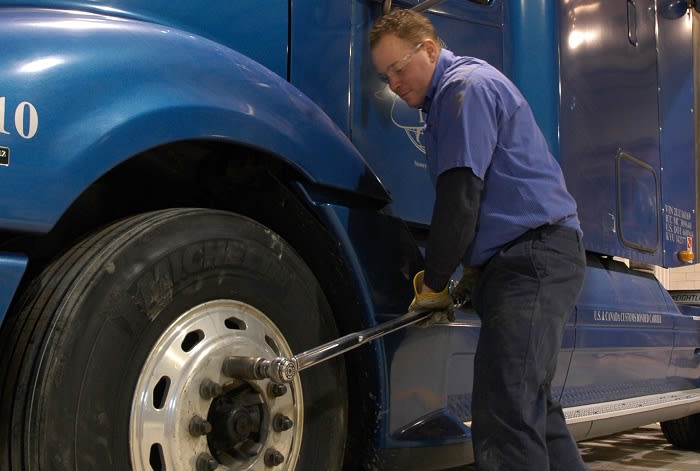
If you don’t use the proper tools, you’ll never know how much – or how little – clamping force you have on the wheels.
Photo: Jim Park
8 min to read
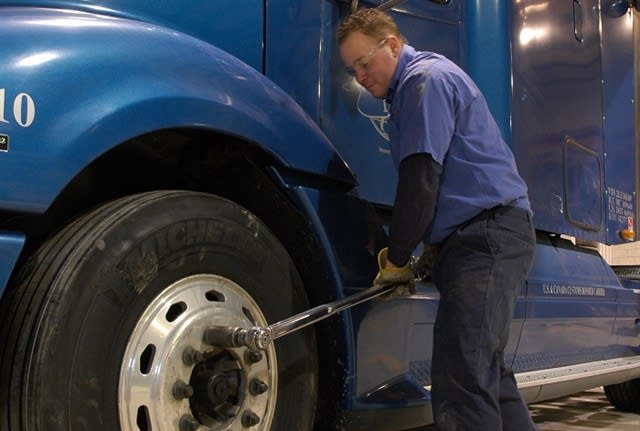
If you don’t use the proper tools, you’ll never know how much – or how little – clamping force you have on the wheels.Photo: Jim Park
Wheel installation is pretty simple, right? Bolt ’em on, torque ’em down and you’re good to go. If that’s what you believe, then perhaps you’ve had more than your share of truck wheel separation incidents.
I wouldn’t go so far as to call wheel installation rocket science, but there’s much more to doing it right — and many more pitfalls to taking shortcuts — than you may think. If you haven’t reviewed your wheel installation procedures lately, what follows will give you something to think about.
More Than Torquing Your Nuts
When technicians work on wheels, they often refer to the wheel nut tightening process as torquing the nuts, but that doesn’t really tell the whole story.
Instead of torque, wheel-end manufacturers use the term clamping force. Clamping force is caused by the tension in the stud. Tension is a function of torque and friction. A brand new Grade 8 M22-1.5 wheel bolt and nut can provide approximately 50,000 pounds of clamping force, so when you apply 500 lb-ft of torque to the entire 10-bolt wheel end, you have 500,000 pounds of clamping force holding the wheel in place.
That, however, is only under optimum conditions, like when the assembly is brand new or when all the necessary installation steps have been followed and the hardware is in very good condition.
Inspecting Your Truck Wheels
Let’s start with the hardware. This process begins when the wheel is removed from the truck. First, ensure the wheel isn’t cracked or broken and the stud holes are perfectly round. Elongated holes are indications that the wheel was at one time loose on the hub. Obviously, if the wheel is damaged it should be pulled from service.
Next, check the hub and ensure the studs are not damaged, stretched or badly corroded. The threads should be in good condition, have no paint or contaminants on them, and be the correct length and diameter for the type of wheel (aluminum or steel). The threads must match the nuts, e.g., metric or English sizing. If you have to replace a damaged stud, the two adjacent studs should also be replaced. If you have two or more damaged studs, all 10 studs should be replaced with new hardware of the correct size and grade for the application.
“You do not have to replace all the studs each time you do a wheel installation,” says Brandon Uzarek, field engineer for wheels at Accuride Corp. “Good quality studs will last a long time provided they have not been stretched or damaged. [On the other hand] I have seen examples where you can rub the thread from the stud with your thumb. Studs like that obviously have to be replaced.”
The stud condition is critical to getting the proper clamping force at the wheel.
“Torque is critical due to the fact the stud stretches like a spring; if the correct torque is not applied you will not get the correct clamp load,” explains David Walters, manager of warranty and field service at Arconic, which makes Alcoa wheels. “Thus you could either under-torque to have loose wheels or over-torque and yield [stretch] the stud. Over-torque is the most common in the industry.”
Why the Wheel Surface Matters
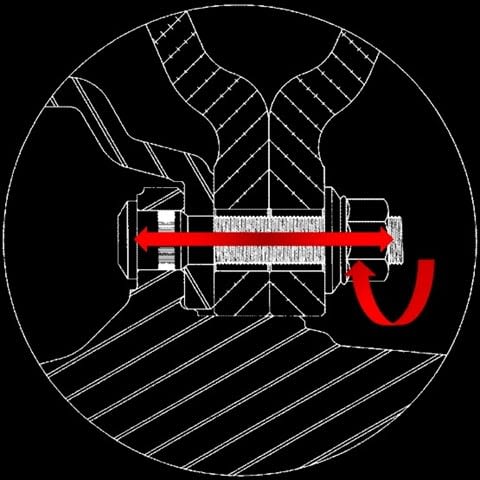
Over-tightening (over-torquing) the nuts stretches the stud so that it loses its “spring” force. Once that happens, clamping force is greatly diminished.Image: Accuride
Loss of clamping force can result from several other common installation errors, such as neglecting to thoroughly prepare the hub and wheel mounting faces. Any contacting surfaces must be absolutely free of dirt, rust, excess paint or other material that can be compressed as the clamping force is applied.
“Paint, rust or dirt will eventually wash away or fall out, reducing the clamping force,” Walters says. “In particular, steel wheels that are painted are most susceptible. Corrosion of the steel and old paint can flake away.”
A thorough going-over with a wire brush will usually remove loose material, but repainted steel wheels can be a problem too. Paint will compress under the heavy clamp load, and like rust flakes or dirt that tumble away over time, the compression of the paint will leave a gap that could cause the nut to loosen due to the loss of clamping force.
Wheels should not be painted with a paintbrush, because you can’t guarantee an even thickness to the coating. “The coating cannot be any more than 3 - 3.5 mils thick, especially on the mounting surfaces and between the bolt holes,” warns Jeff Redding, national equipment and coatings manager at IMI, a recognized wheel refinisher. “Excessive coating thickness can lead to a loss of clamping force and eventually loose nuts and possibly a wheel loss.”
Refinishing Steel Wheels
Refinishing steel wheels can save fleets lots of money, but it can cause trouble if it’s not done properly. The stripping process needs to be carefully controlled so that not too much of the original metal in the wheel is removed. According to Maxion Wheels, corrosion pitting is metal from the wheel that has been eaten away. The company advises caution when working with deeply pitted wheels.
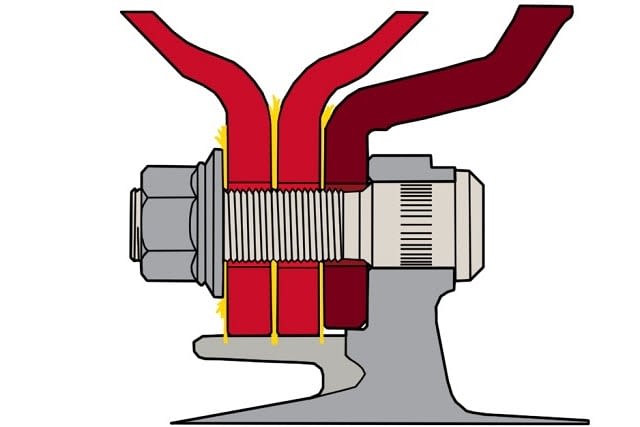
Without properly cleaning the mounting faces of the hub and the wheels, material trapped in there can loosen over time and fall out, leaving the wheels loose against the face of the hub.Image: Accuride
Paint should be applied as evenly as possible. Some tire shops offering wheel refinishing use a spray booth to reapply the coating, but that doesn’t always produce an even thickness. Accuride offers a refinishing program called ProFinish where wheels are stripped of corrosion and old paint and then repainted on the same line as its new wheels.
“We are able to get an OE finish with the same OE controls because we use the same process for new and refinished wheels,” Uzarek explains. “Fleets should do paint thickness audits of their wheel refinishers to ensure they get a consistent, even coating thickness, especially at the mounting face.”
Truck Wheel Re-installation Precautions
Now that you have inspected all the wheel studs, replaced any damaged ones, removed any rust and dirt from the treads, and determined that your hub mounting surfaces and the mounting faces of the wheels are clean and free of rust, old paint, dirt and debris, it’s time to hoist the wheel into place and start tightening it.
When using two-piece flange nuts, do not reuse seized nuts or those difficult to move on the washer. Watch for paint build-up between the nut and the washer as well as dirt or debris. Any restriction in movement between the nut and the washer will lower the clamping force with the applied torque.
If you have to replace any of the nuts, or the studs for that matter, be sure to replace them with OE-quality parts with the correct grade and ratings.
“These parts are important and failure can lead to drastic consequences,” warns Brian Thomas, marketing communications manager at Arconic. “Counterfeit parts may not be up to quality and/or OEM standards. There is no industry oversight or quality requirements with knock-offs, so it’s not easy to verify the quality of no-name parts.”
Before installing the nuts, place 2-3 drops of motor oil on the clean threads of the studs and 1-2 drops of motor oil between the washer and the nut on the two-piece flange nut. This process reduces friction and allows you to achieve a desirable clamping force once the wheel is torqued down.
It’s okay to run the nuts up to snug using a power tool, but impact guns should never be used to achieve the final torque unless they are calibrated torquing tools. Use a proper torque wrench.
TIghter is Not Better When Re-Installing Truck Wheels
Tighter is not better. Many technicians attempt to achieve maximum clamping force by applying more than 500 ft-lbs. of torque without realizing the possible consequences.
“If a wheel stud is subjected to excessive torque, it is possible to stretch the stud past its yield point,” cautions Uzarek. “If this occurs, the joint will act as if it is under-torqued and there will be low clamping force.”
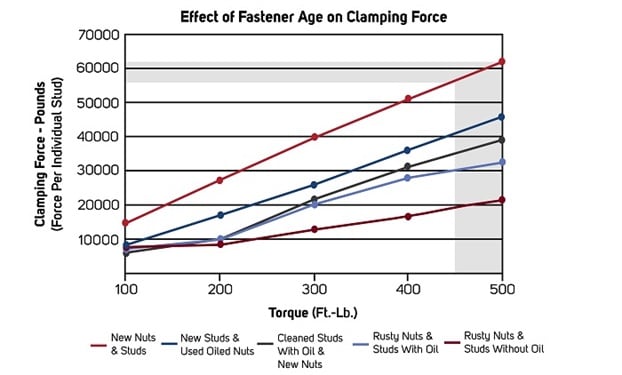
As they age and with repeated on and off cycles, wheels studs gradually lose their ability to maintain maximum clamping force.Source: Accuride
TMC’s RP 237A, Torque Checking Guidelines for Disc Wheels, shows torque fastener recommendations ranging from 300 to 900 ft-lbs., depending on the wheel type, fastener and procedure. There is no one-size-fits-all here. Refer to this RP for proper torque ratings and procedures for your particular setup or consult with the manufacturer.
The final step in the process is to re-torque the wheel nuts somewhere between 50 and 100 miles after a wheel has been installed. This is important because the wheel will settle into place during this period. Foreign matter may work its way out of the mounting surfaces, causing a loss of bolt tension and a loss of clamping force.
“This is a key recommendation that in many cases seems to be ignored by the industry,” Uzarek cautions. “Failure to comply with this requirement seems to be the difficulty in having this work performed at the recommended distances. Companies claim that it is difficult to plan a vehicle’s route that will bring it to a location where this work can be done to meet the specified distance.”
And of course wheel nuts should be re-torqued at regular maintenance intervals or every 10,000 miles to account for any changes in clamping force.
A note of caution here: installing wheel nut “locking devices” may provide peace of mind that the wheel nuts are not coming loose, but they can’t provide any protection against a loss of clamping force, such as a stretched stud, or the falling-out of any debris that may have been present between the mounting surfaces when the wheel was installed. By all means, use them, but doing so shouldn’t eliminate the need for regular inspections and re-torques.
And you thought installing wheels was easy.
Subscribe to Our Newsletter
More Maintenance

Sponsored•September 16, 2026
Color Match Smarter: Tools That Restore & Perform
For fleet managers and collision repair professionals keeping heavy-duty trucks on the road, getting the color right the first time isn't just about appearance — it's about efficiency, turnaround time, and bottom-line results. Discover how today's digital color tools are transforming the repair process from guesswork to precision.
Read More →
Wrong Repair Prompts Recall of Freightliner, Western Star 4x2 Trucks
DTNA is recalling more than 2,400 trucks that received an incompatible software fix instead of the hardware repair required to address brake valve corrosion.
Read More →
Truck Drivers Need More Than Another Alert
Fleets have more visibility into truck health, safety events, and driver activity than ever. The next challenge is turning all that information into useful guidance for the person who has to decide what to do next.
Read More →
The Maintenance Checks Trucking Fleets Should Prioritize Before Fall Freight Picks Up
Making it through August isn’t the same as being ready for the next several months of operation. Find out what systems may have suffered from summer heat and need to be checked out before fall.
Read More →
What Three Fleets Are Doing Differently When Buying Truck Parts in 2026
With freight improving but costs still climbing, fleet maintenance executives explain how they're balancing price, quality, and supplier relationships.
Read More →
Paccar Recalls 2027 Trucks Built This Summer for Possible Electrical Problem
The nearly 6,000 Kenworth and Peterbilt trucks in the recall could potentially lose engine power, among other things.
Read More →
Will API PC-12 Oil Change Trucking Fleet Maintenance?
The new API PC-12 heavy-duty engine oil category reflects the changing demands of modern diesel engines. But fleets like Foodliner are looking to getting their own data before making decisions on adopting the new oils and questions such as extending oil drain intervals.
Read More →
Brake Safety Week to Focus on Drums and Rotors
Commercial vehicle inspectors are focusing on truck brakes during CVSA's Brake Safety Week, August 23-29.
Read More →Possible Battery-Cable Fires Prompt Recall of 15,000+ International MV and HV Trucks
On the recalled vehicles, manufacturing variations can cause the battery interconnect cable to contact the auxiliary stud and hold down the bracket.
Read More →
Rush, MCT Team Up to Grow Refrigeration Service Network
The joint venture will operate MCT's network of Carrier Transicold dealerships and mobile service locations, with the companies promising greater service capacity and uptime for refrigerated fleets.
Read More →