




What First-Quarter Fleet Earnings Tell Us
The 3.2% first-quarter GDP figure released by the Commerce Department seems to portray a stronger volume environment than was experienced by the trucking industry, judging by first quarter fleet earnings.


The 3.2% first-quarter GDP figure released by the Commerce Department seems to portray a stronger volume environment than was experienced by the trucking industry.
Source: Company Reports, Tahoe Ventures, LLC Estimates
The 3.2% first-quarter GDP figure released by the Commerce Department seems to portray a stronger volume environment than was experienced by the trucking industry, judging by first quarter fleet earnings at press time.
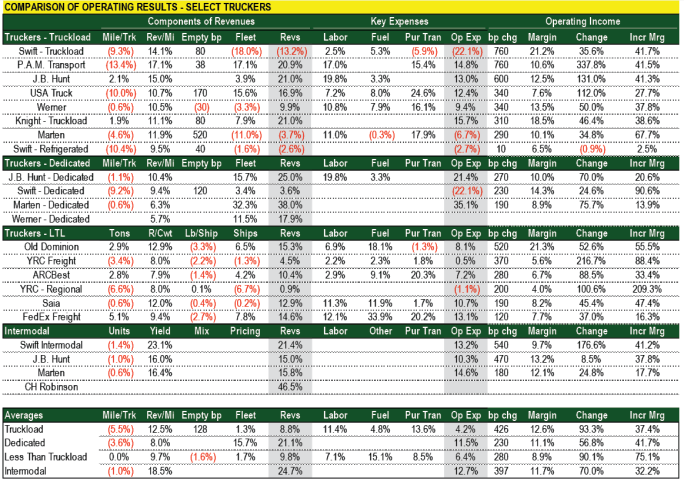
The accompanying table shows some of the key operating statistics and performance indicators in those earnings reports. The companies are ranked in order of the percentage point (basis point) improvement in operating margins.
Pure truckload
Truckload carriers saw the greatest average improvement in operating margins, 125 basis points, despite a surprisingly weak 1.4% revenue decline, compared to fourth-quarter revenues that grew by 8.8%. Fleet size shrank by an average of 1.5%, but 6.4% higher revenue per mile almost offset a 6.8% decline in miles driven. We attribute the decline in miles driven to changes in length of haul, and to carriers shuttling trucks out of the over-the-road divisions into dedicated truckload. USA Capacity Solutions and and PAM Transport took top honors in improving their bottom lines, but overall, operating margins retreated to a median of 7.9%, down from 12.5% in the previous quarter.
Dedicated truckload
More and more companies are breaking out dedicated truckload, and there are some interesting observations here. Median revenue growth was 16.9% (strong, but down from 21.1% in 4Q), with an average operating margin of 8.3%, a 60-basis-point improvement over the 7.7% margins reported a year ago. Fleet growth remained strong at 11.5% (versus fourth-quarter growth of 15.7%), so this is where all the new trucks are going. Despite the short-haul nature of dedicated operations, miles per truck actually rose 4.4%, on a 6.6% improvement in yield (down from 8% in the fourth quarter). Top honors here went to Marten’s dedicated division, improving margins by 450 basis points.
Less-than-truckload
Winter weather affected a number of LTL carriers. We saw 10% fourth-quarter revenue growth drop to 2.6% in the first quarter, with a 4.4% median tonnage decline, on a 5.4% improvement in revenue per hundredweight. Top honors went to FedEx Freight, which reported a 2,500-basis-point improvement in operating margins, driven by an industry-leading 8.5% revenue growth rate. LTL labor costs only rose 3.9%, compared to the 9.7% increase among truckload companies. The median industry profit margin dropped from a record high 8.9% in the fourth quarter to 4.8% in the first quarter, which was 5 basis points lower than the prior year.
Intermodal
Intermodal profits fell by 102 basis points, from a very robust increase of 397 basis points in the fourth quarter. This likely was the result of high inventories because of goods pre-shipped in the fourth quarter ahead of proposed tariffs, and weather-related railroad system breakdowns in the first quarter. Top honors this quarter went to Hub Group’s intermodal division, which reported a 190-basis-point improvement in operating profits. Surprisingly, intermodal loads were down 6% on average.
The takeaway
The first quarter for freight companies was likely much worse than trend, as they were affected by severe winter weather; the pre-tariff shipping; a drop in rail industry fluidity, and a late Easter. However, pricing appears to be holding, despite anecdotal reports of rapid decline. We believe the inventory overhang on truckers will remain until the summer, with plans for capital expenditures likely to moderate as margins deteriorate.
Jeff has been a recognized trucking and transportation authority for almost 30 years, most notably heading freight transportation research for Merrill Lynch, and today runs transportation consulting firm Tahoe Ventures. He can be reached at jkauffman@truckinginfo.com.
More Fleet Management

Color Match Smarter: Tools That Restore & Perform
For fleet managers and collision repair professionals keeping heavy-duty trucks on the road, getting the color right the first time isn't just about appearance — it's about efficiency, turnaround time, and bottom-line results. Discover how today's digital color tools are transforming the repair process from guesswork to precision.
Read More →
FMCSA Pauses Biennial-Update Enforcement Amid Motus Transition
Carriers whose updates were due on or after June 1 have more time, while FMCSA works to stabilize its new registration system and warns of phishing sites impersonating its new carrier registration system, Motus.
Read More →
2026 Blueprint for Countering Smarter Supply Chain Theft
Cargo theft is no longer just the cost of doing business. It's a multi-billion-dollar criminal enterprise exploiting vulnerabilities across your fleet, drivers, and supply chain.
Read More →


How Telematics Improves Visibility, Control, and Performance in Refrigerated Fleets
Explore how telematics help refrigerated fleets improve visibility, uptime, efficiency, compliance, and cargo protection across connected cold chain operations.
Read More →
What the U.S.-Canada Trade War Means for Trucking
Escalating U.S.-Canada tariffs could disrupt cross-border freight, reduce truck volumes, raise costs, and create new uncertainty for carriers on both sides of the border.
Read More →
What Are Trucking’s Top Concerns for 2026?
The American Transportation Research Institute wants to know what's worrying trucking fleet managers, drivers, and other stakeholders in its annual Industry Issues survey.
Read More →
American Trucking Associations Looks for a New Leader
ATA President and CEO Chris Spear abruptly left his job at the association on August 21, at a pivotal time for the trucking industry.
Read More →
Public Wi-Fi Cybersecurity Risks: How Truck Drivers and Fleets Can Protect Their Data
Public Wi-Fi can expose truck drivers and fleets to credential theft, malware, and other cyber threats. Here’s how to reduce the risk on the road.
Read More →
For Nicky Cupp, Fleet Innovation Starts With Frustration
HDT Truck Fleet Innovator Nicky Cupp turns everyday pain points at Fraley & Schilling into opportunities for better technology and smarter processes.
Read More →
Adam Buttgenbach’s Approach to Electric Trucks: Start With Where They Fit
HDT Truck Fleet Innovator Adam Buttgenbach helped PepsiCo build one of North America’s largest EV fleets by focusing on where electric trucks make operational sense.
Read More →