




Truck Platoons on the Horizon?
Real-world deployment of truck platooning systems appears close, but developers aren’t keen to offer many details on their efforts.


News reports indicate that a transition from test tracks to real-world operation on public roads is coming soon for truck platooning technology.
Photo courtesy Peloton
The kind of fuel economy benefits possible with truck platooning would be “impossible to obtain using any other type of technology available to the trucking industry today,” contends Mike Roeth, executive director of the North American Council for Freight Efficiency, which has investigated the potential fuel-saving benefits of truck platooning.
HDT first reported on truck platooning — in which trucks use technology that allow them to follow each other closely enough to reap a fuel-savings benefit — as a concept back in 2011. We saw our first demo of such a system in 2014. Reports are surfacing increasingly of tests being run on public roads and test tracks, both here and overseas, and it appears real-world Class 8 platooning systems are likely to be showcased starting later this year.
Naysayers and skeptics abound when it comes to platooning technology. Many industry observers and fleet executives are concerned about the stress and/or boredom levels for drivers running trucks in a close-following configuration at highway speeds. Others worry that the drivers — or the vehicles — will not be able to identify and react to dangerous road conditions in a timely manner, or that passenger cars will be able to pull in between platooning trucks and create chaos.
Other questions that must be resolved include details on how trucks enter and leave platoons; which truck gets the benefit of being the following truck with greater fuel economy benefits; and whether competing carriers will be willing to cooperate in truck platoons.
Platooning proponents have quietly defended this emerging technology and insist that a platoon of trucks will be as safe — perhaps safer — than any other vehicle on the road, and that the impact on drivers in terms of stress, boredom, limited vision, or situational awareness is minimal. And platooning proponents say the benefits of truck platooning more than make up for any negatives associated with this new technology.
Platooning 101
If you’re old enough to remember the heyday of truck convoys back in the 1970s, or you’re even a casual Nascar fan, you’re already familiar with the basic concept of truck platooning. We don’t think much about the air we move through every second of our lives. But air is a massive barrier that automotive engines must work hard to push through as they propel a vehicle down the road. For Class 8 tractor-trailers, diesel engines must not only get an 80,000-lb. truck up and moving, but then must keep working to keep the truck moving, as natural physical forces such as gravity, wind resistance, and rolling resistance from the tires all work to slow, and eventually stop, all forward motion.
But if one vehicle takes the point position and cuts an invisible pathway through the wall of air in front of it, vehicles following closely behind have a much, much easier time cutting through that air resistance. And they create a sort of pressure wave through the air of their own, which helps push the lead truck through the air mass as well, helping its powertrain work less hard, too. As a result, the engines for both the lead and following truck don’t work as hard — and burn less fuel.
It’s one thing for risk-seeking Nascar drivers to employ this tactic — called “drafting” — during races to conserve fuel and set themselves up for a more competitive finish. But it’s entirely another for Class 8 tractor-trailer drivers to follow each other at extremely close intervals and be able to react to hazards or accidents in a safe and timely manner.
Platooning uses modern technology to get around the reaction time and safety issues that prompted lawmakers to outlaw big-rig convoys in the late ’70s. Platoon-capable trucks feature integrated technologies such as adaptive cruise control, advanced safety systems, first-generation vehicle-to-vehicle (V2V) communications, and camera systems to coordinate vehicle maneuvers, braking, acceleration, and following distances in a way that safely allows following distances as close of 38 feet in some tests.
And, platooning proponents say, the results are worth it. NACFE’s 2016 Confidence Report on truck platooning noted that trucks engaged in platooning operations with following distances ranging from 40 to 50 feet saw overall fuel economy increases of around 7% for the entire platoon. Breaking it down by vehicle, lead trucks typically saw a fuel economy increase of around 4%, with the following truck seeing a boost of around 10%.
NACFE’s report focused on two-truck platoon operations, but truck makers and platooning technology developers such as Peloton report trucks in the third-place position and back receiving fuel economy boosts of as much as 15% while platooning.
“Probably the biggest single contributor to enhanced Class 8 fuel economy today is the advent of highly aerodynamic truck designs combined with the increased use of aftermarket aerodynamic devices such as trailer skirts and gap extenders,” Roeth says. “But even the most highly aerodynamic tractor-trailer that could possibly be designed and put on the road today would be incapable of getting the kinds of fuel efficiency increases platooning delivers.”

Truck platooning allows close following distances between tractor-trailers to greatly enhance fuel economy, as shown in this testing by the PIT Group.
Photo courtesy PIT Group
Legislative roadblocks?
While truck makers and tech companies charge ahead on proving out truck platooning technology, one potential stumbling block involves legislation and regulations.
Several state governments have actively embraced autonomous vehicle technology, including truck platooning, but even the most progressive of them have taken pause in the wake of a number of highly publicized fatal accidents involving vehicles under autonomous control. While platooning is not necessarily the same thing as self-driving vehicles, it does use some of the same types of technologies. Some platooning demonstrations have also showcased autonomous or semi-autonomous functions.
And then there’s simply the question of legal following distance. At press time for instance, the Michigan house passed a bill providing an exemption to following distance rules for platooning trucks. (The state already has a requirement that platoons accommodate other cars wishing to change lanes or exit the highway.) According to a presentation earlier this year by the Federal Highway Administration, 16 states support truck platoon demonstrations and testing. So far, 11 states have put laws on the books regarding truck platooning. But they differ wildly on details, such as terminology, the number of trucks allowed in a platoon, and legal following distances.
Nevertheless, it’s almost a sure bet that we’ll soon see platooning in some fashion. There are, of course, a multitude of autonomous vehicle technology developers, such as Starsky Robotics, Uber, and Waymo, that are concentrating on full autonomous vehicle operation systems, with platooning capability as a related feature. Other companies are focusing on platooning on its own, as an outgrowth of advanced driver assistance systems, or as a stepping stone to more comprehensive autonomous vehicle control systems.
Following are highlights of some of the development work in progress. (Note: just because a company’s not listed here doesn’t mean they aren’t looking into platooning. Navistar, for instance, demonstrated truck platooning at its Indiana test track in 2016, working with Texas A&M Transportation Institute to develop and test the system.)
Daimler Trucks North America
As of press time, Daimler declined to outline its latest platooning developments pending a major announcement in June. (Click here to read about that June demo.) However, the company has staked out an early leadership position with platooning technology by leveraging efforts from its global vehicle technologies in Europe and Asia, even showcasing a three-truck platoon under complete autonomous control running on German highways in 2016.
This year, Daimler has been testing truck platoons on public roads in and around Tokyo, Japan, conducted by its Mitsubishi Fuso division, as well as public road tests running Freightliner trucks in Oregon and Nevada in the U.S.
In the tests run near Tokyo, Daimler focused on combining the technological possibilities of connectivity with its experiences in the field of autonomous driving. This included Wi-Fi-based vehicle-to-vehicle communication, which interacted with driver-assistance systems such as cooperative adaptive cruise control, lane departure assist, and active brake assist.
VW: MAN & Scania
Volkswagen has two heavy truck divisions in Europe, MAN and Scania, both on the cutting edge of platooning technology. In addition to actively participating in the development and testing of platooning technology, VW has stated publicly that it will have systems ready for wide-scale sale and deployment by 2022.
Scania recently announced a partnership with Finland’s Aloha Transport Oyi to use Scania trucks and autonomous vehicle technology to test semi-autonomous platooning operations involving three or more vehicles on public roadways. According to reports, the first vehicle will be operated in cruise mode with a human driver steering. The following trucks in the platoon will be operated under full autonomous control, with human drivers monitoring driving operations.
Earlier this year, MAN placed a number of units with logistics giant DB Schenker for months of evaluation in revenue service. Drivers received specialized training, including using simulators, before hitting the road in April, where they were to be evaluated as part of DB Schenker’s scheduled operations in actual traffic on the A9 freeway that runs between Munich and Nuremberg in Germany.
Peloton
Arguably the early leader in platooning technology in North America, Peloton Technologies recently confirmed that it is still on track to meet its previously announced goal of having its two-truck platooning technology in real-world use by fleets before the end of this year.
Peloton says it is in the process of negotiating with many of the top long-haul fleets in North America as it “fine-tunes” its system in preparation for full integration with OEM vehicle control systems, as well as with systems provided by outside suppliers such as Bendix, Eaton, or Cummins.
Peloton announced a partnership with Omnitracs in February, which will make Peloton’s truck platooning technology available to Omnitracs’ telematics fleet customers. The two companies also will jointly develop technology to further integrate their vehicle safety and operational systems.

In the UK, DAF Trucks has been working on truck platooning technology since early 2015. DAF test drivers have driven tens of thousands of miles on public roads and test tracks.
Photo courtesy DAF Trucks
Peterbilt
Paccar’s Peterbilt division has been quietly working with Peloton and other platooning technology developers. To date, most of the company’s efforts appear to be focused on upgrading its own vehicle systems and electronic controls to fully integrate with platooning systems.
But Peterbilt garnered some recent headlines as well, when it participated in a series of platooning tests with Auburn University in Alabama and the U.S. Army Tank Automotive Research, Development and Engineering Center (TARDEC) with two Peterbilt Model 579 tractor-trailers leading mixed convoys of military vehicles on Interstate 69 in Michigan. The goal of the test was to determine the safety, efficiency, fuel economy, and viability of running military convoys in platoon formations on public roadways.
And Paccar’s DAF Trucks is participating in a two-year truck platooning trial in the UK, led by the UK’s Transport Research Laboratory and working with TNO, Ricardo, and logistics company DHL.
Tesla
Tesla Motors announced last November at the public unveiling of its Semi electric truck that Autopilot and platooning capability would be standard features on the vehicle when it enters production next year.
The remarks by Tesla CEO Elon Musk raised eyebrows in the room, since the usual argument for truck platooning is rooted in boosting fuel economy — and electric trucks don’t burn diesel or gasoline. However, Musk noted that electric trucks are subject to the same physics as those with internal combustion engines. The easier it is for an electric truck to move through the air, the less hard its electric drive motors have to work, and the less energy is drained from the vehicle’s battery systems to power them. Musk went on to say that according to Tesla calculations, a single Tesla Semi truck would cost around $1.26 per mile to operate, but that in a platooning scenario, that cost would drop to 85 cents per mile and “be competitive with rail” in terms of moving goods.
News reports late last summer, ahead of the truck’s public showcase, revealed that Tesla had been in discussions with Nevada on testing electric trucks in platooning operations.
Volvo
Currently, most of Volvo’s truck platooning activities have been centered in Europe, but here in North America, Volvo has been quietly working on its platooning capabilities as well. Last year, the company announced the completion of successful tests involving three VNL tractor-trailers, traveling at 55 mph on Interstate 110 in California at 50-foot intervals. Volvo engineers worked closely with Peloton on that project.
Volvo says it is continuing to develop truck platooning systems and hints that more news is likely to come later this year.
The federal government and research agencies are involved in truck platooning, as well. For instance, last fall, the Federal Highway Administration worked with the Virginia State Police for a demonstration of a three-truck platoon on an 8-mile course on a state highway. And north of the border, PIT Group, the research and engineering branch of FPInnovations, last summer worked with Transport Canada on its Cooperative Truck Platooning Systems testing program at the Motor Vehicle Test Centre in Blainville, Quebec.
Related: Daimler Trucks Demonstrates Truck Platooning
More Fuel Smarts

How GP Transco Builds Fuel Savings a Fraction at a Time
Aerodynamic specs, solar panels, and driver incentives help GP Transco turn small efficiency gains into savings it can reinvest in its people.
Read More →
Trucking’s Diesel Squeeze Isn’t Letting Up
With diesel topping $6 a gallon nationally, ATA's Bob Costello explains why fleets should prepare for continued pressure at the pump.
Read More →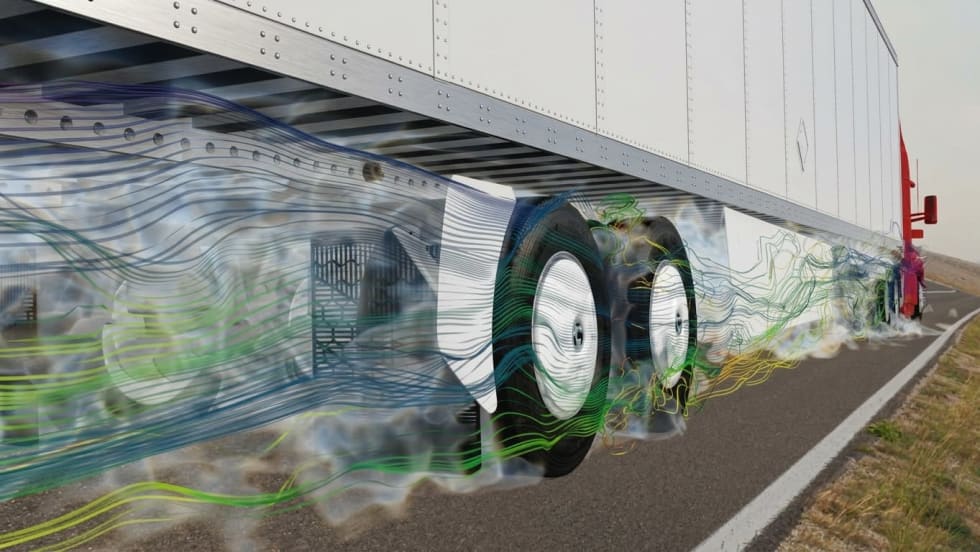
FlowBelow Redesigns Trailer AeroSlider to Cut Fuel Use
The lighter trailer aerodynamic system installs in less than 45 minutes, according to the company, with potential payback in under a year depending on fuel prices and trailer mileage.
Read More →
Why Diesel Price Relief Efforts May Fall Short
Diesel prices have eased from September’s record high, but doubts about additional Russian supply and limits on dyed-diesel tax relief mean trucking fleets still face expensive fuel. And prices could go higher.
Read More →
Why Small Fuel Savings Matter in Trucking
Can better fuel economy help pay for driver raises? In this podcast, GP Transco explains how small efficiency gains create room to reinvest in its people.
Read More →
How GP Transco Cuts Trucking Fuel Costs, a Tenth of a Gallon at a Time
What’s another tenth of a mile per gallon worth? GP Transco shares how equipment upgrades and driver coaching turn small gains into meaningful fuel savings.
Read More →
Electric Yard Tractors Move Beyond Pilots
Operating-cost savings have overtaken sustainability goals as the leading reason surveyed fleets are adopting battery-electric terminal tractors, according to new NACFE research.
Read More →
Geotab Links Fleet Card to Vehicle Data
The new card combines fuel discounts with telematics-based purchase controls. Geotab’s analysis also points to potential savings from choosing lower-priced fuel stops.
Read More →
Fleet Economics Shape Electric Truck Outlook
ACT Research expects costs, charging infrastructure, and technology improvements to drive zero-emission commercial vehicle adoption as federal regulations and incentives retreat.
Read More →
Wex Adds Cardless Fuel Payments for Over-the-Road Customers
A new fuel card feature for Wex customers offers convenience and security.
Read More →