




Top Five Tire Killers
Nobody questions that tires will wear out. But what might be considered reasonable in terms of service life varies considerably from application to application, from truck to truck, and from tire to tire

Nobody questions that tires will wear out. But what might be considered reasonable in terms of service life varies considerably from application to application, from truck to truck, and from tire to tire.
Factors such as tire load, speed, pressure, tread pattern, pavement type, steering geometry, axle alignment, the make of the truck and the axle the tire is mounted on, and even the type of winter de-icing treatment used on the roads, all affect tire life. As a result, it's nearly impossible to quantify "normal" with respect to tire life.
Every tire-wear situation is unique, but it can be said with some certainty that if not for all the external factors, a quality drive tire might easily run out to half a million miles or more, and a quality steer tire would probably go half of that.
Tire wear is often a symptom of another problem such as poor alignment, or bad bearings or kingpins. It's good to know how a mechanical condition affects a tire by the mark it leaves. Simply replacing a worn tire without dealing with the cause only ensures a premature death for the next tire you put on the truck. In most instances, switching brands of tire won't solve the problem, either.
"There would be differences in how different brands of tire react to mechanical influences," says Ralph Beaveridge, Michelin's former director of marketing for truck tires in Canada. "Typically, with different brands of tire, given a similar tread pattern, I'd expect to see the wear re-occurring at about the same mileage."
Certain tire brands and types are engineered to resist certain types of wear. Some do a better job at it than others, but the trick is to solve the root problem before it ruins the tire. You can do that by having your tire dealer analyze the wear to determine its cause. Given the multitude of possible culprits, here is an unscientific list of today's top five tire killers.
Underinflation
This is the most common factor in prematurely ruined tires. Period. For the want of about 20 minutes per week per truck, fleets and owner-operators seem more than willing to give up $50 to $100 worth of tread and casing life. According to the American Trucking Associations' Technology and Maintenance Council, a proper tire pressure check on a typical tractor-trailer should take in the range of 20 minutes a week. That's gauging the tire, topping it up, and screwing the cap back on - much less if you're using a tire inflation system.
TMC notes that just 10 percent underinflation will shorten tread life by 9 percent to 16 percent. If we use an average tire price of $450, underinflation costs you $45 per tire. Now ask yourself if you'd consider 10-psi underinflation "close enough" and just let the tire go? It's alarming, the tire people tell us, how many tires they find consistently underinflated when they go out into the field and do such surveys.
As Goodyear points out, it's the air that carries the load, not the tire; the tire is just the containment device.
"If there's not enough air to properly support the load, the sidewalls will flex more than they were designed for, and that flexing causes excessive heat buildup," Goodyear says. "Together, the weakening of the steel cords in the sidewall, and the softening of the rubber caused by the heat, can trim 15 percent off the life expectancy of the tire."
In a worst-case scenario, you'll wind up with what's called a "zipper" rupture, a circumferential tear in the mid-sidewall of a steel cord radial tire, caused by the weakening of steel cables in the tire's sidewall due to running underinflated or flat (defined as a tire that carries less than 80 percent of proper inflation).
That one-two punch is all a tire needs to send it to the scrap yard long before its time. The effects of heat and flexing are so dramatic that both TMC and the Rubber Manufacturers' Association recommend that any tire found to be 20 percent or more underinflated be immediately removed from service, demounted, and inspected for damage.
Eighty psi certainly won't feel much different from 100 psi when you boot it on your pre-trip, so how are you supposed to know? Gauge it, say tire experts, using an accurately calibrated tire gauge. Tire inflation monitors are an ideal solution, and on a less expensive scale, good quality visual tire pressure indicators won't hurt.
Do you inflate your tires to 100 psi or so just because your pal does? That may be a good ballpark figure, but you can do better. Bridgestone/Firestone strongly suggests using the load and inflation tables to calculate the optimum pressure for your application. The difference between 95 and 105 psi can have a huge impact on how the tire wears in service - and how long it lasts.
Mechanical Wear
You don't have to search hard to find examples of tires literally vanishing before their owners' eyes. Scrubbing and stresses on the tread caused by wheel alignment or frame geometry are everywhere. Unfortunately, the tires often take the rap.
"That fleet's Brand X steers ran out to 120,000 miles, but mine only went to 80,000, so I got a bad set of steers." Ever heard that one? You probably couldn't count the differences between the two owners' trucks, operations, lanes of travel, percentage of time on- and off-road, speed, load weights, etc. So how can you expect similar results in tire life?
Tires exhibiting wear are almost always responding to some external factor, such as wheel alignment, says Michelin's Beaveridge. "Toe-in and toe-out settings affect tires dramatically, and while all tires will exhibit the same type of wear resulting from an alignment problem, some weather it better than others, depending on the design characteristics of the tires," he says.
A few years ago, Michelin surveyed fleet take-offs and found that an amazing 78 percent of the tires in the scrap pile came out of service prematurely.
"It's tragic to see a $500 tire only delivering $100 worth of life," Beaveridge says. "We deal with these maintenance issues all the time with fleets, but it's much harder to get to owner-operators to do it."
Fleets, Beaveridge explains, have the advantage of seeing patterns develop that clue the maintenance people in to a problem. It's not the same with one driver, one truck, and one set of tires that lasts a year or more.
Mismatched Duals
Matching pressures is especially important on dual assemblies. An inflation mismatch greater than 5 psi means that the two tires in a dual assembly could be significantly different in circumference - up to 5/16 inch. While that may not sound like much, because they're bolted together, they have to cover the same amount of road in a single revolution. The larger tire will drag the smaller one a distance of about 13 feet for every mile, or 246 miles for every 100,000 miles on the clock.
Two more problems arise here: The "larger" of the two tires in a dual assembly does more of the heavy lifting, causing it to wear prematurely, while the underinflated tire runs hotter and doesn't make proper contact with the road. Both cause irregular and premature tread wear - not to mention traction issues. Uneven shoulder wear usually appears on the under-inflated tire, while center wear eats away at the properly inflated tire. But don't wait until the tread starts disappearing to worry about your tire pressure. Get out your calibrated tire gauge.
Road Hazards
While potentially the most difficult to manage, road hazard damage can be mitigated by ensuring proper repairs are made, when applicable. Cut and slashed sidewalls resulting from curb strikes can cause irreparable damage to the tire, so inspecting tires for this type of damage is important. Removing the damaged tire reduces the risk of a future roadside service call, and a potential service failure.
Punctures are almost unavoidable, but proper repair procedures can preserve casing life. Have the driver notif
More Maintenance
Rush, MCT Team Up to Grow Refrigeration Service Network
The joint venture will operate MCT's network of Carrier Transicold dealerships and mobile service locations, with the companies promising greater service capacity and uptime for refrigerated fleets.
Read More →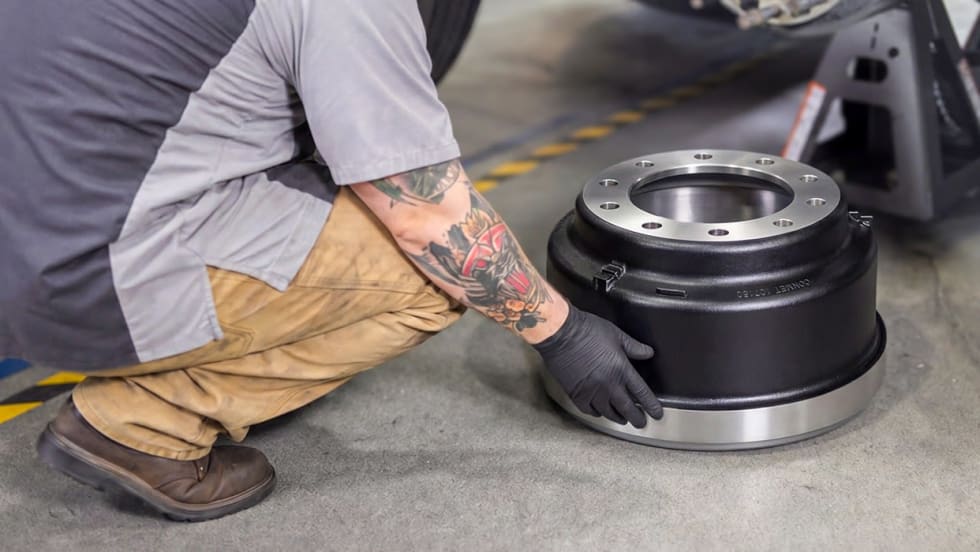
ConMet Expands Aftermarket Brake Drum Lineup With TruCast
A new heavy-duty truck brake drum option in the aftermarket gives customers more flexibility within the ConMet product family.
Read More →
Mack Expands Premium Service Contract Coverage to Medium-Duty MD
With a service contract, inspections, preventive maintenance and repairs can be handled in a single visit instead of multiple ones.
Read More →
Maintenance in the Messy Middle Part 5: Battery-Electric Trucks
No oil changes. No diesel exhaust fluid. No exhaust aftertreatment. But NACFE battery-electric trucks still require specialized maintenance procedures.
Read More →
Trucking Fleets Faced Record Operating Costs During Third Year of Freight Recession
ATRI's annual operational cost report shows carriers trimmed fleets, delayed equipment purchases, and ran older trucks as expenses continued to outpace freight rates.
Read More →
Noregon Launches CAN Mentor to Simplify Vehicle Network Diagnostics
New Noregon software helps technicians identify CAN network issues without requiring advanced diagnostic equipment or specialized training.
Read More →
Maintenance in the Messy Middle Part 4: Renewable Natural Gas
The keys to running renewable natural gas as a fleet fuel depend on specialized technician training, rigorous inspection schedules and an understanding of high-pressure fuel systems.
Read More →
Mack Adds 'Lock & Leave' Feature to Simplify Over-the-Air Software Updates
Mack’s new OTA enhancement allows drivers to start eligible software updates, lock the truck and walk away.
Read More →
Maintenance in the Messy Middle Part 3: Biodiesel
Biodiesel can reduce emissions, improve fuel-system lubricity and use existing diesel infrastructure. But NACFE’s Messy Middle maintenance report says fleets must actively manage storage, cold-weather operation, filters and oil drain intervals to avoid problems.
Read More →
Rush Expands Gulf Coast Peterbilt Network With Louisiana Acquisition
The expanded Rush network gives fleets additional sales, service, leasing and collision repair support across Louisiana's major trucking markets.
Read More →