




Tire Report: The Art & Science of Alignment
Vehicle alignment is a great example of why they teach geometry in high school. How many times did you wonder when you would ever use Euclidean geometry or the Pythagorean theorem?

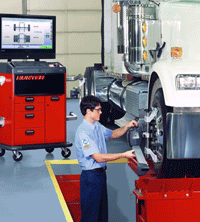
Too many tires are pulled from service prematurely due to extensive irregular wear. In most cases, alignment would solve those problems.
Vehicle alignment is a great example of why they teach geometry in high school. How many times did you wonder when you would ever use Euclidean geometry or the Pythagorean theorem?
Vehicle alignment is pure and applied geometry, without the five-dollar words. From a purely mathematical perspective, alignment is about a series of arcs, angles and intersecting lines that are supposed to keep a truck and all its tires going in the same direction.
The pure science, however, doesn't always account for suspension irregularities, tire peculiarities, manufacturing tolerances, vehicle loading or the 2% crown found on most roads.
If it did, why would trucks said to be in perfect alignment continue chewing up steer and drive tires?
Irregular tread wear can almost always be traced back to some vehicle condition. Alignment and wheel-end maintenance top that list (see wheel-end feature here). That's why you can expect little sympathy from your tire supplier when it comes to adjustments for irregular wear.
Don Nelson, maintenance director at Howard Transportation in Ellisville, Miss., had such a problem a few years ago. In frustration, he pulled 60 tires from a bunch of in-service trucks and told his tire supplier to get over there PDQ to discuss an adjustment. The tire provider called in Mike Beckett of Iowa-based M.D. Alignment.
Before even looking at the tires, Beckett took Nelson through a crash course on tire-wear pattern identification. Then he took him out to the yard to look at a few randomly selected trucks.
"I had him feel the tires on those trucks and proved to him he had feathering wear problems due to alignment," Beckett says. "Then we went in to look at the tires he had pulled from service. He felt each one of them and agreed that all but eight showed feathered wear, which results from improper alignment. His tire supplier wound up adjusting only those tires."
Nelson was as surprised as anyone.
"We did regular alignments on all the trucks, and I had all kinds of printouts showing the trucks were set up properly," he says. "I'd put new tires on the trucks, set them up for the OE recommendations, and within three to six months, the wear would show up again. I assumed it had to be the tires."
"Mike also showed us how to check for bearing adjustment. We found every truck in here had loose bearings. After we campaigned every truck and trailer to set the bearings properly, and then realigned the trucks to his specs, my steer tire life went from about 90,000 miles out to better than 140,000 miles."
As Nelson pointed out, his trucks were aligned regularly, yet he still experienced excessive tire wear. That suggests the specifications he used to align his trucks weren't correct for his application.
Can you do custom alignment that's not to factory spec, but accounts for road geometry and various other operating conditions such as load, terrain and tire brand?
Here's where we see a difference of opinion on vehicle alignment. The two major alignment equipment providers, Hunter and Bee Line, say they align to the recommendations of the truck manufacturer and the axle suppliers. That way, they say, the truck is set up to operate as it was designed.
"We use the specifications provided by the truck and axle manufacturer (not to be confused with the manufacturers' build tolerance specs) to get the truck into 'as new' condition," says Kaleb Silver, product manager for Hunter Engineering. "We don't guess, nor do we have any special formula. We do what truck makers say is best for their trucks, and they do extensive testing to determine what those specifications should be."
Beckett's philosophy, on the other hand, is to align the truck "as driven" to account for various forces that act on the truck every mile it drives.
For example, Beckett says feathered wear on steer tires is a good indicator of where alignment may need to be tweaked, and it's not necessarily anything wrong with the toe settings.
According to Beckett, if the drive axles are aimed perfectly straight ahead, exactly perpendicular with the centerline of the truck, the truck will go straight ahead - on flat road. But on a crowned road, the truck will drift to the right.
"It's as if the truck is driving along the side of a hill. It will naturally want to drift down the hill, or to the right," he says. "To counter that, the driver steers slightly left, which wears the outside edge of the right tire and the inside edge of the left tire."
Beckett's solution is to set up the overall thrust of the tandem drive axles to offset the truck's tendency to drift right. By eliminating the need to counter-steer to keep the truck moving straight in the lane, the steer tires will wear more evenly.
The other issue that divides the factory-spec guys and Beckett's "as-driven" philosophy is the use of turnplates to set steer axle toe. Hunter and Bee Line both use turnplates to measure and set toe. Beckett measures and sets with the truck sitting on the ground.
According to Mike McCoy, national and special accounts manager at Bee Line, you might get a good reading if you measure it as driven, but adjusting it will be a different matter.
"When you're taking the readings and setting the truck, you're doing it in a static position. We always set a little toe-in, like 1/16 of an inch. When the truck is driven down the road, the wheels will tend to pull outward," he says. "When you adjust toe, you're turning the tie-rod tube, which pulls the tires in or out. Those tires have to be free on the turn plates, otherwise they are scrubbing on the floor and you won't get a good reading."
According to Beckett, turnplates, by design, take any preload out of the suspension before it's measured.
"Every truck I have ever checked has a little play in the bearings, kingpins and ball joints," he explains. "As you drive down the road, the tires pull toward toe-out with the play in the front end. An alignment machine will tell you to set 1/16 of an inch toe-in on the turn plates. When you drive it off the turnplate, pavement drag will pull the wheels outward toward zero toe. The assumption is the toe will move less than 1/16 of an inch," Beckett claims.
"The play in even a good tie rod could mean a difference between 1/16 toe-in to 3/16 toe-out. That's why we measure and adjust as-driven, with the truck pulling the wheels apart to its 'natural' toe condition."
Everyone in the alignment game agrees there's no point starting an alignment with damaged, worn or missing parts. And everyone agrees that a good alignment technician can make a world of difference. Simply equipping the shop with accurate, quality tools isn't always enough.
"Some shops may have specialty techs; others have several techs trained to do alignment," notes Silver. "Our machines have so much information, that most techs with some mechanical know-how, and who can follow instructions, can do an alignment - which is not to take anything away from a good alignment tech. An alignment technician that can evaluate problems and come up with the correct solutions is invaluable."
Even if you're using a recognized brand of alignment hardware, if your techs are just going through the motions, you may not be getting the best return on your investment.
Of course, you may consider all this moot when you look at the fact that alignment remains, apparently, one of the most under-utilized tools at a fleet's disposal.
It's hard to argue that far too many tires are pulled from service prematurely due to extensive irregular wear. In most cases, alignment would solve those problems.
McCoy told us that the maintenance manager at one very large fleet said they get tires so
More Maintenance

What Three Fleets Are Doing Differently When Buying Truck Parts in 2026
With freight improving but costs still climbing, fleet maintenance executives explain how they're balancing price, quality, and supplier relationships.
Read More →
Paccar Recalls 2027 Trucks Built This Summer for Possible Electrical Problem
The nearly 6,000 Kenworth and Peterbilt trucks in the recall could potentially lose engine power, among other things.
Read More →
Will API PC-12 Oil Change Trucking Fleet Maintenance?
The new API PC-12 heavy-duty engine oil category reflects the changing demands of modern diesel engines. But fleets like Foodliner are looking to getting their own data before making decisions on adopting the new oils and questions such as extending oil drain intervals.
Read More →
Brake Safety Week to Focus on Drums and Rotors
Commercial vehicle inspectors will be focusing on brakes during CVSA's Brake Safety Week, August 23-29.
Read More →
Possible Battery-Cable Fires Prompt Recall of 15,000+ International MV and HV Trucks
On the recalled vehicles, manufacturing variations can cause the battery interconnect cable to contact the auxiliary stud and hold down the bracket.
Read More →
Rush, MCT Team Up to Grow Refrigeration Service Network
The joint venture will operate MCT's network of Carrier Transicold dealerships and mobile service locations, with the companies promising greater service capacity and uptime for refrigerated fleets.
Read More →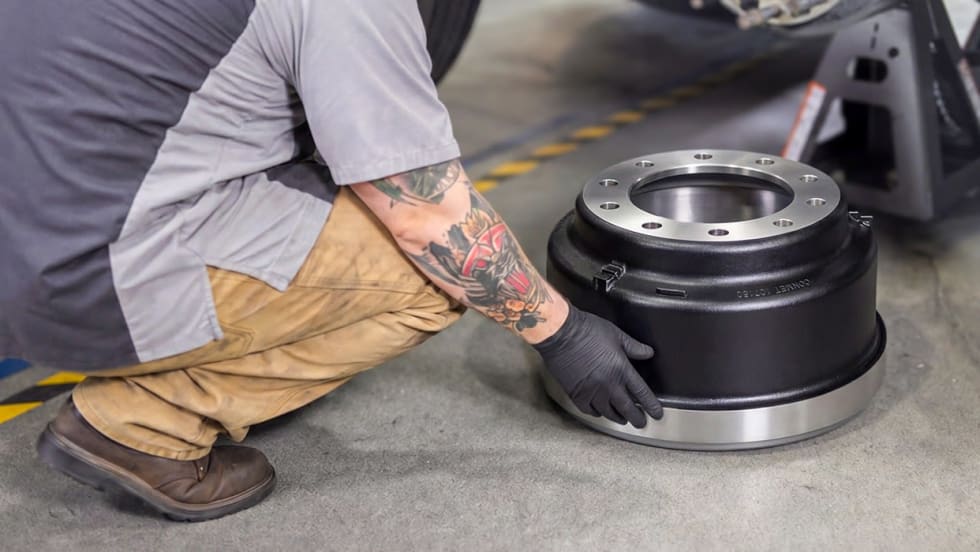
ConMet Expands Aftermarket Brake Drum Lineup With TruCast
A new heavy-duty truck brake drum option in the aftermarket gives customers more flexibility within the ConMet product family.
Read More →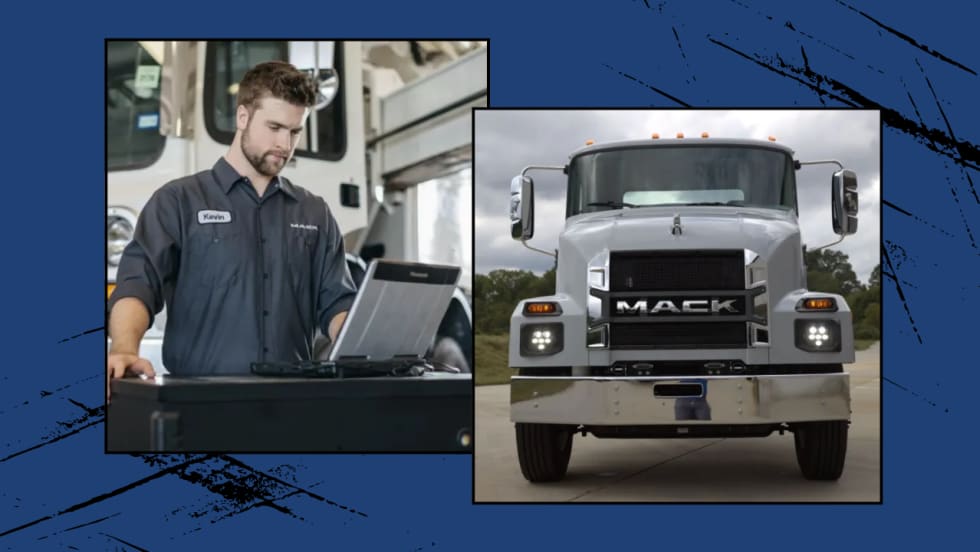
Mack Expands Premium Service Contract Coverage to Medium-Duty MD
With a service contract, inspections, preventive maintenance and repairs can be handled in a single visit instead of multiple ones.
Read More →
Maintenance in the Messy Middle Part 5: Battery-Electric Trucks
No oil changes. No diesel exhaust fluid. No exhaust aftertreatment. But NACFE battery-electric trucks still require specialized maintenance procedures.
Read More →
Trucking Fleets Faced Record Operating Costs During Third Year of Freight Recession
ATRI's annual operational cost report shows carriers trimmed fleets, delayed equipment purchases, and ran older trucks as expenses continued to outpace freight rates.
Read More →