




The Rolling Resistance Paradox
Looking for a tire with the lowest possible rolling resistance? If that’s your only consideration, you might not be happy with the tire you get.

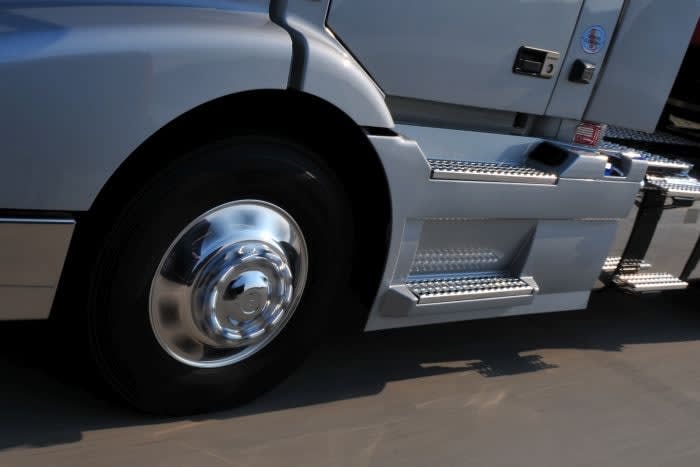
Photo: Jim Park
Photo: Jim Park
Be careful what you ask for because you just might get it. If the lowest possible rolling resistance is your only consideration when spec’ing tires, chances are you’ll be mighty disappointed in the tire you get. In fact, no tire maker in the world would even offer such a tire, but it’s theoretically possible.
If you want really low rolling resistance, try steel wheels, as in train wheels. Steel-on-steel has almost no rolling resistance, but almost no traction either. They’ll last a good long time, but drivers wouldn’t be happy with the ride. I’m using an absurd example to illustrate the point, but an extremely low rolling resistance tire would have similar properties: traction and ride would be poor, the tires might last 50,000 miles, and it would cost you much more over a two-year time frame than the value of the fuel they saved.
Tire makers often express the design goals in the form of a triangle, each axis being one of three important considerations: traction, tread life, and rolling resistance. Historically an improvement in one forced compromises in the other two, but that’s not universally true anymore. Through tire design, it is possible to use technologically advanced compounds and tire-construction techniques to minimize a tire’s rolling resistance with little or no impact on traction or tread life.
“A number of factors influence a tire’s rolling resistance, including the compounds used, casing design and tread pattern,” says Bill Walmsley, product category manager, Michelin Americas Truck Tires. “In most cases, the depth of a tire’s tread blocks is inverse to rolling resistance. The deeper the tread blocks, the better the grip but the worse for fuel economy.”
Sidewall construction can also reduce rolling resistance. However, there are some tire design options available that can lower the rolling resistance, such as the internal components and construction of the tire, Walmsley says.
“Michelin’s Dual Energy Compound tread delivers a fuel-efficient top tread layer which optimizes wear resistance and traction alongside a cool-running tread rubber bottom layer that reduces casing temperature for low rolling resistance,” he says.
Recent design innovations have produced tires that have greater traction properties than one might presume just by looking at them. Tight tread blocks, for example, tend not to squirm as much as treads with widely spaced blocks (we’re talking about drive tires here), so they wear longer while still providing adequate traction. And because the blocks are tighter and stiffer, they help reduce rolling resistance.
“We want to make sure that the tire has good miles to removal and fuel performance, while reducing driver complaints [mostly perceived] about traction,” says Brian Buckham, general manager of commercial tire marketing at Goodyear. “When we design a tire we look at it as a whole system. We look at the tire construction because there’s a way to put tires together and manufacture them for lower rolling resistance that won’t affect the tread rubber. You don’t have to rob the tread to get fuel economy.”
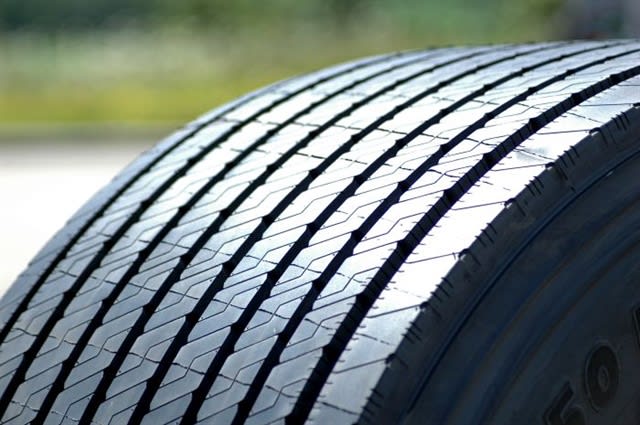
Advances in tread design and compounding lower rolling resistance with little or no sacrifice in tread wear and traction.Photo: Jim Park
Making the comparison
Choosing a tire with the right balance of rolling resistance, tread life and traction is daunting. First, fleets need to get the application right, as certain tires perform better in certain applications, such as the right combination of on- and off-road driving, or urban and highway miles.
“Fleets need to consider the operating environment and understand how the tire can contribute to the success of the fleet,” says Walmsley. “The tire’s performance must sync with the nature of their operations, to their drivers and their habits, driving locations, maintenance practices, budget and other priorities – such as fuel costs. To that end, the best cost per mile or best cost of ownership will dictate which tire to select.”
Bridgestone, Goodyear, Michelin and other tire makers offer online tools for comparing rolling resistance. They are presented as an index where a particular tire can be selected as a baseline (100%) and compared with other tires. A tire with an index rating of 95 would offer 5% less rolling resistance than the baseline tire. Conversely, a tire with a 110 rating would have 10% more rolling resistance than the baseline tire. Depending on the host of the comparison tool, the number might reflect rolling resistance or fuel efficiency. The formats can differ, but the comparisons remain valid.
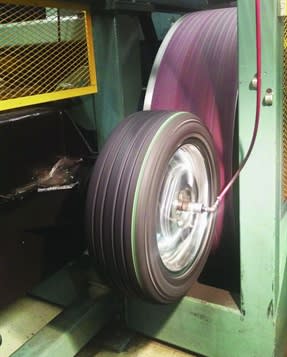
Machines such as this one used by Smithers Rapra, a third-party tire testing company, test rolling resistance under tightly controlled conditions.Photo: Smithers Rapra
These numbers are derived from testing that the tire manufacturers do with their own tires and competitors’ tires. They each use the same Society of Automotive Engineers prescribed test procedure, but slight variations can result from the mechanical differences in the testing machines and even from differences in the individual tires tested.
“We test three individual tires of each make and model and then record the average of the three,” says Buckham. “I think if you compared the rolling resistance number results of two particular tires on each of the tire manufacturer’s websites, you’d find the results are pretty similar.”
Most of the rolling resistance comparison tools offer the opportunity to compare in-house tires against each other as well as competitors’ tires. Of course, you have to compare two tires tailored for a particular application, say an on-highway, fuel-efficient drive tire. There’s no point comparing an on-/off-road tire against a highway tire, because today, more than ever, they are completely different tires.
So how do you know which fuel-saving tires are best for your trucks? Bridgestone recommends customers work directly with their local tire dealer to determine which tire is most appropriate for their application and needs.
“Every application is different and as such, it is vital to select the right tire for the job — and this means matching the tire to the application to ensure you are getting the best combination of fuel efficiency (i.e. low rolling resistance) and wear life,” says Robert Palmer, director of market sales engineering, Bridgestone Americas Tire Operations. “The ATA’s Technology & Maintenance Council is a great resource for those seeking information and guidance about choosing the right tires for an application. Rather than recommending a specific product, TMC identifies test procedures for customers to follow to ensure they are getting a tire that is suited for their needs and application, which typically includes fuel efficiency, tread life, etc.”
And don’t overlook your obligation to look after the tires. “Proper inflation pressure and tire maintenance have roles in helping deliver optimum fuel efficiency,” Palmer reminds us. “An improperly inflated tire will change the tire’s contact patch and ultimately increase a tire’s rolling resistance over time.” And then out the window goes all that diligent research you did to determine the tire with the lowest rolling resistance.
More Fuel Smarts

How Volvo Updated Its D13 for EPA 2027 [Watch]
Volvo’s updated D13 promises lower emissions without sacrificing performance or fuel economy. Take a closer look at what changed inside the engine in this HDT Spotlight video.
Read More →
Diesel Price Spike Shortens Payback for Natural Gas Trucks, Report Says
Energy Vision estimates fleets could recover the higher purchase price of an RNG-fueled Class 8 tractor in 1.3 to 2.8 years under current fuel-price scenarios.
Read More →
Calstart Becomes Catalyst Mobility, Reflecting Broader Focus
Calstart is now Catalyst Mobility, reflecting the nonprofit’s growing national role in clean transportation, including zero-emission trucks, infrastructure and incentive programs.
Read More →

Record Diesel Prices Squeeze Trucking Fleets
Average U.S. diesel prices have climbed to nearly $6 a gallon, surpassing the 2022 record as tight refinery capacity and Middle East disruptions keep fuel costs elevated.
Read More →
How Fuel Delivery Shapes Engine Performance
Fuel delivery depends on more than what happens at the injector. For fleet, maintenance and technical professionals, looking at the full path from pump to injector can provide useful context for understanding engine performance.
Read More →
East Coast Port Launches $45M Electric Truck Push
The Port Authority of New York and New Jersey announced millions in incentives for zero-emission drayage trucks, yard tractors, and new charging hubs near the port.
Read More →
California Bill Could Shed Light on Electric Truck Prices
Why do battery-electric Class 8 trucks remain so expensive? A California bill headed to Gov. Gavin Newsom would give fleets and state agencies more visibility into what manufacturers charge.
Read More →
Detroit Opens Orders for EPA 2027 Engines
Detroit isn’t starting from scratch to meet EPA 2027 diesel emissions standards. Its Gen 6 DD13 and DD15 engines keep much of today’s platform while updating the fuel and aftertreatment systems.
Read More →
Zero-Emission Truck Corridor Planned for West Coast
California, Oregon, Washington, British Columbia and Baja California are coordinating plans for truck charging and hydrogen fueling from Canada to Mexico.
Read More →
A Closer Look at Kenworth’s Electric T880E Vocational Truck [Video]
Learn more about Kenworth's T880E battery-electric vocational truck at the Paccar Technical Center, including its range, applications, upfitting considerations, and PTO options, in this HDT Spotlight video.
Read More →